
United States Lawn Care Market Set to Reach USD 89.47 Billion by 2033 as Smart and Sustainable Landscaping Gains Momentum
Rising Homeownership, Outdoor Living Trends, and Eco-Friendly Solutions Drive Market Expansion Across the United States

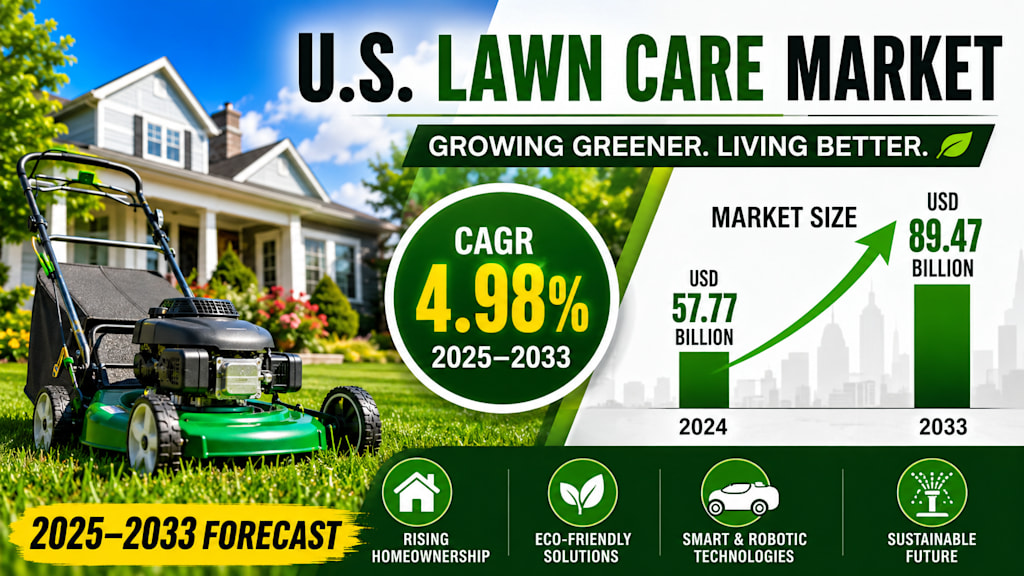
The United States lawn care market is entering a new phase of growth, supported by increasing homeownership, expanding suburban communities, and a growing consumer preference for attractive outdoor spaces. According to industry estimates, the market was valued at USD 57.77 billion in 2024 and is projected to reach USD 89.47 billion by 2033, registering a CAGR of 4.98% during the forecast period.
Lawn care has evolved far beyond simple grass cutting. Today, it encompasses a wide range of services and products, including mowing, fertilization, weed management, irrigation systems, pest control, landscaping, aeration, and lawn renovation. As homeowners and businesses increasingly view outdoor environments as extensions of living and working spaces, investments in lawn maintenance continue to rise.
Lawn Care Remains a Core Part of American Property Culture
For decades, well-maintained lawns have been associated with property value, neighborhood appeal, and personal pride throughout the United States. Whether in suburban neighborhoods, commercial complexes, schools, parks, or sports facilities, healthy green lawns remain an important part of the country's landscape.
The popularity of outdoor entertaining, backyard recreation, and home improvement projects has further strengthened demand for lawn care products and professional maintenance services. Consumers are increasingly willing to spend on lawn enhancement solutions that improve both aesthetics and environmental performance.
Growing Homeownership and Suburban Expansion Fuel Demand
One of the most significant drivers of market growth is the continued expansion of suburban housing developments. New residential communities typically include landscaped lawns, creating long-term demand for maintenance products and services.
Homeowners frequently invest in lawn care to improve curb appeal, enhance property values, and maintain community standards. As suburban development extends into new regions, the demand for lawn mowers, fertilizers, grass seed, irrigation systems, and professional lawn care services continues to increase.
Government initiatives promoting urban greenery are also contributing to market growth. Investments in community forests, green infrastructure, and public landscaping projects support the broader ecosystem of lawn and landscape maintenance across the country.
Outdoor Living Trends Transform Consumer Spending
The growing popularity of outdoor living spaces has become another powerful market catalyst. Patios, outdoor kitchens, fire pits, entertainment zones, and backyard gathering spaces have become major priorities for homeowners.
As a result, lawn care is increasingly viewed as a lifestyle investment rather than a seasonal chore. Social media platforms continue to showcase outdoor transformations and landscaping projects, encouraging homeowners to upgrade their lawns with premium grass varieties, decorative edging, irrigation systems, and advanced weed-control programs.
Consumers are spending more on creating visually appealing outdoor environments that serve both recreational and social functions.
Sustainability Becomes a Key Industry Trend
Environmental awareness is reshaping the lawn care industry. Consumers are actively seeking sustainable alternatives that reduce water consumption and chemical usage while maintaining lawn quality.
Organic fertilizers, natural weed-control solutions, native grass species, and drought-resistant seed blends are experiencing strong demand. Water-efficient irrigation technologies are also becoming increasingly popular as homeowners seek to reduce utility costs and comply with local regulations.
The emergence of robotic lawn mowers, smart irrigation controllers, and app-based lawn management systems demonstrates how technology is helping homeowners maintain lawns more efficiently while minimizing environmental impact.
The growing adoption of Internet of Things (IoT) technologies in lawn care is expected to create substantial opportunities for manufacturers and service providers over the coming decade.
Industry Faces Regulatory and Environmental Challenges
Despite positive growth prospects, the lawn care market faces several challenges.
Water scarcity remains a major concern in many regions, particularly in western states. Drought conditions and watering restrictions have forced homeowners and landscape professionals to adopt more sustainable lawn management practices.
Environmental regulations governing fertilizer use, pesticide applications, and water conservation continue to become more stringent. While these regulations support environmental protection, they also increase compliance costs for lawn care companies and product manufacturers.
The shift toward drought-tolerant landscaping and low-maintenance lawn alternatives is expected to influence traditional lawn care business models in the years ahead.
Labor Shortages Impact Service Providers
Professional lawn care companies are also grappling with workforce shortages. Recruiting and retaining skilled labor remains a challenge, particularly for businesses that depend on seasonal workers.
Rising labor costs, licensing requirements, insurance expenses, and regulatory compliance obligations are increasing operational costs across the industry. Smaller service providers may face difficulties competing with larger organizations that possess greater resources and workforce flexibility.
These challenges could contribute to higher service pricing and greater adoption of automation technologies within the industry.
Lawn Mowers Continue to Lead Equipment Sales
The lawn mower segment remains one of the largest categories within the U.S. lawn care market. Demand remains strong across push mowers, self-propelled models, riding mowers, and robotic systems.
Battery-powered electric mowers are gaining market share due to their lower emissions, reduced maintenance requirements, and quieter operation. Consumers increasingly prefer environmentally friendly equipment that delivers convenience without sacrificing performance.
Manufacturers continue to focus on innovations in battery technology, safety features, automation, and smart connectivity.
Grass Seed and Fertilization Segments Show Strong Potential
Grass seed sales are supported by new lawn installations, lawn renovations, and recovery efforts following weather-related damage. Homeowners increasingly seek seed blends tailored to regional climates, shade conditions, drought tolerance, and heavy foot traffic.
Meanwhile, the fertilization and weed-control market remains essential for maintaining lawn health. Both professional landscapers and do-it-yourself consumers continue to invest in products that enhance growth while minimizing environmental impact.
Slow-release fertilizers, organic formulations, and environmentally compliant weed-control products are becoming increasingly important growth categories.
Residential Segment Dominates Market Revenue
Residential applications account for the largest share of lawn care spending in the United States. Single-family homeowners continue to generate significant demand for mowing, fertilization, weed control, aeration, landscaping, and seasonal maintenance services.
Many consumers now prefer bundled service packages and subscription-based lawn care programs. Busy lifestyles, aging homeowner populations, and dual-income households are encouraging greater outsourcing of lawn maintenance responsibilities.
Technology-enabled scheduling, mobile applications, and automated service management platforms are further enhancing customer convenience.
Regional Markets Showcase Diverse Growth Opportunities
California remains a leader in sustainable lawn care innovation due to strict water conservation regulations and recurring drought conditions. Demand for drought-resistant grasses, smart irrigation systems, and xeriscaping solutions continues to rise.
New York benefits from strong demand in suburban counties where residential lawn maintenance remains a priority. Environmental regulations are encouraging greater adoption of organic lawn care products and eco-friendly practices.
New Jersey combines a robust suburban lawn care culture with increasing environmental awareness, creating opportunities for sustainable service providers and product manufacturers.
Florida presents a unique market due to its year-round growing season. Frequent mowing, fertilization, pest management, and storm-related cleanup services create consistent demand throughout the year.
Future Outlook
The future of the United States lawn care market will be shaped by sustainability, automation, and consumer demand for high-quality outdoor living spaces. As smart technologies become more affordable and environmental awareness continues to grow, the industry is expected to undergo significant transformation.
Companies that successfully combine innovation, efficiency, and environmentally responsible practices will be well-positioned to capitalize on the market's projected growth through 2033. With homeowners, businesses, and municipalities continuing to invest in outdoor environments, lawn care will remain an essential and expanding sector of the U.S. economy.
About the Creator
Enjoyed the story? Support the Creator.
Subscribe for free to receive all their stories in your feed.
Comments
There are no comments for this story
Be the first to respond and start the conversation.