
United States Household Appliances Market to Reach US$ 147 Billion by 2034 as Smart Homes and Energy-Efficient Living Redefine Consumer Demand
Connected Appliances, Social Media Trends, and Sustainability Goals Are Driving a New Era of Growth Across the U.S. Home Appliance Industry

The United States household appliances market is entering a major transformation phase as consumers increasingly adopt smart, energy-efficient, and connected home technologies. From AI-powered refrigerators and app-controlled dishwashers to air fryers promoted by influencers across social media, modern appliances are evolving beyond basic functionality into lifestyle-enhancing tools.
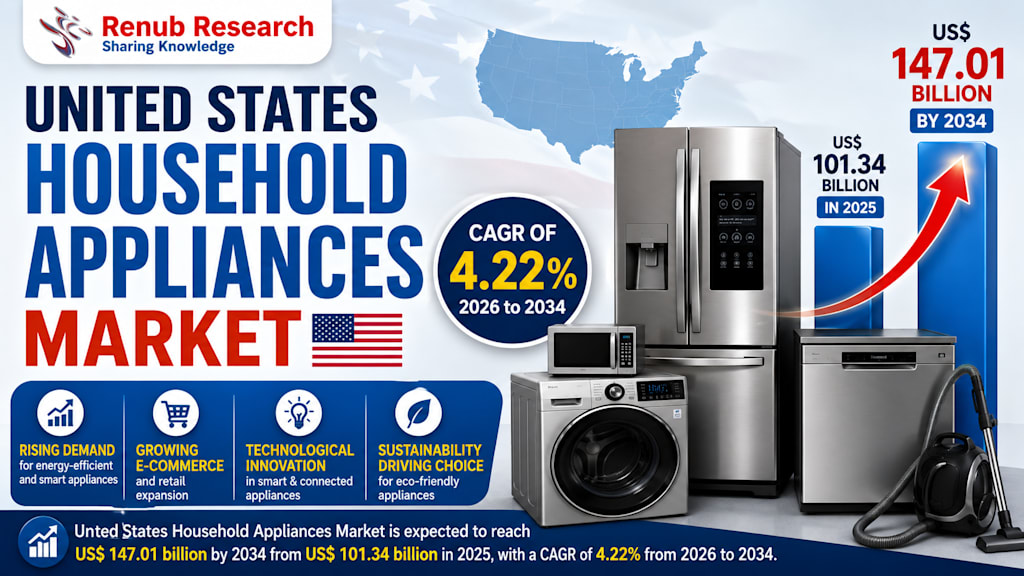
According to Renub Research, the United States household appliances market is expected to grow from US$ 101.34 billion in 2025 to US$ 147.01 billion by 2034, expanding at a CAGR of 4.22% between 2026 and 2034. Rising disposable incomes, rapid smart-home adoption, urban housing expansion, and growing consumer demand for convenience and sustainability continue to fuel long-term market growth.
Household appliances have become essential to modern living, helping consumers save time, improve comfort, reduce energy consumption, and simplify daily tasks. Major appliances such as refrigerators, washing machines, dishwashers, ovens, and air conditioners continue to dominate household spending, while smaller appliances like coffee makers, air fryers, humidifiers, and vacuum cleaners are experiencing strong growth due to evolving lifestyle habits and digital influence.
As American households become increasingly technology-driven, appliance manufacturers are focusing heavily on innovation, connectivity, and energy efficiency to stay competitive in a rapidly changing marketplace.
Smart Homes Are Becoming the Center of Appliance Innovation
One of the strongest forces driving the U.S. household appliances market is the rapid rise of smart home ecosystems. Consumers now expect appliances to offer more than simple utility—they want products that connect seamlessly with smartphones, voice assistants, and broader home automation systems.
Modern appliances increasingly feature sensors, remote monitoring, AI-driven automation, and voice integration designed to improve convenience while optimizing energy use.
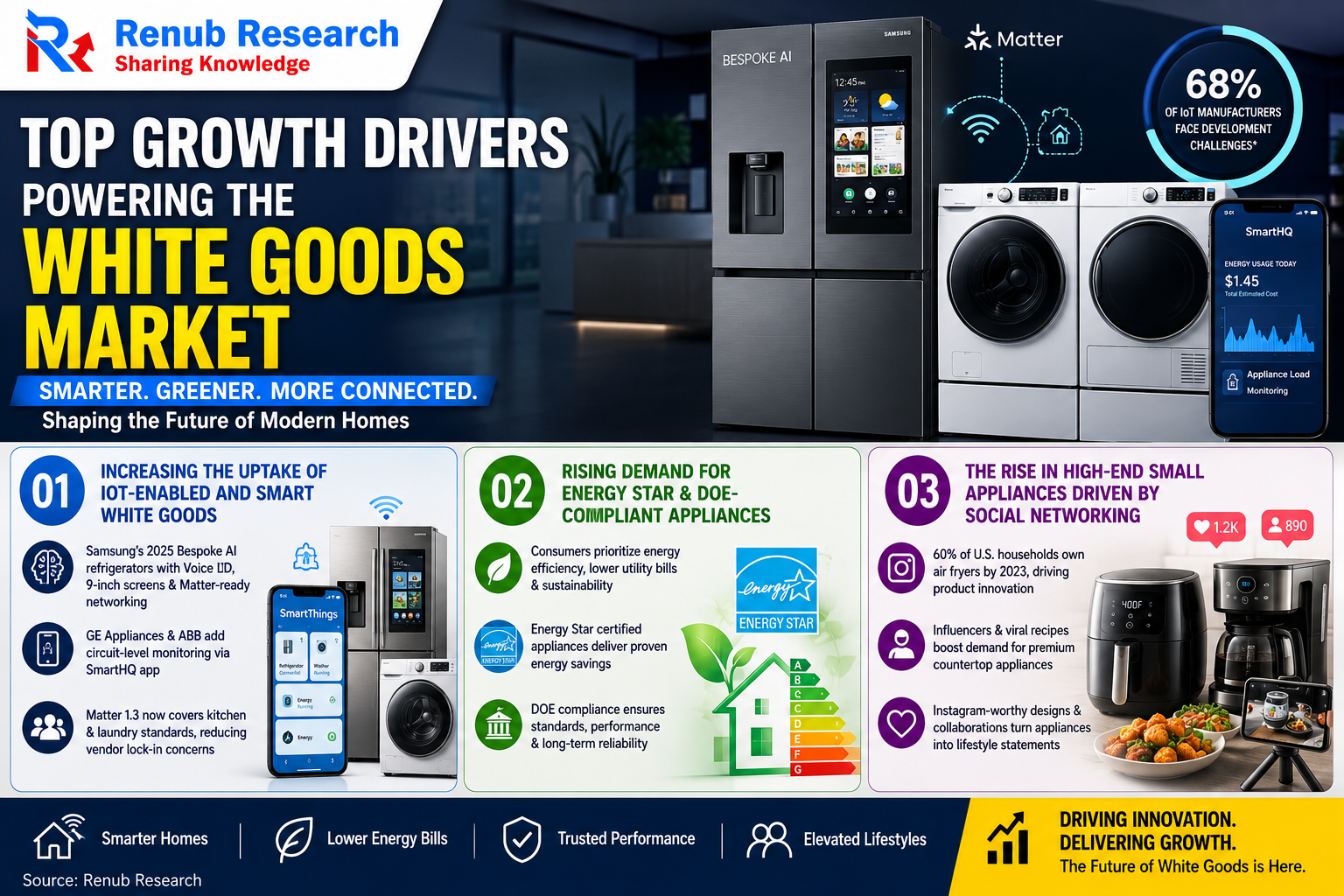
Samsung’s 2025 Bespoke AI refrigerator lineup reflects this growing trend. The appliances feature voice recognition technology, large touchscreen displays, and Matter-ready networking capabilities that allow them to integrate more effectively with smart home ecosystems.
Meanwhile, GE Appliances partnered with ABB to introduce circuit-level appliance monitoring through the SmartHQ platform, allowing homeowners to track appliance energy consumption in real time. These types of innovations are transforming appliances into intelligent home-management systems rather than standalone products.
Consumers increasingly value the ability to monitor, control, and automate appliances remotely. Whether adjusting refrigerator temperatures through a smartphone app or receiving maintenance alerts from a washing machine, connected technology is becoming a mainstream expectation.
The growing adoption of Matter 1.3 interoperability standards is also helping reduce consumer concerns around device compatibility and vendor lock-in. As smart-home ecosystems become more standardized, consumers are more willing to invest in connected appliances across multiple product categories.
Energy Efficiency Is No Longer Optional
Energy efficiency has become one of the most important purchasing factors in the U.S. household appliances market.
Consumers are increasingly focused on lowering electricity bills, reducing environmental impact, and meeting sustainability goals. Government efficiency regulations and ENERGY STAR certification programs are also encouraging households to replace older appliances with modern alternatives.
Rising electricity costs across many parts of the country are accelerating demand for energy-saving technologies such as inverter compressors, smart cooling systems, and water-efficient laundry appliances.
Manufacturers are responding by designing appliances that consume less power while offering improved performance and longer operational lifespans.
Whirlpool Corporation’s January 2024 partnership with One Energy further highlights the industry’s sustainability focus. The company announced plans to expand onsite wind and solar systems at its Ohio manufacturing facilities, helping reduce dependence on traditional energy sources while supporting cleaner production operations.
Consumers increasingly view sustainability as part of product quality. Appliances that help conserve electricity and water are often perceived as smarter long-term investments despite higher upfront costs.
This shift is especially noticeable among younger homeowners and environmentally conscious consumers who prioritize sustainable living solutions when purchasing household products.
Social Media Is Changing How Consumers Buy Appliances
One of the most interesting trends reshaping the market is the growing influence of social media on appliance purchasing decisions.
Platforms such as TikTok, Instagram, YouTube, and Pinterest have transformed household appliances into lifestyle and content-creation products. Consumers are increasingly discovering kitchen gadgets, coffee machines, and cooking appliances through influencers, viral recipes, and online product demonstrations.
Air fryers represent one of the clearest examples of this phenomenon. By 2023, approximately 60% of American households owned air fryers, helping fuel a massive increase in frozen food products designed specifically for air fryer preparation.
Brands are now actively designing products with visual appeal and social media compatibility in mind. Sleek finishes, minimalist aesthetics, and premium countertop designs have become powerful selling points.
Manufacturers are also collaborating with food influencers and lifestyle creators to showcase appliance functionality in real-life scenarios. Instead of relying solely on traditional advertising, companies are leveraging recipe videos, kitchen transformations, and wellness-focused content to build consumer engagement.
Coffee makers, blenders, air fryers, and specialty cooking appliances are especially benefiting from this trend because they fit naturally into food and lifestyle content ecosystems.
Millennials and Gen Z consumers are particularly responsive to appliances that support healthier lifestyles, convenience-focused meal preparation, and visually appealing kitchen environments.
Home Construction and Remodeling Continue Supporting Demand
The appliance industry is also benefiting from strong residential construction activity and ongoing home renovation trends across the United States.
New housing developments generate substantial demand for refrigerators, cooking appliances, HVAC systems, washing machines, and dishwashers. At the same time, remodeling projects often involve upgrading kitchens and laundry rooms with modern appliance packages.
Urbanization and expanding living spaces continue supporting long-term appliance demand, particularly in rapidly growing states such as Texas and Florida.
Consumers renovating older homes are increasingly choosing smart appliances that integrate with modern home systems while improving energy efficiency.
Replacement cycles also remain a critical source of industry stability. Even during periods of economic uncertainty, households eventually need to replace aging appliances due to wear, breakdowns, or rising energy costs associated with outdated models.
Frequent product upgrades and shorter innovation cycles further encourage consumers to replace appliances sooner than in previous decades.
Premium Appliances Continue Gaining Popularity
As disposable incomes rise, many consumers are moving toward premium appliance categories that offer advanced features, enhanced durability, and elevated design aesthetics.
High-end refrigerators, luxury coffee machines, multifunctional ovens, and premium dishwashers are seeing strong demand among affluent households and tech-focused buyers.
Miele’s updated G7000 dishwasher series introduced in March 2024 demonstrates how manufacturers are targeting premium buyers through convenience and sustainability innovations. The new models include improved detergent dosing systems, quieter operation, and redesigned basket layouts optimized for reusable bottles and modern kitchen accessories.
Similarly, LG Electronics launched its 14-place LG Dios Objet Collection Dishwasher in February 2024 with multiple installation configurations designed to improve flexibility for different kitchen layouts and living spaces.
Consumers increasingly view appliances as long-term lifestyle investments rather than simple utility products. Design, user experience, smart features, and brand reputation now play larger roles in purchasing decisions.
High Prices Remain a Major Challenge
Despite strong market momentum, the U.S. household appliances industry faces several ongoing challenges.
One of the most significant barriers is the high upfront cost associated with technologically advanced and energy-efficient appliances.
Smart features, premium materials, AI integration, and advanced energy-saving systems often increase retail prices substantially. For many consumers, especially during periods of inflation or economic uncertainty, appliance upgrades can become difficult to justify financially.
Price-sensitive consumers may delay replacement purchases or choose lower-cost alternatives rather than premium models.
Although financing options are widely available, not all households are comfortable taking on additional debt for non-essential upgrades.
This pricing pressure creates a difficult balancing act for manufacturers trying to maintain profitability while expanding accessibility to advanced appliance technologies.
Supply-Chain Disruptions Continue Affecting Production
The industry also continues facing supply-chain-related disruptions that impact manufacturing timelines, inventory availability, and product pricing.
Semiconductor chips, steel, plastics, and electronic components remain critical to appliance production. Delays or shortages in these materials can significantly slow manufacturing operations.
Transportation bottlenecks, port congestion, and fluctuating raw material costs have further complicated supply-chain stability in recent years.
These disruptions often result in higher prices for consumers and longer waiting periods for certain appliance models.
Manufacturers are responding by diversifying supplier networks, localizing portions of production, and investing in more resilient logistics systems. However, supply-chain unpredictability remains a major concern for the industry moving forward.
California Leads in Smart and Sustainable Appliance Adoption
California remains one of the strongest regional markets in the United States due to its environmentally conscious consumers, high urban density, and rapid smart-home adoption.
Demand for energy-efficient refrigerators, HVAC systems, and water-saving laundry appliances is particularly strong because of strict state efficiency standards and high electricity costs.
Consumers in cities such as Los Angeles and San Francisco are especially interested in connected appliances that integrate with home automation systems.
The state’s affluent population and active housing market continue supporting premium appliance sales and advanced technology adoption.
Texas Benefits From Population Growth and Housing Expansion
Texas is another major contributor to household appliance demand thanks to its rapidly expanding population and strong residential construction activity.
Cities like Houston, Dallas, and Austin continue experiencing significant housing development, creating steady demand for refrigerators, air conditioners, cooking appliances, and laundry systems.
The state’s hot climate also drives strong demand for cooling technologies and energy-efficient HVAC systems.
Texas benefits from a diverse consumer base that supports both premium and budget-friendly appliance categories.
New York and Florida Showcase Unique Consumer Needs
New York’s appliance market is heavily shaped by urban living and limited residential space. Consumers often prefer compact, multifunctional appliances designed for apartments, condos, and high-rise living environments.
Slim refrigerators, combination washer-dryer units, and space-saving kitchen appliances are particularly popular in New York City.
Florida, meanwhile, benefits from strong migration trends, tourism-related housing activity, and climate-driven demand for cooling systems and humidity-control appliances.
The state’s growing retiree population also creates demand for user-friendly, durable appliances that prioritize reliability and convenience.
The Future of the U.S. Appliance Industry
The future of the United States household appliances market will likely be defined by three major themes: connectivity, sustainability, and personalization.
Consumers increasingly expect appliances to integrate seamlessly into their digital lifestyles while helping reduce energy costs and environmental impact.
Manufacturers that successfully combine smart functionality, efficiency, affordability, and attractive design will be best positioned to capture future market share.
At the same time, social media and influencer-driven marketing will continue shaping consumer preferences, especially among younger buyers who increasingly view appliances as part of lifestyle identity and home aesthetics.
With continued innovation across AI, IoT integration, automation, and energy-saving technologies, the U.S. household appliances market appears poised for steady long-term expansion through 2034.
Final Thoughts
The United States household appliances market is rapidly evolving from a utility-driven industry into a technology-centered consumer lifestyle market. Smart connectivity, energy efficiency, premium experiences, and social-media-driven consumer behavior are reshaping how Americans interact with appliances in their everyday lives.
Although challenges such as high prices and supply-chain instability remain, the industry’s strong innovation pipeline and growing consumer demand for smarter, more sustainable living solutions continue supporting long-term growth opportunities across the market.
About the Creator
Enjoyed the story? Support the Creator.
Subscribe for free to receive all their stories in your feed.
Comments
There are no comments for this story
Be the first to respond and start the conversation.