
United States Dishwasher Market Set to Reach US$ 13.05 Billion by 2033 as Smart and Energy-Efficient Appliances Transform American Kitchens
Growing Demand for Convenience, Sustainability, and Smart Home Integration Continues to Drive Dishwasher Adoption Across the United States

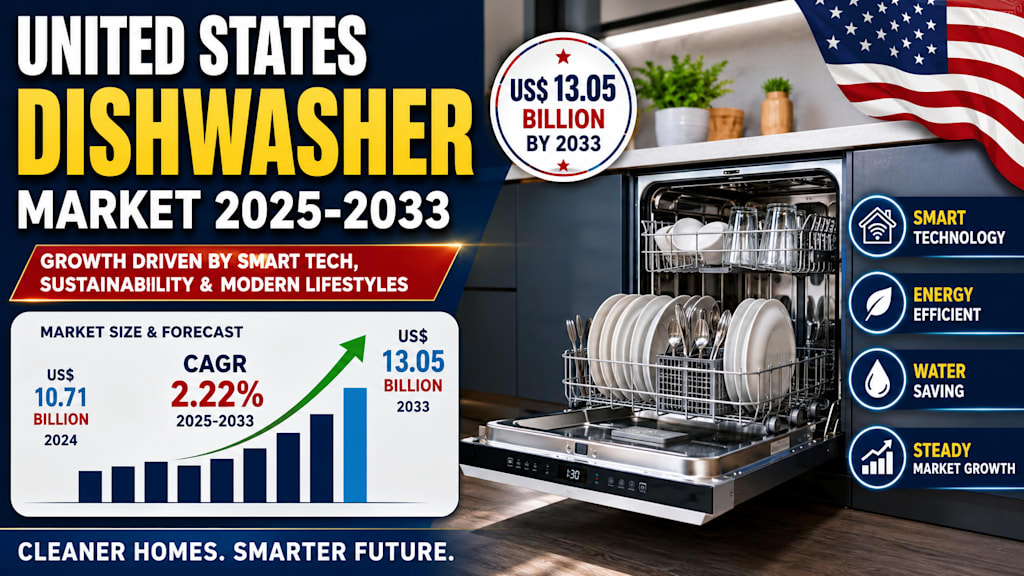
United States Dishwasher Market Outlook 2025–2033
The American kitchen has undergone a remarkable transformation over the past decade. Once viewed as a luxury appliance, the dishwasher has become an essential household necessity for millions of families seeking convenience, efficiency, and improved hygiene. As consumers increasingly embrace smart home technologies and energy-saving appliances, the dishwasher market is experiencing steady growth across residential and commercial sectors.
According to Renub Research, the United States Dishwasher Market is projected to increase from US$ 10.71 Billion in 2024 to US$ 13.05 Billion by 2033, expanding at a CAGR of 2.22% between 2025 and 2033.
The market's growth trajectory is supported by rising urbanization, increasing disposable income, technological innovations, environmental awareness, and a strong preference for automated household solutions. Modern dishwashers are no longer simple cleaning machines; they have evolved into intelligent appliances featuring Wi-Fi connectivity, voice assistant compatibility, advanced sensors, and highly efficient water management systems.
As American consumers continue prioritizing convenience and sustainability, the dishwasher industry is poised to remain an important segment of the country's home appliance market.
Why Dishwashers Have Become a Household Essential
In today's fast-paced world, consumers are continuously searching for ways to save time without compromising cleanliness and hygiene. Dishwashers offer a practical solution by automating one of the most repetitive household chores.
Modern dishwashers use high-temperature water, specialized detergents, and advanced spray mechanisms to remove grease, stains, and food residue effectively. Compared to manual dishwashing, these machines often consume less water while delivering superior sanitization.
The increasing popularity of smart homes has further elevated dishwasher demand. Homeowners now expect appliances to integrate seamlessly with mobile applications and digital ecosystems, enabling remote monitoring and control.
Moreover, dishwashers support sustainability goals by reducing water waste and improving energy efficiency. These environmental benefits resonate strongly with consumers who seek eco-friendly lifestyles while lowering utility bills.
Rising Consumer Demand for Convenience Drives Market Expansion
One of the most significant factors fueling dishwasher adoption in the United States is the growing desire for convenience.
Busy work schedules, dual-income households, and changing lifestyles have significantly reduced the time available for household chores. Consumers increasingly view dishwashers as practical tools that simplify daily routines and improve quality of life.
The demand is particularly strong among younger homeowners and working professionals who value automation and smart technology. Features such as delayed start options, customizable wash cycles, automatic detergent dispensing, and smartphone integration have enhanced consumer appeal.
Additionally, the growing popularity of connected homes has encouraged manufacturers to introduce dishwashers that communicate with other smart devices. Voice-controlled operation through digital assistants and app-based monitoring capabilities are becoming increasingly common, making dishwashers an integral part of the modern smart kitchen.
Sustainability and Energy Efficiency Become Major Purchase Drivers
Environmental awareness continues to reshape purchasing decisions across the United States appliance industry.
Consumers are paying closer attention to water conservation and energy consumption when selecting household appliances. As a result, ENERGY STAR-certified dishwashers have gained significant popularity.
Modern dishwashers are designed to use substantially less water than traditional handwashing methods. Advanced technologies such as soil sensors, intelligent water recycling systems, and optimized spray patterns allow appliances to clean effectively while minimizing resource consumption.
Federal and state governments have also played an important role by promoting energy-efficient appliance adoption through incentive programs and rebate schemes. These initiatives encourage consumers to replace older models with environmentally friendly alternatives.
Manufacturers continue investing heavily in research and development to create products that meet increasingly stringent efficiency standards while maintaining superior cleaning performance.
As sustainability becomes a long-term consumer priority, energy-efficient dishwashers are expected to remain a major growth catalyst throughout the forecast period.
Housing Market Growth Supports Dishwasher Sales
The expansion of residential construction and home renovation projects is creating favorable conditions for dishwasher manufacturers.
New homes across the United States increasingly include built-in dishwashers as standard kitchen appliances. Homebuilders recognize that modern buyers expect fully equipped kitchens featuring high-quality, energy-efficient appliances.
In addition, homeowners continue investing in kitchen remodeling projects aimed at enhancing functionality and increasing property value. During and after the COVID-19 pandemic, many Americans spent more time at home and prioritized upgrades to their living spaces.
This trend significantly boosted demand for premium kitchen appliances, including dishwashers equipped with advanced features and modern designs.
The ongoing growth of suburban housing developments and residential renovation activities is expected to generate sustained demand for dishwashers over the next decade.
Challenges Limiting Market Growth
High Installation and Ownership Costs
Despite strong growth prospects, affordability remains a challenge for some consumers.
Premium dishwashers equipped with smart technologies and energy-saving features often require significant upfront investment. Installation expenses, particularly for built-in models, can further increase total ownership costs.
Maintenance and repair costs also influence purchasing decisions. Consumers may hesitate to invest in advanced models if replacement parts and servicing expenses are perceived as expensive.
While manufacturers offer financing programs and promotional discounts, cost sensitivity remains a key concern among lower-income households.
Space Constraints in Urban Housing
Limited kitchen space presents another challenge for market expansion.
Many urban apartments, particularly in older cities such as New York, were not originally designed to accommodate built-in dishwashers. Installation can require plumbing modifications and additional space that may not be readily available.
Although compact and portable dishwashers provide alternative solutions, awareness and availability remain relatively limited compared to traditional built-in units.
As urban housing density continues to increase, manufacturers will need to develop innovative space-saving products to address this challenge effectively.
Built-in Dishwashers Continue to Dominate the Market
Built-in dishwashers represent the largest and most influential product category within the United States dishwasher market.
Consumers prefer these appliances because they blend seamlessly with modern kitchen designs while offering larger capacities and quieter operation.
Builders frequently include built-in dishwashers as standard features in newly constructed homes, further supporting market penetration.
Premium models now offer advanced capabilities such as:
Smart connectivity
Voice command integration
Multiple wash zones
Sensor-based cleaning
Ultra-quiet performance
Water-saving technologies
These innovations continue to strengthen the appeal of built-in dishwashers among middle- and upper-income households.
Residential Segment Remains the Primary Revenue Generator
Residential applications account for the majority of dishwasher sales in the United States.
Increasing household incomes, busy lifestyles, and growing awareness of hygiene benefits are encouraging consumers to invest in automated cleaning solutions.
The post-pandemic focus on cleanliness and home cooking has further accelerated dishwasher adoption. Families are spending more time preparing meals at home, resulting in increased dishwashing requirements and greater appreciation for labor-saving appliances.
Manufacturers are responding by introducing affordable models targeting first-time buyers while simultaneously expanding premium offerings for consumers seeking advanced functionality.
As dishwasher ownership becomes increasingly common across American households, residential demand will remain the market's dominant growth engine.
Commercial Dishwasher Market Gains Momentum
The commercial dishwasher sector is also experiencing robust growth.
Restaurants, hotels, cafeterias, hospitals, schools, and institutional kitchens require efficient solutions capable of processing large volumes of dishes while maintaining strict sanitation standards.
Commercial dishwashers help businesses reduce labor costs, improve operational efficiency, and ensure compliance with food safety regulations.
The recovery of the hospitality and foodservice industries following pandemic-related disruptions has generated renewed demand for commercial kitchen equipment.
Additionally, sustainability initiatives within the commercial sector are encouraging adoption of water-efficient and energy-saving dishwasher technologies.
As foodservice establishments continue modernizing operations, commercial dishwasher demand is expected to remain strong.
Offline Retail Channels Continue to Lead Sales
Despite rapid growth in e-commerce, physical retail stores remain the preferred purchasing channel for many dishwasher buyers.
Large home improvement and appliance retailers provide consumers with opportunities to compare products, receive expert guidance, and access installation services.
Many customers prefer seeing appliances in person before making significant purchases, especially when evaluating design, capacity, and features.
Retailers also attract consumers through financing programs, promotional discounts, bundled appliance packages, and extended warranty offerings.
While online channels continue gaining market share, offline retail remains a critical component of the United States dishwasher distribution ecosystem.
California Leads State-Level Market Growth
California stands among the most influential dishwasher markets in the United States.
The state's large population, environmental regulations, and sustainability-focused consumers create strong demand for energy-efficient appliances.
Recurring drought concerns have heightened awareness regarding water conservation, encouraging households to adopt modern dishwashers that use less water than manual washing.
Major metropolitan areas such as Los Angeles and San Francisco also exhibit strong demand for smart, premium kitchen appliances integrated with connected home ecosystems.
California's combination of innovation, environmental responsibility, and purchasing power positions it as a leading growth market.
New York's Unique Urban Market Dynamics
New York presents a distinctive dishwasher market characterized by diverse housing types and space limitations.
While suburban households commonly install built-in dishwashers, urban residents often favor compact and portable alternatives that fit smaller apartments.
The state's high-income population and fast-paced lifestyle contribute to strong demand for convenience-oriented appliances.
Additionally, New York's extensive hospitality and restaurant sectors generate significant commercial dishwasher sales, further strengthening overall market growth.
Manufacturers that successfully address space constraints while maintaining functionality are likely to achieve strong performance in the New York market.
New Jersey Emerges as a Consistent Growth Market
New Jersey continues to experience steady dishwasher market expansion.
The state's suburban demographic profile, relatively high household incomes, and proximity to major metropolitan centers support appliance demand.
Consumers increasingly seek products that combine convenience, energy efficiency, and smart technology features.
Both traditional retailers and e-commerce platforms are benefiting from growing consumer interest in premium and mid-range dishwasher models.
As sustainability awareness and smart home adoption continue increasing, New Jersey is expected to remain an important contributor to national dishwasher sales.
Competitive Landscape
The United States dishwasher market remains highly competitive, with leading manufacturers focusing on innovation, sustainability, product differentiation, and smart technology integration.
Major industry participants include:
Electrolux AB
Panasonic
Whirlpool Corporation
Robert Bosch GmbH
Samsung Electronics
Siemens
LG Electronics
Haier Group
10 Recent Industry Developments
1. Whirlpool Corporation
Expanded its smart dishwasher lineup with enhanced remote monitoring and voice assistant integration capabilities.
2. Bosch
Introduced advanced water-saving technologies designed to improve cleaning performance while reducing resource consumption.
3. Samsung Electronics
Launched AI-powered dishwasher features that automatically optimize wash cycles based on load conditions.
4. LG Electronics
Enhanced ThinQ connectivity across its dishwasher portfolio, enabling improved smartphone-based appliance management.
5. Electrolux
Focused on sustainable manufacturing initiatives and expanded its energy-efficient dishwasher offerings.
6. Haier
Strengthened its premium kitchen appliance portfolio through innovative dishwasher designs targeting modern households.
7. Panasonic
Invested in intelligent sensor technologies that improve cleaning precision and energy efficiency.
8. Siemens
Expanded premium dishwasher models featuring ultra-quiet operation and advanced automation features.
9. Bosch
Accelerated adoption of eco-friendly production methods and recyclable materials in appliance manufacturing.
10. Whirlpool
Introduced upgraded sanitization technologies to meet growing consumer demand for hygiene-focused kitchen appliances.
Final Thoughts
The United States dishwasher market is entering a period of stable and technology-driven growth. Rising consumer demand for convenience, increasing environmental awareness, and expanding smart home adoption are transforming dishwashers from basic kitchen appliances into intelligent household systems.
With the market expected to grow from US$ 10.71 Billion in 2024 to US$ 13.05 Billion by 2033, manufacturers have significant opportunities to capitalize on evolving consumer preferences. Energy efficiency, smart connectivity, water conservation, and innovative design will remain the key factors shaping competitive success.
As American households continue embracing automation and sustainability, the dishwasher industry is positioned to play a central role in the future of modern kitchen living.
About the Creator
Enjoyed the story? Support the Creator.
Subscribe for free to receive all their stories in your feed.
Comments
There are no comments for this story
Be the first to respond and start the conversation.