
United States Communication Equipment Market Expected to Reach US$ 168 Billion by 2033 Amid 5G and Smart Connectivity Boom
Rapid expansion of 5G networks, IoT devices, cloud communication, and AI-driven infrastructure is transforming America’s communication equipment industry

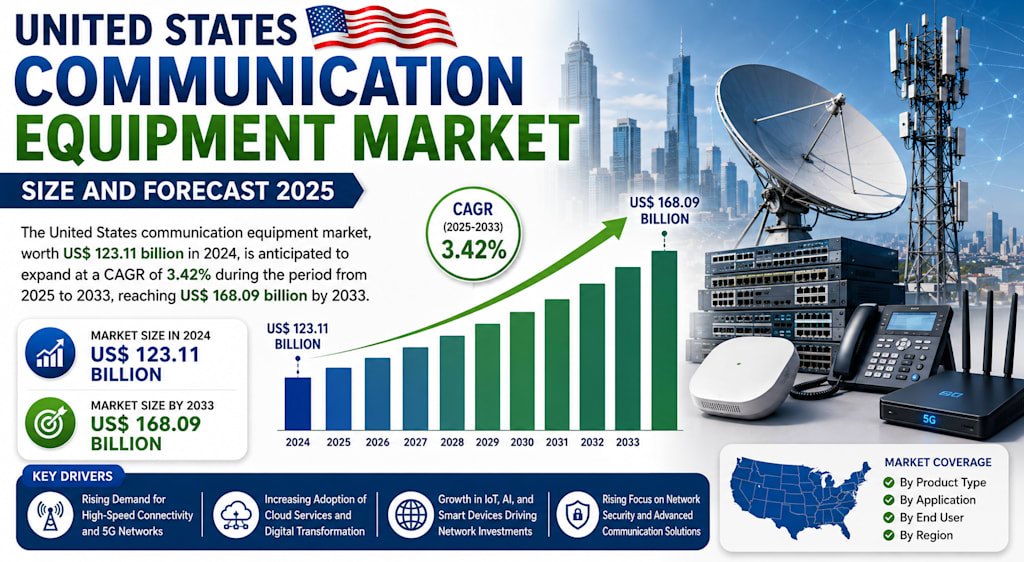
The United States communication equipment market is entering a powerful phase of transformation driven by the rapid evolution of digital connectivity, smart technologies, and next-generation communication infrastructure. As businesses and consumers increasingly rely on faster, safer, and more efficient communication systems, demand for advanced communication equipment continues to rise across the country.
According to Renub Research, the United States communication equipment market was valued at US$ 123.11 billion in 2024 and is projected to reach US$ 168.09 billion by 2033, growing at a CAGR of 3.42% from 2025 to 2033. The market is expanding due to rising investments in 5G networks, IoT devices, cloud communication systems, and high-speed digital infrastructure.
From smartphones and fiber-optic systems to routers, cloud networking solutions, and AI-powered communication platforms, the industry is becoming one of the most important pillars of the modern digital economy.
Communication Equipment Is Powering Modern America
Communication equipment includes technologies and systems that transmit, receive, and process voice, video, and data signals. These technologies play a critical role in enabling seamless communication across businesses, governments, healthcare institutions, transportation systems, and households.
The market covers a wide range of products, including smartphones, routers, switches, fiber-optic systems, satellite communication equipment, broadcasting technologies, and networking infrastructure.
Today, communication equipment is essential for nearly every aspect of daily life. Businesses depend on high-speed networks for remote work and cloud collaboration, healthcare providers use advanced communication systems for telemedicine, and government agencies require secure infrastructure for national security and emergency response operations.
As digital transformation accelerates across industries, communication equipment has become a backbone of economic productivity and technological innovation in the United States.
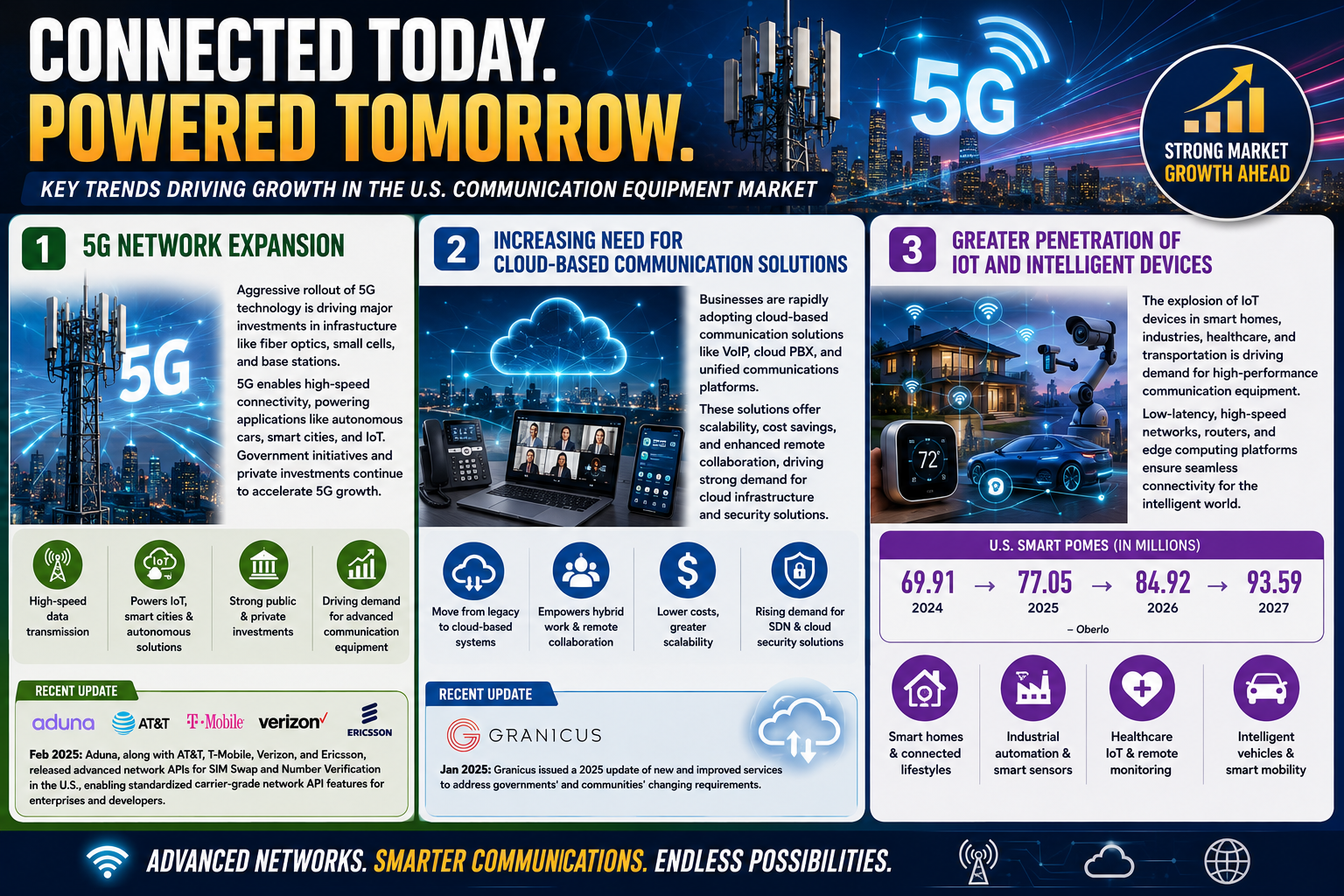
5G Expansion Is Driving Massive Industry Growth
One of the biggest growth drivers in the U.S. communication equipment market is the aggressive rollout of 5G technology.
Telecommunication companies are investing billions of dollars into next-generation infrastructure, including fiber optics, base stations, wireless towers, and small-cell networks.
The expansion of 5G technology is creating enormous demand for advanced communication equipment because consumers and businesses increasingly expect faster internet speeds, low latency, and seamless connectivity.
5G technology is also supporting the development of several emerging technologies, including:
Autonomous vehicles, smart cities, industrial automation, cloud gaming, remote healthcare systems, and IoT connectivity.
The technology allows devices to communicate faster and more efficiently, creating opportunities for businesses across multiple industries.
In February 2025, Aduna partnered with AT&T, Verizon, T-Mobile, and Ericsson to launch advanced network APIs for SIM swap and number verification services in the United States. The collaboration is expected to improve mobile ecosystem functionality and strengthen digital communication services.
As 5G adoption expands nationwide, communication equipment manufacturers are expected to experience sustained long-term growth.
Cloud Communication Is Reshaping Business Operations
Cloud-based communication systems are becoming increasingly important for businesses across the United States.
Companies are moving away from traditional communication systems and adopting cloud-based platforms because they offer greater flexibility, lower operating costs, and improved scalability.
The rise of remote work and hybrid business models has significantly increased demand for:
VoIP systems, cloud PBX solutions, unified communication platforms, software-defined networking, and cloud security technologies.
Organizations now rely heavily on digital collaboration tools for video conferencing, file sharing, customer service, and secure communication.
Cloud communication also allows businesses to expand operations more efficiently while reducing infrastructure costs associated with traditional hardware systems.
In January 2025, Granicus introduced upgraded customer experience solutions designed to support evolving communication needs for governments and communities.
As businesses continue modernizing operations, cloud communication infrastructure is expected to remain a major driver of market growth.
IoT Devices Are Increasing Demand for Advanced Networks
The rapid expansion of the Internet of Things (IoT) is another major factor fueling demand for communication equipment.
IoT devices rely on stable, high-speed communication networks to function effectively. These devices are increasingly being used in:
Smart homes, healthcare systems, manufacturing facilities, transportation networks, industrial automation, and connected vehicles.
Consumers are purchasing more smart devices than ever before, including smart speakers, smart thermostats, wearable fitness trackers, and connected security systems.
According to industry data, the number of smart homes in the United States is expected to increase significantly over the coming years, creating stronger demand for advanced communication infrastructure.
The growth of IoT technology is also driving investments in routers, switches, edge computing systems, wireless communication equipment, and low-latency networking solutions.
As smart environments become more common, communication equipment companies are expected to benefit from rising connectivity requirements.
Mobile Communication Equipment Continues Expanding
The mobile communication equipment segment remains one of the strongest areas within the overall market.
Consumers continue upgrading smartphones, tablets, smartwatches, wireless accessories, and wearable communication devices to access faster connectivity and improved digital experiences.
The expansion of 5G-compatible smartphones has accelerated replacement cycles and encouraged consumers to invest in advanced mobile devices.
The market is also being influenced by several technology trends, including:
AI-powered smartphones, foldable devices, wearable technology, enhanced battery systems, and high-performance mobile processors.
Businesses are also increasing demand for secure enterprise communication devices and rugged industrial mobile equipment designed for remote operations and fieldwork.
In March 2025, Telness Tech launched MVNO services for the T-Mobile network to support communication service expansion in the United States.
As mobile connectivity becomes more integrated into daily life, demand for innovative mobile communication equipment is expected to remain strong.
Fixed-Line Communication Still Holds Importance
Despite the rise of wireless technologies, fixed-line communication systems continue playing an important role in several industries.
Sectors such as healthcare, finance, government, and defense still rely heavily on secure fixed-line infrastructure because of its stability, reliability, and enhanced security features.
Fixed-line communication systems include:
Landline telephony, fiber-optic broadband, PBX systems, enterprise communication networks, and high-speed wired internet infrastructure.
The deployment of fiber-to-the-home (FTTH) services is also increasing demand for upgraded communication equipment across residential and commercial markets.
Many communication providers are modernizing traditional fixed-line systems by integrating cloud technology and VoIP solutions to remain competitive.
Although mobile communication dominates consumer markets, fixed-line systems remain essential for mission-critical operations and enterprise-level security.
Network Communication Equipment Is Becoming Essential
Network communication equipment forms the foundation of modern digital infrastructure.
The market includes products such as:
Routers, switches, Wi-Fi systems, modems, fiber-optic equipment, and enterprise networking solutions.
Businesses require reliable networking infrastructure to support cloud computing, remote work, data centers, and cybersecurity operations.
The rise of edge computing and AI-powered network management is further increasing demand for sophisticated networking technologies.
Organizations are investing heavily in software-defined networking (SDN), automation tools, and advanced cybersecurity systems to improve operational efficiency and protect against cyber threats.
As data traffic continues increasing worldwide, network communication equipment will remain a vital component of digital transformation.
Cybersecurity Challenges Continue Rising
While communication technology creates new opportunities, it also introduces serious cybersecurity risks.
The growing use of cloud communication, IoT devices, and wireless networks has increased vulnerability to cyberattacks, data breaches, and hacking incidents.
Cybercriminals frequently target:
Routers, wireless networks, cloud systems, mobile devices, and VoIP platforms.
Companies are responding by investing heavily in encryption technologies, AI-based threat detection systems, and multi-factor authentication tools.
Regulatory requirements such as GDPR and CCPA are also forcing businesses to strengthen data privacy protections and security compliance measures.
Cybersecurity has become one of the most critical challenges facing the communication equipment industry today.
High Infrastructure Costs Remain a Major Challenge
Building and maintaining advanced communication infrastructure requires massive financial investments.
The deployment of 5G networks, fiber-optic systems, and satellite communication technologies involves expensive equipment, network towers, data centers, and licensing costs.
Large telecom companies can typically manage these investments, but smaller businesses often struggle with high entry barriers and operational expenses.
Government regulations and spectrum licensing fees also increase costs for communication service providers and infrastructure companies.
Despite these financial challenges, demand for improved connectivity continues driving investments across the industry.
Regional Trends Across the United States
Communication equipment demand varies significantly across different U.S. regions based on economic activity, technological development, and industrial concentration.
Western United States
The western region, particularly California and Washington, serves as a major technology and innovation hub.
The presence of Silicon Valley has created strong demand for advanced networking systems, cloud infrastructure, data centers, and high-speed communication technologies.
The region’s entertainment, gaming, aerospace, and defense industries also contribute to strong communication equipment demand.
Eastern United States
The eastern region includes major financial and government centers such as New York, Washington D.C., and Boston.
Businesses and government agencies in these areas prioritize secure communication systems, cloud collaboration tools, enterprise networking, and encrypted communication technologies.
The region also remains a center for telecommunications research and innovation.
Northern United States
Northern states such as Illinois and Michigan are seeing increased investments in industrial automation, IoT communication systems, and broadband infrastructure.
Manufacturing and automotive industries require advanced communication networks for supply chain management, automation, and remote monitoring.
Government-backed rural broadband initiatives are also improving connectivity across underserved areas.
Why the Future of the Market Looks Strong
The future of the United States communication equipment market appears highly promising as digital transformation continues accelerating across industries.
Several major trends are expected to support long-term growth, including:
5G expansion, rising IoT adoption, cloud computing growth, AI-powered networking, smart city initiatives, remote work trends, and increasing demand for secure communication systems.
Communication equipment is no longer limited to telecommunications companies alone. Today, nearly every industry depends on reliable digital infrastructure for operations, customer engagement, and productivity.
As businesses and consumers continue demanding faster, smarter, and safer communication technologies, the market is expected to remain one of the most important sectors in the U.S. economy.
Final Thoughts
The United States communication equipment market is entering a new phase of innovation powered by 5G technology, cloud computing, IoT connectivity, and AI-driven digital infrastructure.
From smartphones and routers to fiber-optic systems and smart networking platforms, communication equipment has become essential for modern business operations and everyday life.
According to Renub Research, the market is projected to grow from US$ 123.11 billion in 2024 to US$ 168.09 billion by 2033, highlighting the growing importance of digital connectivity in the American economy.
As industries continue investing in advanced communication technologies, companies that focus on innovation, cybersecurity, scalability, and next-generation networking solutions are expected to lead the future of the market.
The communication revolution is far from over — and the next decade could redefine how America connects, communicates, and operates in a digitally connected world.
About the Creator
Enjoyed the story? Support the Creator.
Subscribe for free to receive all their stories in your feed.
Comments
There are no comments for this story
Be the first to respond and start the conversation.