
United States Automotive Robotics Market Accelerates as EV Manufacturing, AI Automation, and Smart Factories Redefine Vehicle Production
Rising electric vehicle demand, Industry 4.0 adoption, and rapid advancements in AI-powered robotics are transforming the future of automotive manufacturing across the United States.

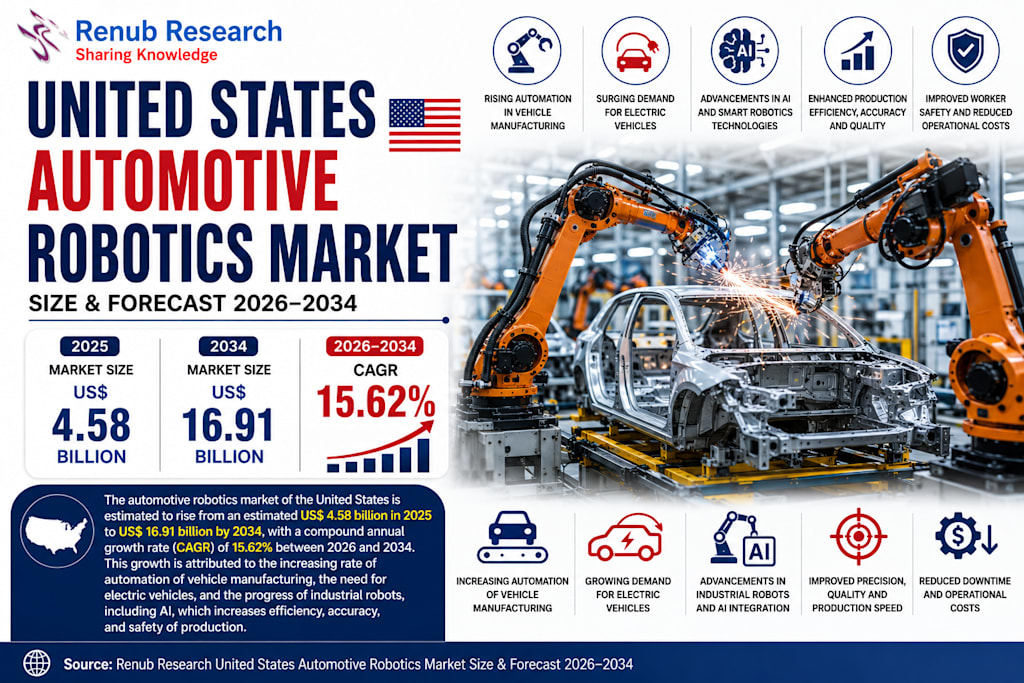
Market Overview
The United States automotive robotics market is witnessing rapid growth as automakers increasingly adopt automation technologies to improve manufacturing efficiency, precision, and production scalability. Robotics has become a core component of modern vehicle manufacturing, supporting critical processes such as welding, painting, assembly, material handling, inspection, and cutting operations. According to Renub Research, the United States automotive robotics market is projected to grow from US$ 4.58 billion in 2025 to US$ 16.91 billion by 2034, expanding at a remarkable CAGR of 15.62% during 2026–2034.
Automotive robotics refers to the use of programmable robotic systems in vehicle manufacturing and assembly operations. These robots can be stationary industrial robots or collaborative robots, commonly known as cobots, which work alongside human operators to improve efficiency and safety. Modern automotive robots are integrated with advanced technologies such as artificial intelligence (AI), machine learning (ML), sensors, vision systems, and real-time analytics that allow them to perform complex manufacturing tasks with minimal error rates.
The increasing shift toward electric vehicles (EVs) is playing a major role in transforming the automotive manufacturing landscape in the United States. EV production requires highly precise and automated processes, particularly in battery manufacturing, component assembly, and quality inspection. Automakers are therefore investing heavily in advanced robotic technologies to modernize factories and increase production efficiency.
Industry 4.0 technologies are also accelerating adoption of robotics in the automotive sector. IoT-enabled manufacturing systems, AI-powered analytics, cloud connectivity, and predictive maintenance technologies are creating smarter and more efficient production environments. Automotive manufacturers increasingly rely on robotics not only to reduce labor costs and improve consistency, but also to remain globally competitive in a rapidly evolving industry.
Growth Drivers
One of the strongest growth drivers in the United States automotive robotics market is the increasing adoption of automation across vehicle manufacturing facilities. Automotive manufacturers are under constant pressure to improve efficiency, maintain product quality, reduce downtime, and increase production flexibility. Robotics provides a highly effective solution for achieving these goals because robots can perform repetitive manufacturing tasks with exceptional precision and consistency.
Robots are widely used in welding, painting, assembly, inspection, and material handling operations because they significantly reduce the likelihood of production errors while increasing operational speed. Automation also helps manufacturers maintain workplace safety standards and minimize labor-intensive tasks. As vehicle demand continues rising, automotive companies are increasingly investing in robotic manufacturing systems to meet production targets more efficiently.
In May 2025, the International Federation of Robotics (IFR) reported that industrial robot installations in the United States automotive industry increased by 10.7%, reaching approximately 13,700 units. This sharp increase highlights how rapidly manufacturers are embracing robotic automation to strengthen production capabilities.
The rapid expansion of electric vehicle manufacturing is another major factor driving market growth. EV production involves highly complex assembly operations, particularly in battery manufacturing and battery pack integration, where precision is critical. Robotics plays an essential role in ensuring accurate handling, assembly, and inspection of EV components.
Automakers are heavily modernizing production facilities to support growing EV demand. Government incentives promoting clean-energy transportation are additionally accelerating investment in EV manufacturing infrastructure, creating significant opportunities for robotics vendors. Since EV manufacturing generally requires a higher level of automation than traditional internal combustion engine vehicle production, demand for advanced robotics systems is expected to rise substantially over the next decade.
Technological advancements in robotics and artificial intelligence are also transforming automotive manufacturing processes. New-generation robots are becoming increasingly intelligent, adaptable, and flexible due to advances in AI and machine learning technologies. These systems can now respond dynamically to changing production requirements while improving decision-making capabilities and operational efficiency.
Collaborative robots, or cobots, are gaining popularity because they allow humans and machines to work safely together on assembly lines. Vision systems integrated with AI are additionally improving quality inspection processes by enabling robots to detect manufacturing defects automatically. These innovations are encouraging automakers to deploy increasingly sophisticated robotic technologies throughout their operations.
In March 2026, Brain Corp introduced BrainOS Clean 2.0, a major software upgrade designed to enhance intelligent adaptation and integration capabilities for robotic cleaning solutions developed in partnership with Tennant Company. The development reflects the broader industrial trend toward autonomous AI-powered robotics systems.
Market Challenges
Despite strong growth momentum, the United States automotive robotics market faces several important challenges. One of the biggest obstacles is the high initial investment required to implement advanced robotic systems. Purchasing industrial robots, integrating them into manufacturing lines, and upgrading factory infrastructure can involve substantial costs.
Large automotive manufacturers may have the financial resources to absorb these investments, but small and medium-sized enterprises often struggle with the high capital expenditure required for robotic implementation. In addition to hardware costs, companies must also invest in software systems, maintenance, and employee training programs, further increasing expenses.
Workforce displacement and skill shortages represent another major concern. As robotics adoption increases, traditional manual manufacturing jobs may decline, raising concerns regarding workforce displacement. At the same time, advanced robotics systems require highly skilled workers capable of operating, maintaining, and programming complex automation technologies.
This creates a significant skills gap within the automotive manufacturing industry. Companies increasingly need technicians, engineers, and robotics specialists with expertise in AI, automation, and industrial software systems. Reskilling and workforce development initiatives are therefore becoming essential to support long-term industry growth.
United States Automotive Robotics Sensors Market
The automotive robotics sensors market in the United States is growing rapidly because sensors are essential for precision, safety, and real-time monitoring in automated manufacturing systems. Sensors provide robots with critical information regarding position, force, proximity, and temperature during manufacturing operations.
Vision sensors integrated with AI are increasingly important for automated quality inspection systems. The growing adoption of Industry 4.0 technologies and smart manufacturing practices is further strengthening demand for advanced sensor solutions across automotive production facilities.
United States Automotive Robotic Arm Market
The robotic arm segment is experiencing strong growth due to increasing automation within vehicle manufacturing facilities. Robotic arms are widely used for welding, painting, assembly, and material handling operations because they provide flexibility, precision, and operational consistency.
Technological advancements such as AI integration, advanced motion control systems, and collaborative robotic arms are improving performance and expanding application capabilities. Growing EV production is additionally increasing demand for high-precision robotic arms across battery assembly and electronics manufacturing processes.
United States Automotive Robotics Articulated Market
Articulated robots represent one of the most widely used robotic categories within automotive manufacturing because of their flexibility and ability to perform complex repetitive tasks. These robots feature multiple rotary joints, enabling efficient operation within confined manufacturing environments.
The increasing adoption of smart factories and precision manufacturing technologies is supporting strong growth within the articulated robotics segment. Although operational complexity and high implementation costs remain challenges, articulated robots continue playing a vital role in automotive production automation.
United States Automotive Robotics Welding Market
Robotic welding remains one of the largest applications within the automotive robotics industry. Automotive manufacturers increasingly rely on robotic welding systems because they provide superior speed, consistency, and precision compared to manual welding operations.
The transition toward electric vehicles is also driving demand for specialized robotic welding systems designed for battery components and lightweight materials. Advances in laser welding technologies are improving efficiency while reducing material waste and enhancing product quality.
United States Automotive Robotics Cutting Market
The automotive robotics cutting market is expanding as manufacturers increasingly adopt robotic cutting systems to improve precision and efficiency. Robotic cutting technologies are widely used for trimming, laser cutting, and processing advanced materials used in modern vehicles.
The growing use of lightweight composite materials in electric and fuel-efficient vehicles is increasing demand for highly precise robotic cutting systems capable of handling complex materials while minimizing waste.
Georgia Automotive Robotics Market
Georgia’s automotive robotics market is growing steadily due to increasing manufacturing activity and expanding automotive component production within the state. Workforce development initiatives and improving logistics infrastructure are supporting adoption of robotics technologies across manufacturing facilities.
The growing EV market is also contributing to increased demand for automation technologies within Georgia’s expanding industrial sector.
Washington Automotive Robotics Market
Washington is emerging as an innovation-driven market for automotive robotics because of its strong technology ecosystem and focus on AI-based automation solutions. Although the state is not traditionally a major automotive manufacturing hub, its expertise in advanced technologies and clean energy innovation is supporting growth in robotics applications.
Texas Automotive Robotics Market
Texas represents one of the fastest-growing automotive robotics markets in the United States due to its large industrial base, favorable business environment, and expanding EV manufacturing activity. Robotics plays a significant role in improving production accuracy and operational efficiency across Texas manufacturing facilities.
The state’s skilled workforce and investment in manufacturing technology continue strengthening its position within the national automotive robotics market.
New York Automotive Robotics Market
New York’s automotive robotics market is growing steadily due to increasing adoption of advanced manufacturing technologies and strong support for research and development activities. Academic institutions, innovation centers, and technology organizations are contributing to robotics and automation advancements applicable to automotive production.
Government initiatives supporting advanced manufacturing and EV innovation are additionally encouraging robotics adoption across the state.
Recent Developments Companies in Vocal Format
- International Federation of Robotics (IFR) reported a 10.7% increase in industrial robot installations across the U.S. automotive sector.
- Brain Corp launched BrainOS Clean 2.0 to improve autonomous robotic adaptation and integration capabilities.
- Hyundai Motor Company expanded global EV and automation initiatives ahead of FIFA World Cup 2026 partnerships.
- ABB continues strengthening industrial robotic automation technologies for automotive manufacturing facilities.
- FANUC CORPORATION remains focused on AI-powered robotic automation and smart factory solutions.
- KUKA Robotics continues advancing collaborative robotic technologies for precision vehicle manufacturing.
- Yaskawa Electric Corporation is expanding intelligent robotic systems for automotive production automation.
- Kawasaki Robotics remains active in robotic welding and assembly technologies for EV manufacturing.
- Omron Adept Robotics continues supporting advanced automation systems for smart industrial operations.
- Nachi-Fujikoshi Corp. remains focused on precision robotic technologies for automotive assembly and manufacturing.
Segment Outlook
The United States automotive robotics market is segmented by component into sensors, controllers, end effectors, robotic arms, drives, and other supporting technologies. Robotic arms and sensors remain among the fastest-growing components because of increasing automation complexity and precision requirements.
By robot type, the market includes articulated, Cartesian, SCARA, cylindrical, and other robotic systems. Articulated robots dominate the market because of their flexibility and ability to perform complex manufacturing operations efficiently.
Key applications include welding, material handling, painting, cutting, and assembly operations. Welding remains one of the largest application areas due to the automotive industry’s need for consistent and high-precision manufacturing quality.
Final Thoughts
The United States automotive robotics market is entering a transformative growth phase driven by EV expansion, AI-powered automation, and the rapid evolution of smart manufacturing technologies. Robotics is becoming essential for improving manufacturing speed, precision, safety, and scalability within the automotive industry. Renub Research’s projection of US$ 16.91 billion by 2034 highlights the enormous long-term opportunity across the automotive automation sector. Companies that focus on intelligent robotics, collaborative automation, AI integration, and flexible manufacturing systems are expected to lead the future of automotive production in the United States.
About the Creator
Enjoyed the story? Support the Creator.
Subscribe for free to receive all their stories in your feed.
Comments
There are no comments for this story
Be the first to respond and start the conversation.