
United Arab Emirates Smart Home Market Set to Surpass US$ 1.64 Billion by 2033 as Smart Living Becomes the New Standard
Government-backed smart city initiatives, widespread 5G adoption, rising consumer demand for convenience, and growing interest in energy-efficient homes are accelerating the UAE smart home market's transformation.

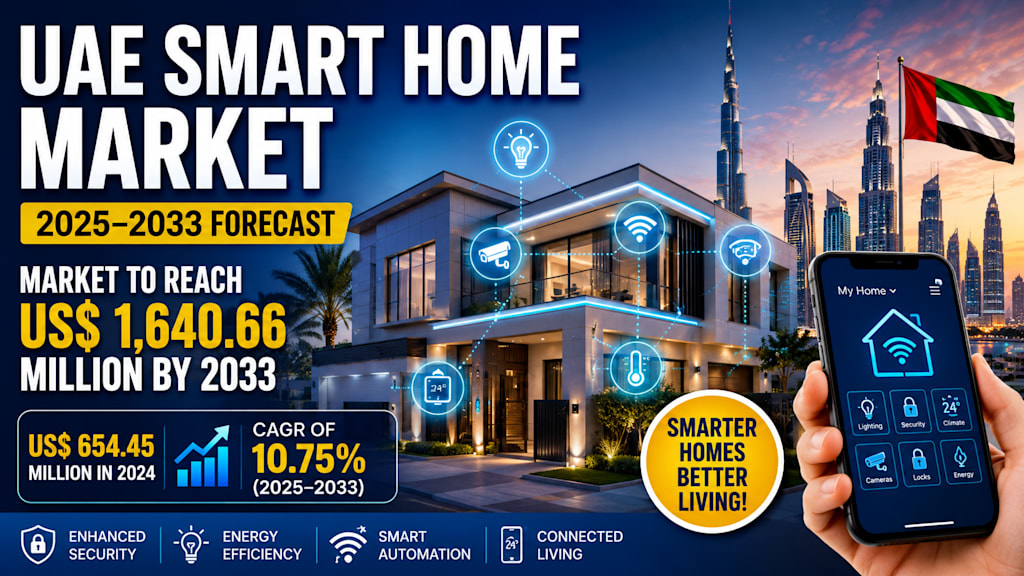
United Arab Emirates Smart Home Market Set for Strong Growth Through 2033
The United Arab Emirates is rapidly establishing itself as one of the world's most technologically advanced nations. From smart cities and AI-powered government services to autonomous transportation projects, innovation remains at the center of the country's development strategy. Among the sectors benefiting most from this digital transformation is the smart home industry.
According to Renub Research, the United Arab Emirates Smart Home Market is projected to grow from US$ 654.45 million in 2024 to US$ 1,640.66 million by 2033, expanding at a CAGR of 10.75% during 2025–2033. This impressive growth reflects increasing consumer demand for convenience, security, energy efficiency, and connected living experiences.
As technology becomes more integrated into everyday life, smart homes are no longer viewed as luxury additions. Instead, they are becoming essential components of modern living across the UAE.
The Rise of Smart Living in the UAE
The UAE has consistently ranked among the world's leading countries in digital adoption. A young, tech-savvy population combined with strong government support has created ideal conditions for smart home technology to flourish.
Modern UAE households are increasingly embracing connected devices that allow homeowners to control lighting, security systems, entertainment devices, and household appliances through smartphones, tablets, or voice assistants. These technologies provide greater convenience while helping users optimize energy consumption and improve home security.
The country's robust digital infrastructure is a major contributor to market growth. Internet penetration has reached nearly universal levels, and smartphone ownership continues to be among the highest globally. This connectivity foundation enables consumers to seamlessly manage smart home ecosystems from virtually anywhere.
As residents become more familiar with connected technologies, adoption rates are expected to rise across both existing homes and new residential developments.
Smart City Initiatives Driving Market Expansion
One of the most important growth drivers for the UAE smart home market is the government's commitment to smart city development.
Projects such as Dubai Smart City and sustainable urban developments like Masdar City demonstrate the country's vision of integrating advanced technology into everyday urban life. These initiatives encourage the deployment of connected infrastructure and promote the adoption of smart home solutions among residents.
Government-led programs have also increased awareness about the benefits of smart living. Competitions, innovation initiatives, and digital transformation campaigns encourage citizens and businesses to explore advanced technologies that improve quality of life.
By creating an environment where technology adoption is actively encouraged, the UAE government continues to play a pivotal role in expanding the smart home ecosystem.
5G Technology Unlocking New Possibilities
The rollout of 5G networks across the UAE represents another major catalyst for market growth.
Smart homes depend on reliable, high-speed communication between devices. The low latency and enhanced connectivity offered by 5G networks enable smoother operation of connected systems, including security cameras, smart thermostats, lighting controls, and entertainment devices.
Consumers increasingly expect real-time responsiveness from their smart devices. Whether adjusting home temperatures remotely, receiving instant security alerts, or controlling appliances through mobile applications, 5G technology enhances the overall user experience.
The UAE's leadership in 5G deployment places it in a strong position to support the next generation of smart home innovations, including artificial intelligence-driven automation and advanced Internet of Things (IoT) ecosystems.
Energy Efficiency Becoming a Key Priority
Sustainability has emerged as a major focus area for both consumers and policymakers across the UAE.
As awareness of environmental issues grows, homeowners are increasingly seeking solutions that reduce energy consumption and lower utility costs. Smart home technologies offer a practical way to achieve these goals.
Energy-efficient lighting systems, smart thermostats, intelligent climate controls, and automated power management solutions help optimize electricity usage without sacrificing comfort. These technologies are particularly valuable in a region where cooling requirements can contribute significantly to household energy consumption.
In addition to reducing costs, smart energy management systems align with the UAE's broader sustainability objectives and environmental initiatives. As a result, demand for energy-efficient smart home solutions is expected to remain strong throughout the forecast period.
Security and Safety Fueling Consumer Interest
Security remains one of the most compelling reasons consumers invest in smart home technology.
Modern smart security systems provide homeowners with greater control and visibility over their properties. Features such as real-time video monitoring, motion detection, smart doorbells, automated locks, and remote access controls enhance protection and provide peace of mind.
For families and property owners, the ability to monitor homes remotely through smartphones is particularly attractive. Whether traveling abroad or managing multiple properties, users can stay connected to their homes at all times.
As concerns about safety and property protection continue to grow, demand for advanced security-focused smart home solutions is expected to increase steadily.
Artificial Intelligence Enhancing Home Automation
Artificial intelligence is becoming a defining feature of modern smart homes.
AI-powered assistants and connected devices can learn user preferences and automatically adjust settings to improve comfort and efficiency. From voice-controlled entertainment systems to intelligent appliances that optimize performance based on usage patterns, AI is transforming the way people interact with their homes.
In the UAE, where consumers often embrace emerging technologies quickly, AI-enabled smart home solutions are gaining considerable traction. These systems not only enhance convenience but also provide personalized experiences that improve overall quality of life.
As AI capabilities continue to evolve, future smart homes are expected to become increasingly autonomous, requiring minimal user intervention for routine tasks.
Challenges Facing the UAE Smart Home Market
Despite its strong growth outlook, the market faces several challenges that could influence adoption rates.
Lack of Standardization
One significant issue is the lack of compatibility between devices from different manufacturers.
Consumers often encounter difficulties when attempting to integrate products from multiple brands into a single ecosystem. Incompatible platforms can create frustration and increase installation complexity.
The development of universal standards and improved interoperability will be crucial for creating seamless smart home experiences.
Privacy and Cybersecurity Concerns
As smart devices collect and process increasing amounts of personal data, privacy concerns have become more prominent.
Consumers remain cautious about potential cyber threats, data breaches, and unauthorized access to connected systems. Devices such as cameras, voice assistants, and smart sensors may handle sensitive information that requires robust protection.
Manufacturers are responding with stronger encryption protocols and enhanced cybersecurity measures, but maintaining consumer trust will remain a critical priority.
Regional Outlook Across the UAE
East UAE
Eastern regions are witnessing growing adoption of smart home technologies as residents seek enhanced convenience and security. Government initiatives, increasing technology awareness, and expanding digital infrastructure continue to support growth. However, challenges such as high initial costs and privacy concerns remain important considerations.
West UAE
Western UAE has become a showcase for luxury smart living. Homes increasingly feature integrated automation systems controlling lighting, entertainment, climate, and security. Energy-efficient technologies such as smart irrigation systems, solar energy solutions, and AI-powered appliances are also becoming more common.
The combination of innovation, sustainability, and luxury continues to define smart home adoption across the region.
Market Segmentation Highlights
The UAE Smart Home Market covers several major product and application categories:
By Component
Hardware
Smart Appliances
AI Speakers
Services
By Application
Comfort and Lighting
Control and Connectivity
Energy Management
Home Entertainment
Security
Smart Appliances
Among these categories, security systems, smart appliances, and energy management solutions are expected to remain key revenue generators due to their practical benefits and growing consumer acceptance.
10 Recent Developments from Major Industry Participants
Johnson Controls expanded its smart building and home automation portfolio through AI-enabled energy optimization solutions.
Schneider Electric strengthened its EcoStruxure ecosystem with enhanced residential energy management capabilities.
Emerson Electric introduced new connected monitoring technologies designed to improve efficiency and predictive maintenance.
LG Electronics expanded its ThinQ smart home platform, integrating more AI-powered appliances and connected services.
Legrand SA launched advanced smart lighting and home automation solutions focused on energy efficiency.
Siemens AG increased investment in intelligent building technologies supporting connected residential environments.
Honeywell enhanced its smart security and climate control offerings with cloud-connected features.
Apple continued expanding HomeKit compatibility across a broader range of third-party smart home devices.
Leading industry participants increased collaboration with IoT platform providers to improve interoperability and device integration.
Multiple smart home manufacturers accelerated AI integration efforts to deliver personalized automation experiences and predictive home management.
Competitive Landscape
The UAE smart home market remains highly competitive, with global technology leaders actively investing in innovation and market expansion.
Key companies operating in the market include:
Johnson Controls
Schneider Electric
Emerson Electric
LG Electronics
Legrand SA
Siemens AG
Honeywell
Apple
These organizations continue to invest heavily in research, development, artificial intelligence, cloud computing, and IoT technologies to strengthen their competitive positions and capture emerging opportunities within the UAE smart home sector.
Final Thoughts
The UAE smart home market is entering a period of remarkable expansion. Driven by government-backed smart city initiatives, advanced digital infrastructure, growing environmental awareness, and rising consumer expectations, smart home technology is becoming a mainstream component of modern living.
With market value projected to climb from US$ 654.45 million in 2024 to US$ 1,640.66 million by 2033, the sector presents substantial opportunities for technology providers, investors, developers, and service providers.
As artificial intelligence, IoT connectivity, and 5G networks continue to evolve, UAE households will increasingly embrace intelligent, connected, and sustainable living environments. The country's commitment to innovation ensures that smart homes will play a central role in shaping the future of residential life throughout the coming decade.
About the Creator
Enjoyed the story? Support the Creator.
Subscribe for free to receive all their stories in your feed.
Comments
There are no comments for this story
Be the first to respond and start the conversation.