
United Arab Emirates Foodservice Market Rises on Tourism, Delivery, and Premium Dining Demand
The UAE foodservice market is projected to grow from US$ 20.54 billion in 2025 to US$ 68.07 billion by 2034, supported by tourism, expatriate-led consumption, cloud kitchens, and a fast-evolving dining culture.

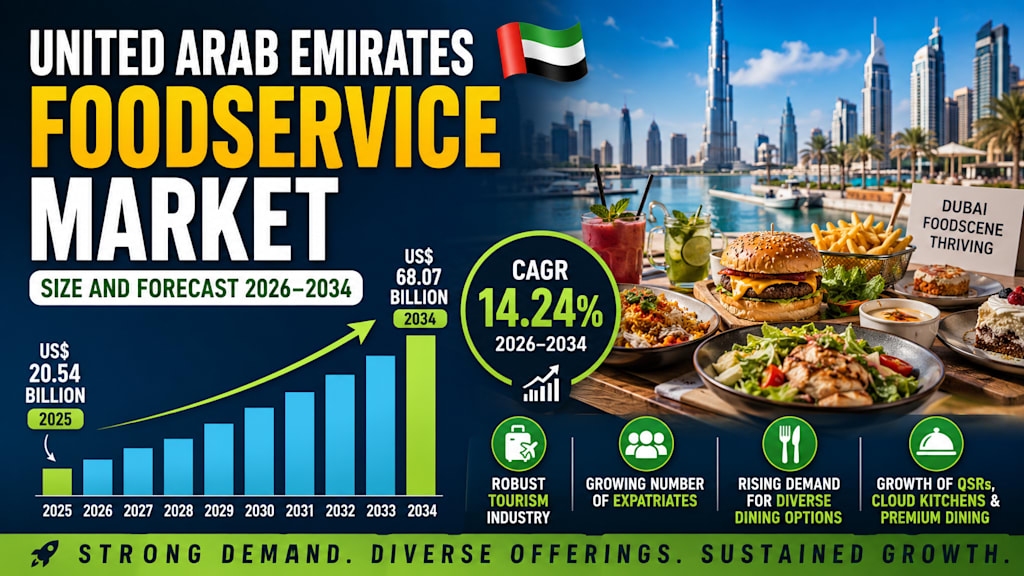
United Arab Emirates Foodservice Market Overview
The United Arab Emirates foodservice market is entering a powerful growth phase, and the story is bigger than just restaurant openings. It is about a country where tourism, urban living, international residents, luxury hospitality, and digital convenience all meet in one place. In the market outlook shared in your source, the sector is expected to climb steadily from 2025 to 2034 at a strong CAGR of 14.24%, showing how deeply foodservice is woven into the UAE’s consumer economy. The category covers restaurants, cafes, hotels, caterers, QSRs, cloud kitchens, and institutional dining, making it one of the most diversified parts of the hospitality landscape.
The UAE foodservice industry has matured rapidly because the country brings together a high-spending local market, a global expatriate base, and a strong hospitality ecosystem. Dubai and Abu Dhabi stand out as international dining destinations, while the rise of delivery apps and fast casual formats has pushed the market into a new phase of convenience-led growth. Hotels, luxury venues, multinational brands, and independent operators all play a role in shaping demand.
Strong Tourism Demand
Tourism remains one of the strongest engines behind this market. Abu Dhabi welcomed 26.6 million tourists in 2025, and that kind of visitor flow creates year-round demand for meals, beverages, delivery, and premium dining experiences. The UAE also continues to stand out as a destination for conferences, luxury hospitality, global dining concepts, and large-scale events. That matters because tourists do not just fill hotel rooms; they fill restaurants, cafes, lounges, food courts, and delivery apps. When a market has constant international movement and event-driven traffic, foodservice becomes a daily consumption category rather than an occasional one.
The tourism effect is especially visible in cities such as Dubai and Abu Dhabi, where dining is part of the visitor experience. Travelers increasingly expect multicultural menus, premium café concepts, social dining spaces, and quick delivery options. This has encouraged operators to expand across multiple formats rather than rely on one channel alone. Hotels and resorts remain major contributors because their guests generate continuous demand for breakfast, room service, fine dining, banquets, and casual dining.
Rising Expatriate Population and Urban Consumption
Another major driver is the UAE’s urban and expatriate-heavy population structure. In early 2025, 88.1% of the UAE population lived in urban areas, while only 11.9% lived in rural regions. The country is also home to a very large expatriate base, and the source notes that the expatriate population in 2026 is expected to reach 10.24 million, compared with 1.33 million UAE nationals. That mix shapes food preferences in a very direct way. It creates demand for Indian, Arab, Italian, Chinese, American, and fusion cuisines, while also pushing consumers toward quick-service restaurants, casual dining, cafes, and delivery platforms that match their fast-paced routines.
The expatriate influence is not only about variety. It is also about frequency. Many residents live in dense urban environments, work long hours, and depend on convenience-led food choices. That has strengthened demand for both affordable and premium foodservice, depending on the occasion. The result is a market where people may order a quick lunch on weekdays, dine at a branded restaurant in a mall on weekends, and choose premium or themed dining for social gatherings.
Digital Ordering and Cloud Kitchen Expansion
Digital ordering is now one of the defining forces in UAE foodservice. The market has shifted from traditional dine-in dependence to a more flexible model built around apps, aggregators, delivery logistics, and cloud kitchens. Your source highlights that cloud kitchens are growing because they cut operating costs and allow faster expansion across multiple locations. It also points to a Talabat initiative offering 100 cloud kitchens free of rent until September 2026, which is designed to support local restaurant brands and reduce overhead pressure. That is a strong signal of where the industry is heading: lower-friction expansion, stronger delivery economics, and more digitally enabled restaurant brands.
This shift is changing how restaurants think about growth. Instead of relying only on expensive dine-in real estate, many brands now build around hybrid models that combine takeaway, delivery, and selective dine-in presence. This approach helps operators manage rent and staffing costs while still reaching consumers across the UAE’s major urban zones. As digital ordering habits continue to strengthen, cloud kitchens will remain one of the most important growth engines in the market.
Market Challenges
At the same time, the UAE market is not easy money. High rent, salaries, raw material costs, and licensing expenses make the business demanding, especially for smaller operators. Competition is intense because international chains, regional brands, and independent restaurants all compete for the same urban consumer. On top of that, foodservice operators must comply with strict food safety, sanitation, and licensing rules, while also managing a workforce that depends heavily on expatriate labor. In other words, the market rewards efficiency and innovation, not just presence. Brands that win here are usually those that balance quality, speed, compliance, and a clear value proposition.
The workforce issue is especially important because foodservice depends heavily on chefs, kitchen teams, service staff, delivery personnel, and support workers. High turnover and visa-related complexity can affect consistency and service quality. Meanwhile, regulatory standards are high, which protects consumer trust but adds operational pressure. The winners are typically companies that invest in staff training, brand systems, and supply chain control.
Segment Growth Opportunities
The strongest segment opportunities are spread across several formats. Cafes and bars benefit from the UAE’s social culture and premium café experience, especially in Dubai and Abu Dhabi. Burger outlets continue to grow because they fit the QSR model: convenient, affordable, and easy to deliver. Pizza remains another major winner because it travels well, suits group dining, and has become one of the most commonly ordered foods in the country. Chained outlets are also thriving because consumers trust their hygiene, consistency, loyalty systems, and mall-and-airport presence. Even foodservice retail is becoming more important as supermarkets and convenience stores expand ready-to-eat and ready-to-go offerings.
In practical terms, the market is rewarding formats that fit modern lifestyles. Consumers want speed during the workweek, variety on weekends, and quality when they go out. That is why pizza, burgers, coffee shops, casual chains, and cloud kitchens are all expanding at the same time. The UAE is not moving toward one dominant model; it is moving toward a multi-format ecosystem.
Regional Market Outlook
Geography matters too. Dubai is the most developed market because it combines tourism, international business traffic, large events, and a highly diversified foreign population. Sharjah is more family-oriented and value-driven, with strong demand for casual dining, cafes, QSR, and affordable outlets. Abu Dhabi is supported by government activity, higher disposable incomes, museums, cultural attractions, and luxury hospitality. Fujairah is smaller, but tourism and resort activity give it room to grow, especially for casual dining and hotel-linked foodservice. This regional spread shows that the UAE is not one single foodservice market; it is a cluster of different demand patterns, each with its own pricing and format logic.
Dubai remains the pace-setter because it blends premium tourism, business travel, mall culture, and international cuisine trends. Sharjah offers more value-conscious dining and family-friendly formats. Abu Dhabi benefits from institutional demand, events, and high-end hospitality. Fujairah, though smaller, has an advantage in resort-linked dining and less crowded competition. Together, these emirates create a layered market with room for different business models.
Competitive Landscape
The key players list also shows how broad the competitive field is. The market includes names such as Al Khaja Group Of Companies, Alamar Foods Company, Alghanim Industries & Yusuf A. Alghanim & Sons WLL, Americana Restaurants International PLCs, Apparel Group, BinHendi Enterprises, CKE Restaurants Holdings Inc., D.ream International, Emirates Fast Food Company, and JF Street Food. That mix tells a clear story: the market is not limited to one type of operator. It spans global franchise specialists, regional groups, premium hospitality players, and multi-brand restaurant platforms. In a market like the UAE, that diversity is a strength because consumers themselves are diverse, mobile, and highly exposed to global dining trends.
These players also reflect the broader direction of the market: franchising, premium casual dining, digital ordering, and brand diversification. Large operators are expanding through partnerships, acquisitions, and new concepts, while smaller brands are trying to differentiate through cuisine, speed, or delivery convenience. The competitive environment is intense, but it is also full of opportunity for businesses that understand the local rhythm of consumption.
Final Thoughts
From an investor or operator perspective, the outlook remains attractive because the demand drivers are structural rather than temporary. Tourism is not a one-season story. Urbanization is not reversing. Expatriate demand remains high. Delivery habits are already embedded. And premium dining continues to benefit from the UAE’s hospitality image. The real winners will be businesses that can combine strong branding with operational discipline, adapt to delivery-first habits, and keep menus flexible enough for multicultural tastes. In short, the UAE foodservice market is not just growing; it is maturing into a more digital, segmented, and experience-led industry.
The long-term opportunity is clear: brands that can serve both convenience and experience will have the strongest position. In a market shaped by global visitors, expatriates, and rising digital expectations, foodservice has become a strategic part of the UAE’s consumer story.
Recent Developments by Companies
Americana Restaurants reported Q1 2026 financial results, highlighting robust double-digit growth across revenue, EBITDA, and net profit, which signals continued scale in the regional foodservice market.
Americana Restaurants added Malak Al Tawouk to its brand portfolio in February 2026, securing a 75-year exclusive license to expand the Arabic QSR brand across MENA.
Americana Restaurants said its FY 2025 revenue reached $2.51 billion, underscoring the size and resilience of its restaurant platform in a competitive market.
Americana Restaurants expanded into premium retail in July 2025 through an exclusive franchise agreement with carpo World Ltd., showing a move toward higher-value food and beverage concepts.
Americana Restaurants also expanded its footprint in Oman in January 2025 by acquiring Pizza Hut Oman, reinforcing the group’s franchise-led growth model.
Alamar Foods introduced self-ordering kiosk pilots in the UAE and an AI-driven WhatsApp chatbot, showing how digital ordering is becoming central to restaurant operations.
Alamar Foods launched a strong carry-out promotion in the UAE as part of its omnichannel strategy, reflecting how brands are using convenience-led offers to protect demand.
Alamar Foods grew its store base to 719 restaurants by June 2025, which highlights continued outlet expansion even in a demanding operating environment.
Apparel Group announced a strategic partnership with Bisleri International in May 2025, with the UAE as the launch market and broader MEA expansion planned.
Apparel Group launched the first GCC Sur La Table store in Dubai in July 2025, adding an experience-led culinary retail concept to the market. D.ream International also signed a partnership to open a restaurant in Dubai in 2025, showing continued premium dining momentum.
About the Creator
Enjoyed the story? Support the Creator.
Subscribe for free to receive all their stories in your feed.
Comments
There are no comments for this story
Be the first to respond and start the conversation.