
Understanding Modern Digital Printing Technologies
How DTG, DTF, and UV printing differ and where each technology fits into modern printing workflows

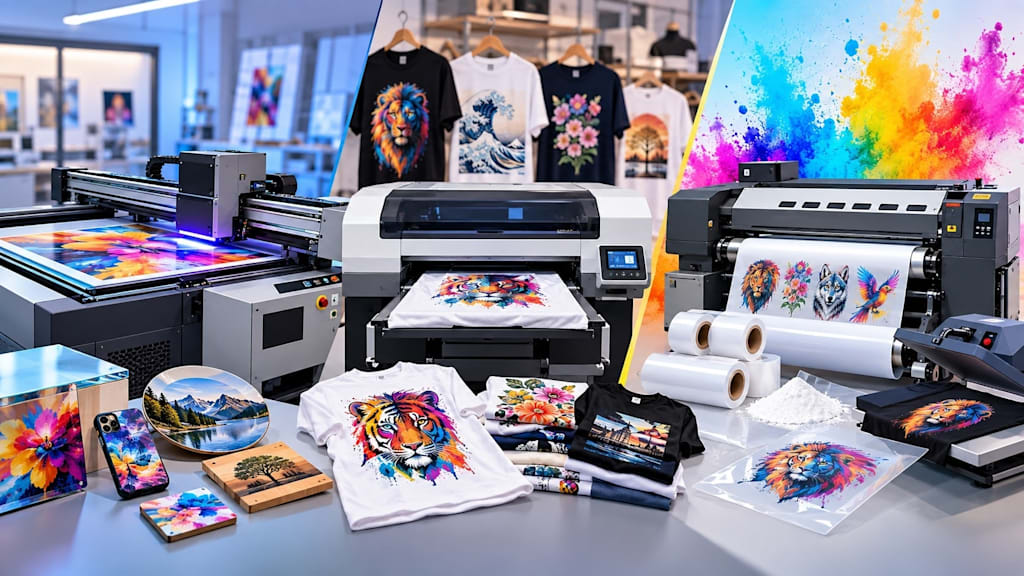
Digital printing has changed the way customized products are produced. From personalized clothing to signs and promotional materials, modern printing systems allow designs to be transferred from digital files to physical products with relatively little preparation. Among the technologies used today, direct-to-garment (DTG), direct-to-film (DTF), and ultraviolet (UV) printing have become important parts of the digital printing landscape.
Although these technologies can sometimes be discussed together, they are designed for different applications. Understanding how they work, what materials they support, and where they fit into a production workflow can help users make more informed decisions.
Understanding UV Printing
UV printing is a digital printing process in which ultraviolet light is used to cure ink shortly after it is deposited onto a surface. Unlike conventional textile printing, UV printing is commonly associated with rigid or specialty materials.
Depending on the printer and ink system, UV technology can be used for materials such as acrylic, plastic, glass, wood, metal, boards, and other compatible surfaces. The ability to print on different substrates has made UV printing relevant to signage, decoration, packaging prototypes, personalized products, and other applications.
A UV Printer Factory may produce different types of equipment designed for specific material sizes and applications. However, the term itself does not describe a single machine configuration. Printers can vary considerably in their print areas, ink systems, curing mechanisms, and supported materials.
For users considering UV printing, substrate compatibility is one of the most important factors to examine. A material that appears suitable may require a particular ink formulation, surface preparation, or primer to achieve satisfactory adhesion.
What Is Direct-to-Garment Printing?
Direct-to-garment printing, commonly called DTG printing, is designed primarily for printing artwork directly onto textiles. Instead of using a separate transfer medium, the printer applies specialized textile ink directly to the garment.
The basic concept is similar to inkjet printing, but the equipment and ink are specifically adapted for fabric. Garments are normally positioned on a platen before the printhead moves across the printing area and deposits the artwork.
Pretreatment can also form an important part of the process, particularly when white ink is being used. The garment may need to be prepared before printing so that the ink interacts appropriately with the fabric.
The direct-to-garment process is particularly useful for detailed designs, photographs, gradients, and artwork containing multiple colors. Because the design originates as a digital file, changing from one design to another generally does not require creating a new physical screen.
Choosing a DTG Printer
A DTG Printer can range from relatively compact equipment intended for limited production to larger systems designed for more demanding workloads.
When evaluating a printer, users should consider more than print resolution. Factors such as maximum print area, printing speed, supported fabrics, ink consumption, maintenance requirements, and software compatibility can have a significant effect on the overall workflow.
A small workshop may have different requirements from a commercial garment-printing operation. Similarly, someone producing personalized shirts individually may prioritize flexibility, while a larger production environment may place greater importance on throughput and consistency.
Custom T-Shirt Printing
A Custom T-shirt Printing Machine can use several different printing technologies. DTG is one option, while DTF, screen printing, heat-transfer vinyl, and sublimation are other possibilities.
The choice depends partly on the type of artwork and fabric involved. DTG is often associated with detailed full-color designs printed directly onto garments. Screen printing can be practical for larger quantities of designs with relatively limited colors. DTF uses a different workflow in which artwork is printed onto a transfer film before being applied to fabric.
This distinction is important because the term "custom T-shirt printing" describes an application rather than a single printing technology.
DTG Printing for Small Businesses
For a DTG printer for small business, workflow efficiency can be particularly important. Small businesses may produce a wide range of designs but only a limited number of each design.
Digital printing can support this type of production because artwork can be changed through software without preparing a new physical screen. This can be useful for personalized clothing, small clothing collections, event shirts, artwork merchandise, and made-to-order products.
However, operating costs should also be considered. Ink, pretreatment materials, cleaning supplies, replacement parts, electricity, maintenance, and rejected garments can all contribute to the actual cost of production.
The purchase price of a printer therefore provides only part of the picture.
Industrial DTG Printing
Production requirements change considerably when a business moves from occasional printing to higher-volume manufacturing. An Industrial DTG printer is generally designed around the demands of larger-scale production.
Industrial systems may provide larger print areas, faster operation, multiple printheads, automated features, or other characteristics intended to improve production efficiency. The exact capabilities vary between machines and manufacturers.
Higher production capacity also introduces additional considerations. Equipment may require more workspace, specialized maintenance procedures, appropriate ventilation, pretreatment systems, and trained operators.
The most appropriate system therefore depends on the volume and type of garments being produced rather than simply choosing the largest available machine.
How DTF Printing Differs
Direct-to-film printing, or DTF, follows a different process from DTG. In DTF printing, artwork is first printed onto a specialized film. Adhesive powder is then applied before the design is transferred onto a garment using heat.
This workflow allows the transfer to be prepared separately from the garment. In some production environments, this can provide flexibility when dealing with different fabrics or when transfers need to be prepared in advance.
A DTF Printer Factory may therefore focus on equipment built around this transfer-based workflow rather than direct garment printing.
DTG and DTF should not necessarily be viewed as competing technologies. Their advantages depend on the application, materials, order quantities, and desired production process.
DTG Versus DTF
One of the clearest differences is where the artwork is initially printed.
With DTG, the design is printed directly onto the garment. With DTF, the design is printed onto film and subsequently transferred to the garment.
DTG can be particularly suitable for detailed designs on compatible textiles, while DTF can provide flexibility across a wider variety of garment materials. DTF also separates the printing stage from the garment application stage, which can be useful in certain production workflows.
Neither approach is appropriate for every situation. Fabric composition, garment color, design complexity, production volume, and equipment availability all influence the choice.
The Role of Digital Printing Today
The development of digital printing has made short-run and customized production more practical. Businesses no longer have to rely exclusively on processes designed around large quantities or lengthy physical preparation.
At the same time, digital printing does not eliminate production challenges. Operators still need to understand ink behavior, material compatibility, color management, equipment maintenance, and finishing requirements.
For garment printing in particular, the quality of the final result depends on several stages rather than the printer alone. Fabric selection, pretreatment, artwork preparation, printing, curing, and washing can all influence durability and appearance.
Making Sense of Different Printing Technologies
DTG, DTF, and UV printing serve different purposes within the broader digital printing industry.
DTG focuses primarily on direct textile printing. DTF uses a film-based transfer process that can be adapted to different garments and workflows. UV printing uses ultraviolet curing and is commonly applied to rigid and specialty substrates.
Understanding these distinctions is more useful than treating one technology as universally suitable. The right approach depends on the products being produced, materials involved, expected production volume, design requirements, available workspace, and operating process.
As digital printing continues to evolve, these technologies are likely to remain important tools for customized and short-run production. For businesses and individuals entering the field, understanding the underlying processes can provide a clearer foundation for selecting equipment and developing an efficient printing workflow.
About the Creator
Enjoyed the story? Support the Creator.
Subscribe for free to receive all their stories in your feed.
Comments
There are no comments for this story
Be the first to respond and start the conversation.