
"Trump Eases Trade War Talk: Signals Shift from Tariffs to Diplomacy with China"
Former President signals a strategic pivot, emphasizing diplomacy over economic confrontation in ongoing U.S.-China trade tensions
By kushal karPublished about a year ago • 3 min read
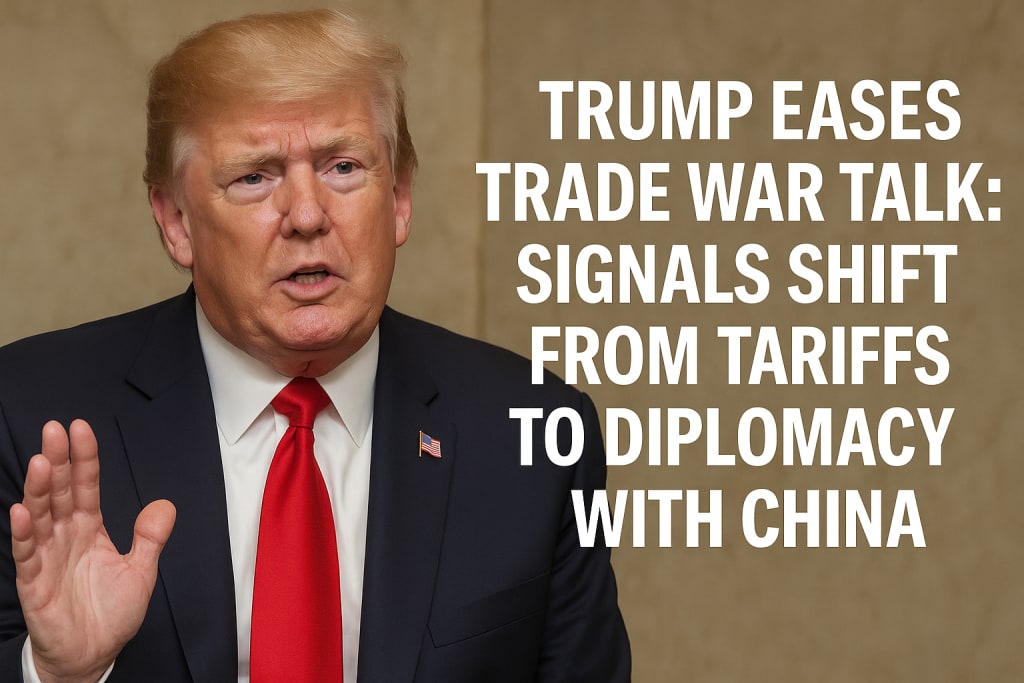
- Trump Softens Tariff Rhetoric: A Strategic Shift Toward Diplomacy with China In a move that marks a significant shift from his previous hardline approach, former U.S. President Donald Trump has signaled a reluctance to further increase trade tariffs on Chinese imports. Speaking during a recent media appearance, Trump stated he would "rather not" impose additional tariffs, describing them as a “tremendous power” but also acknowledging the economic fallout that such actions can cause. His comments hint at a strategic pivot toward diplomacy, even as the United States continues to grapple with complex trade relations with China. For years, Trump built his political and economic brand on “America First” policies, with tariffs being a cornerstone of his approach to confronting what he deemed “unfair” trade practices by China. During his presidency, tariffs were raised on hundreds of billions of dollars in Chinese goods, prompting retaliatory actions from Beijing. The result was a bruising trade war that rattled global markets and strained international supply chains. Trump’s change in tone is notable. He still emphasizes that tariffs remain an option and a source of leverage, but his hesitation to raise them further may be influenced by new global and domestic economic realities. “We have a big stick when it comes to China, and they know it,” Trump said. “But I’d rather get a fair deal than keep using that stick.” His comments come at a time when the U.S. economy is dealing with persistent inflation concerns, a recovering post-pandemic workforce, and growing anxiety about international instability. According to economic analysts, escalating trade tensions further could hurt American consumers through higher prices, especially in sectors heavily reliant on Chinese imports like electronics, apparel, and machinery. The International Monetary Fund (IMF) recently warned that expanding U.S. tariffs could slow global economic growth and spark inflationary pressures. While a global recession is not predicted, the IMF emphasized the potential for increased volatility in financial markets and reduced investor confidence, particularly if the world’s two largest economies continue their adversarial posture. From China’s perspective, there has been a noticeable shift toward stabilizing the relationship. Chinese officials have reiterated their opposition to trade wars, calling for dialogue and cooperation. “Trade wars and tariff wars have no winners and don’t serve anyone’s interests,” Chinese Foreign Ministry spokeswoman Mao Ning said. Her comments echoed the Chinese government's broader narrative—that economic engagement with the U.S. is beneficial for both nations and for global stability. Trump’s nuanced approach may also reflect political strategy as he gears up for another potential presidential run. With the American electorate increasingly focused on cost-of-living issues and economic security, Trump may be seeking to distance himself from policies that could be perceived as exacerbating financial strain. Moreover, while tariffs were popular among some segments of the Republican base, they have also faced criticism from farmers, small business owners, and import-heavy industries. At the same time, experts warn that despite Trump’s softened rhetoric, tensions remain high. U.S. lawmakers from both parties continue to scrutinize China’s growing influence in sectors like technology, energy, and defense. Washington is also concerned about China’s control over critical minerals and its investments in artificial intelligence and quantum computing. “Even if Trump is backing off on tariffs, the broader geopolitical competition with China isn’t going anywhere,” said Michael Spencer, a senior policy analyst. “The rhetoric may change, but the rivalry remains.” Still, there are signs of hope. Trump hinted that a new trade agreement could be in the works, possibly within the next few months. “I believe we can get something done—something that benefits both countries and avoids all the chaos,” he said. This optimistic tone stands in contrast to the confrontational posture of years past, raising the possibility of a new chapter in U.S.-China trade relations. As the global economy remains fragile and interconnected, the world is watching closely. Whether Trump’s shift is a genuine embrace of diplomacy or a temporary recalibration remains to be seen. But for now, his reluctance to escalate tariffs signals a moment of pause—and perhaps a pathway to progress.
About the Creator
Enjoyed the story? Support the Creator.
Subscribe for free to receive all their stories in your feed.
Comments
There are no comments for this story
Be the first to respond and start the conversation.