
Transportation Battery Market: Electrification, Fast Charging, and New Chemistries Are Redefining Mobility
The global transportation battery market is gaining strong momentum as automakers, battery makers, and governments push harder toward cleaner mobility, higher energy density, and faster charging. The market is projected to rise from US$ 110.04 billion in 2025 to US$ 340.16 billion by 2034, expanding at a CAGR of 13.36% from 2026 to 2034.

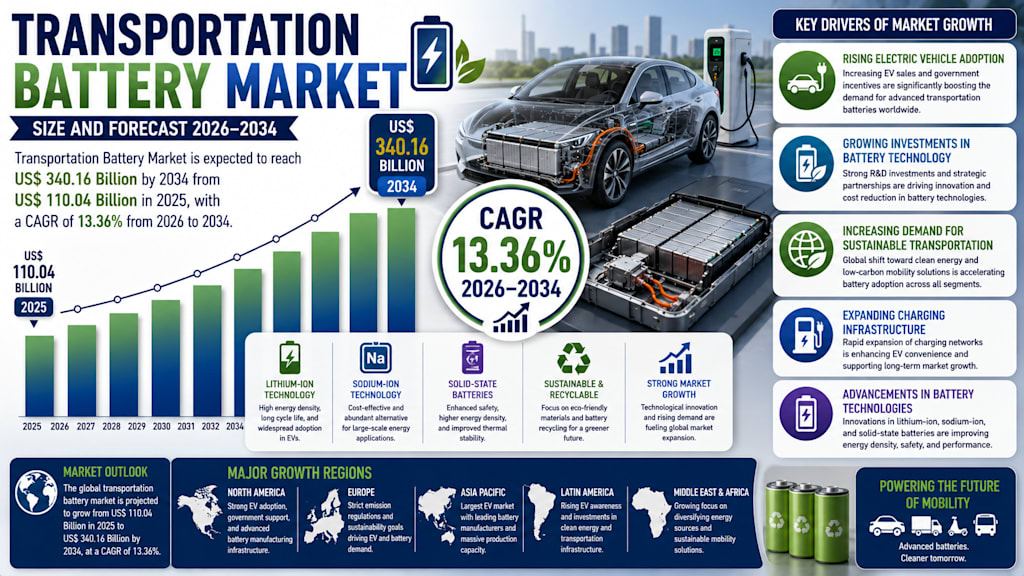
Market Overview
Transportation batteries have moved from being a supporting component to becoming one of the most important pillars of modern mobility. These rechargeable energy storage systems power electric vehicles, hybrid vehicles, buses, trucks, rail systems, and other transport applications. Their role is simple but transformative: they store electricity and deliver it efficiently to electric motors, reducing dependence on fossil fuels and helping lower carbon emissions. Lithium-ion batteries continue to dominate because they deliver strong energy density, long cycle life, and fast-charging capability, while sodium-ion and solid-state batteries are gaining attention for their safety, sustainability, and long-term performance potential.
The market’s growth story is being shaped by a mix of policy pressure, consumer demand, and technology innovation. Cleaner transport targets, stricter emissions rules, and rising EV adoption are forcing automakers to accelerate electrification programs. At the same time, investment in charging networks, battery recycling, and higher-energy-density battery systems is helping the market move beyond early adoption into a more mature growth phase. In practical terms, the transportation battery industry is no longer just about making batteries bigger; it is about making them smarter, safer, faster to charge, and more cost-efficient over the full vehicle life cycle.
Why the Market Is Growing
One of the biggest growth engines is innovation in battery chemistry. Manufacturers are now competing to build batteries with higher energy density, faster charging, better thermal stability, and reduced material dependence. That is why technologies such as sodium-ion, silicon-anode lithium-ion, and solid-state batteries are receiving so much attention. These chemistries are not just incremental upgrades; they are designed to solve the core anxieties that still slow EV adoption, especially charging time, range limitations, and battery safety. CATL’s April 2025 unveiling of the Naxtra sodium-ion battery and the second-generation Shenxing superfast-charging battery is a strong example of how the market is moving toward longer range, faster charging, and lower dependence on lithium resources.
Another major driver is the rise of electric commercial vehicles. Fleet operators, logistics companies, bus networks, and delivery platforms are under pressure to reduce operating costs and emissions at the same time. That makes batteries with higher durability, better heat management, and longer daily operating capability increasingly valuable. In this segment, battery technology is becoming a business decision as much as a sustainability decision. Companies are not just buying batteries; they are buying uptime, route reliability, and lower fuel exposure. The growing electrification of public transit and logistics fleets is therefore widening the addressable market for transportation battery makers.
A third growth factor is the push for fast-charging and long-range vehicles. As consumer expectations rise, battery makers are being pushed to deliver charging times that feel closer to refueling than waiting. This is especially important in passenger EVs, heavy-duty trucks, and next-generation mobility platforms. Amprius’s April 2025 launch of its SiCore 450 Wh/kg high-energy cell shows how the industry is responding with lightweight, high-performance batteries designed for electric mobility applications that need both range and efficiency.
Challenges That Still Shape the Industry
Despite the strong outlook, the transportation battery market still faces serious structural challenges. Raw material volatility remains one of the most visible risks. Lithium, cobalt, nickel, and graphite prices can fluctuate sharply, and supply chains remain exposed to geopolitical tension, mining constraints, and environmental scrutiny. These pressures affect battery manufacturing costs, vehicle pricing, and profit margins. The industry is responding with recycling, material substitution, and chemistry redesign, but those solutions take time to scale commercially.
Charging infrastructure is another limiting factor. In many markets, the EV adoption curve is still constrained by insufficient fast-charging access, especially in rural and developing regions. Even when vehicle demand is there, charging confidence may not be. In parallel, battery recycling remains underdeveloped in many countries, creating a future sustainability and waste-management challenge as the first large wave of EV batteries reaches end-of-life. The market’s next stage of growth will depend not only on better batteries, but also on better systems around them.
Regional Market Highlights
The United States continues to expand its transportation battery footprint through EV adoption, incentives, and domestic manufacturing investment. The country is seeing stronger demand for high-performance batteries across passenger EVs, buses, and commercial fleets, while commercial-scale manufacturing continues to improve supply security. The file also notes Forge Battery’s July 2024 shipment of its 300 Wh/kg lithium-ion cells, showing how the U.S. market is moving toward higher-energy battery commercialization.
Germany remains one of Europe’s most important transportation battery markets because of its automotive base and strong electrification push. German automakers are investing heavily in new battery platforms, high-power charging, and next-generation vehicle architectures. BMW’s February 2025 800-volt Neue Klasse direction reflects that push toward faster charging and longer driving range. The move also highlights how battery strategy has become central to premium vehicle positioning in Europe.
China is still the world’s largest transportation battery market, supported by massive EV production, large-scale battery manufacturing, and aggressive chemistry innovation. Chinese players continue to lead in lithium-ion, sodium-ion, and next-generation battery development, and the country’s supply chain strength gives it a major advantage in both domestic demand and export capacity. CATL’s product announcements in 2024 and 2025 underline how quickly China is setting the pace for range, charging, and battery architecture.
Saudi Arabia is emerging as a fast-developing market, supported by sustainability goals and transport electrification under Vision 2030. The country is building charging infrastructure and supporting local EV ecosystem development, and Ceer Motors’ progress on EV assembly and battery-related infrastructure in March 2024 signals that the market is still in an early but promising buildout stage.
Recent Developments from Key Companies
SAMSUNG SDI signed its first EV battery supply deal with Mercedes-Benz in April 2026, strengthening its position in the premium EV supply chain and expanding cooperation in high-performance battery development.
SAMSUNG SDI signed a mid- to long-term LFP cathode material supply deal with L&F in March 2026, reinforcing its effort to secure material supply and diversify battery chemistry support.
SAMSUNG SDI won a KRW 1.5 trillion ESS prismatic battery supply deal in the U.S. in March 2026, showing that transportation battery know-how is increasingly overlapping with stationary energy storage demand.
BMW Group and Solid Power added Samsung SDI to their ASSB development path in October 2025, signaling deeper industry collaboration on all-solid-state battery commercialization.
BMW Group and Solid Power tested all-solid-state battery cells in a BMW i7 in May 2025, a notable step toward higher energy density and improved safety in future EV platforms.
CATL unveiled the Naxtra battery and second-generation Shenxing superfast-charging battery in April 2025, advancing sodium-ion and fast-charging technologies for future EV use.
Amprius launched its SiCore 450 Wh/kg high-energy cell in April 2025, targeting electric mobility platforms that need very high energy density and lightweight performance.
Panasonic Energy announced readiness to commence mass production of 4680 automotive lithium-ion batteries in September 2024, a major signal for the next wave of EV cell architecture.
Samsung SDI and General Motors finalized a battery cell manufacturing partnership in August 2024, with plans for a new facility aimed at strengthening North American battery supply.
CATL unveiled Shenxing PLUS at Auto China 2024, claiming a 1,000-kilometer range and 4C fast charging for LFP technology, which underlines the speed of battery innovation in the EV market.
Company Landscape
The competitive landscape is being shaped by global battery specialists and diversified industrial groups. Companies such as Panasonic Corporation, Exide Industries, VARTA, Hitachi Group Ltd, Robert Bosch GmbH, Samsung SDI, and LG Chem Ltd are all positioned within the broader transportation battery ecosystem, either through direct cell manufacturing, automotive partnerships, or component supply. The market is increasingly rewarding companies that can balance chemistry innovation, large-scale manufacturing, and secure supply chains.
Editorial Takeaway
The transportation battery market is moving into a more strategic phase. The early story was about EV adoption; the current story is about the quality of electrification. That means better batteries, faster charging, longer range, stronger safety standards, and smarter sourcing of raw materials. The market’s projected rise to US$ 340.16 billion by 2034 reflects more than just higher vehicle sales. It reflects a broader transformation in how the world powers mobility.
In the coming years, the winners are likely to be the companies that can combine chemistry breakthroughs with industrial scale, build resilient supply chains, and align with the global shift toward cleaner transport. On that count, the market still has room to run, and the next chapter will likely be defined by solid-state batteries, sodium-ion alternatives, and faster, more affordable charging systems.
Final Thoughts
This draft is structured for quick editorial approval, with the required market size and forecast, a clear news-style tone, and a dedicated company developments section. It is ready to publish with only light copyediting if needed.
About the Creator
Enjoyed the story? Support the Creator.
Subscribe for free to receive all their stories in your feed.
Comments
There are no comments for this story
Be the first to respond and start the conversation.