
Transformers Market Accelerates as Renewable Energy and Grid Modernization Reshape Global Power Infrastructure
Rising electricity demand, expanding renewable energy projects, and smart grid development are driving strong global growth in transformer technologies.

Transformers Are Becoming the Backbone of the Modern Energy Economy
As the global energy landscape evolves, transformers are becoming more critical than ever to the operation of modern power systems. From renewable energy integration and industrial expansion to smart grid development and urban electrification, transformers sit at the center of almost every major electrical infrastructure project worldwide.
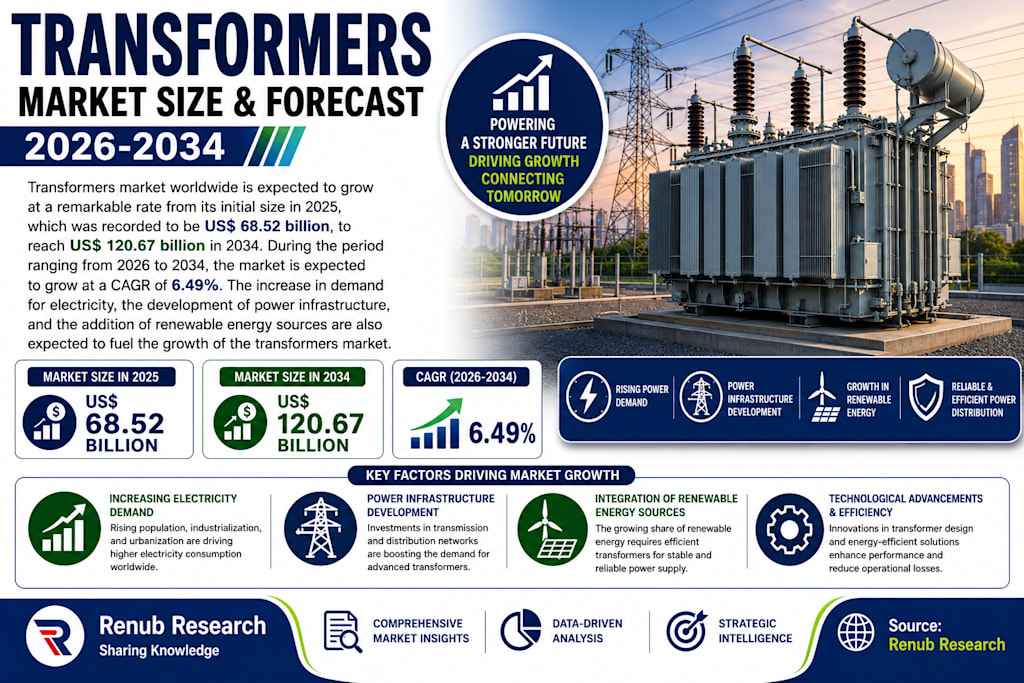
According to Renub Research, the global Transformers Market is expected to grow from US$ 68.52 billion in 2025 to US$ 120.67 billion by 2034, registering a compound annual growth rate (CAGR) of 6.49% from 2026 to 2034. The market’s strong momentum is being fueled by rising electricity demand, modernization of aging power grids, rapid urbanization, and increasing renewable energy adoption across global economies.
Although transformers often operate quietly behind the scenes, they are among the most essential technologies supporting modern civilization. Without them, large-scale electricity transmission and safe power distribution would not be possible.
Why Transformers Are So Important
Transformers are electrical devices designed to transfer energy between circuits while adjusting voltage levels without changing frequency. They work using electromagnetic induction and are critical for the efficient transmission and distribution of electricity.
In practical terms, transformers allow electricity generated at power plants to travel long distances at high voltage with minimal energy loss. They then reduce voltage levels so electricity can be safely used in homes, offices, factories, hospitals, and transportation systems.
Without transformers, modern electrical grids could not function efficiently.
Their importance continues to grow because electricity demand itself is increasing rapidly. Population growth, industrial expansion, urban development, digital infrastructure, and electrification are all creating greater pressure on power systems worldwide.
As economies become more dependent on electricity, transformers are becoming increasingly valuable infrastructure assets.
Rising Electricity Demand Is Driving Market Growth
One of the biggest drivers behind the transformers market is the steady increase in global electricity demand.
Urbanization continues to reshape the global economy, with more than half of the world’s population already living in urban areas. By 2050, nearly 70% of the global population is expected to reside in cities.
Urban expansion creates enormous demand for residential buildings, transportation systems, industrial facilities, commercial centers, and digital infrastructure — all of which depend heavily on reliable electrical networks.
Every new housing project, manufacturing facility, office complex, data center, and public transportation system requires transformers to regulate and distribute electricity efficiently.
Developing countries are especially important growth markets because they continue investing heavily in electrification programs and power infrastructure expansion.
As global energy consumption rises, transformer demand naturally increases alongside it.
Renewable Energy Is Reshaping Transformer Requirements
The global transition toward renewable energy is another major force transforming the transformer industry.
Solar farms, offshore wind projects, and hybrid renewable energy systems require advanced transformers capable of integrating variable energy generation into national grids.
Renewable power generation often occurs in remote locations far from urban demand centers. Efficiently transmitting that electricity over long distances requires specialized transformer technologies that can manage high voltages and fluctuating power flows.
As countries accelerate investments in clean energy infrastructure, transformer demand is expanding significantly.
The renewable energy sector also requires highly efficient transformer systems capable of minimizing transmission losses and supporting grid stability despite intermittent power generation from solar and wind sources.
A major technological milestone came in May 2025 when Hitachi Energy successfully tested the world’s first 765 kV / 400 kV single-phase transformer using natural ester insulation oil at ultra-high voltage levels. This innovation reflects growing industry focus on safer and more environmentally sustainable transformer technologies.
Renewable integration is no longer a niche market segment. It is becoming one of the primary long-term growth engines for transformer manufacturers worldwide.
Smart Grid Modernization Is Creating New Opportunities
Electric grids around the world are undergoing major modernization efforts as governments and utilities attempt to improve reliability, efficiency, and resilience.
Many countries still rely on aging transmission and distribution infrastructure that was not designed for today’s energy demands or decentralized renewable systems.
Modern smart grids require advanced transformers capable of supporting digital monitoring, automation, and intelligent energy management.
Governments and utility companies are investing heavily in upgraded substations, transmission corridors, and smart distribution systems that can handle growing electricity demand while supporting renewable integration.
This modernization trend is creating strong demand for intelligent transformer technologies equipped with sensors, digital communication systems, and real-time monitoring capabilities.
Advanced transformers help utilities improve fault detection, optimize energy flow, reduce downtime, and enhance operational efficiency.
Grid modernization is especially important because power systems are becoming far more complex than they were in previous decades. Electric vehicles, distributed renewable energy generation, industrial automation, and digital infrastructure are placing increasing pressure on existing electrical networks.
Transformers are central to ensuring these modern systems function reliably.
Industrialization Continues to Support Demand
Industrial growth remains another major contributor to transformer market expansion.
Factories, manufacturing plants, refineries, commercial facilities, and industrial automation systems all require stable and efficient power distribution infrastructure.
Three-phase transformers, in particular, are widely used in industrial and commercial environments because they can efficiently handle large electrical loads.
As countries continue expanding industrial production and manufacturing capacity, transformer demand increases correspondingly.
The growth of electric vehicle production, semiconductor manufacturing, data centers, and advanced industrial automation is further strengthening the need for reliable transformer systems capable of supporting energy-intensive operations.
Industrial facilities also increasingly prioritize operational efficiency and energy management, encouraging adoption of modern transformer technologies with improved performance characteristics.
Large Power Transformers Are Becoming More Critical
Large transformers play a particularly important role in modern electrical infrastructure because they support high-capacity transmission systems capable of transporting electricity over long distances.
These transformers are essential for national power grids, utility-scale renewable projects, and high-voltage transmission networks.
The increasing deployment of renewable energy projects is significantly boosting demand for large transformers because renewable electricity must often travel long distances from remote generation sites to urban consumption areas.
Despite their high costs and complex installation requirements, large transformers remain indispensable for modern energy systems.
Many countries are also replacing aging high-voltage infrastructure, creating additional demand for advanced large transformer solutions.
As global electricity consumption rises and renewable deployment expands, the strategic importance of large transformers will continue increasing.
Medium Transformers Remain Essential for Distribution
Medium transformers occupy a critical position within electricity distribution systems.
These transformers step down voltage to levels suitable for residential buildings, commercial establishments, and industrial applications.
Urbanization, industrial growth, and infrastructure development are all contributing to increased demand for medium transformers worldwide.
In developing countries, electrification programs and infrastructure expansion are especially important growth drivers for this segment.
Medium transformers offer a practical balance between capacity and versatility, making them essential across multiple industries and applications.
Air-Cooled Transformers Gain Attention for Safety Benefits
Air-cooled transformers are becoming increasingly popular because of their environmental and safety advantages compared to oil-cooled systems.
Instead of using oil for cooling, these transformers rely on air circulation, reducing the risk of oil leakage and fire hazards.
This makes them particularly attractive for indoor applications such as hospitals, commercial buildings, educational institutions, and environmentally sensitive locations.
Air-cooled systems also generally require lower maintenance compared to oil-cooled alternatives.
Growing environmental awareness and stricter safety regulations are encouraging broader adoption of air-cooled transformer technologies in many markets.
High Costs Continue to Challenge the Industry
Despite strong market growth prospects, the transformer industry still faces several important challenges.
One of the biggest obstacles is the high initial cost associated with transformer manufacturing, installation, and integration.
Large power transformers and smart transformer systems require significant capital investment, which can create difficulties for utilities and infrastructure developers operating under budget constraints.
Maintenance costs also remain a concern, particularly for aging infrastructure systems that require regular inspection and servicing.
In developing countries, financial limitations can delay modernization projects even when electricity demand continues increasing.
Advanced technologies, digital monitoring systems, and environmentally friendly materials often increase upfront costs further.
While these investments typically provide long-term operational benefits, initial affordability remains a challenge in many regions.
Supply Chain Problems and Raw Material Costs Create Pressure
Transformer manufacturing depends heavily on raw materials such as copper, steel, aluminum, and insulating components.
Fluctuating prices for these materials create uncertainty for manufacturers and infrastructure developers.
Supply chain disruptions have also become a significant challenge in recent years. Delays in material sourcing, transportation bottlenecks, and geopolitical instability can slow transformer production and infrastructure deployment.
Because transformers are large, complex, and highly specialized products, supply chain interruptions can significantly impact project timelines.
Manufacturers are increasingly trying to diversify supplier networks and improve production resilience, but material volatility remains an ongoing industry concern.
Regional Markets Show Strong Growth Potential
Different regions are contributing to transformer market growth in different ways.
The United States market is driven largely by aging grid infrastructure upgrades, renewable energy integration, and increasing electrification of transportation systems.
The United Kingdom is benefiting from strong investment in offshore wind projects and smart grid modernization initiatives aimed at supporting sustainability goals.
India represents one of the fastest-growing transformer markets due to rapid electrification, infrastructure expansion, industrial growth, and increasing renewable energy development.
Saudi Arabia is investing heavily in power infrastructure, industrial diversification, and renewable energy projects under its Vision 2030 strategy, creating significant transformer demand.
Across all regions, electricity infrastructure modernization remains a central theme shaping long-term market growth.
Smart Transformers Represent the Future
The future of the transformer industry will likely be defined by intelligence, automation, and sustainability.
Smart transformers equipped with digital sensors, real-time monitoring systems, and predictive maintenance capabilities are expected to become increasingly common.
These advanced systems help utilities improve operational efficiency, reduce outages, optimize power distribution, and monitor equipment health continuously.
Artificial intelligence and IoT integration are also expected to play larger roles in future transformer systems.
At the same time, environmental sustainability will continue driving innovation in transformer insulation materials, cooling technologies, and energy efficiency improvements.
As energy systems become more decentralized and digitally connected, intelligent transformer infrastructure will become increasingly essential.
Final Thoughts
The Transformers Market is expanding rapidly because global power systems are evolving toward cleaner, smarter, and more electrified infrastructure. Rising electricity demand, renewable energy integration, and smart grid development are all strengthening the importance of transformers in the modern economy.
With the market projected to grow from US$ 68.52 billion in 2025 to US$ 120.67 billion by 2034, transformers are expected to remain one of the most important technologies supporting global energy transition and infrastructure modernization.
About the Creator
Enjoyed the story? Support the Creator.
Subscribe for free to receive all their stories in your feed.
Comments
There are no comments for this story
Be the first to respond and start the conversation.