
Tokenized Real-World Assets (RWAs): The Bridge Between TradFi and DeFi
Unlocking global liquidity by transforming physical assets into programmable, digital blockchain tokens.
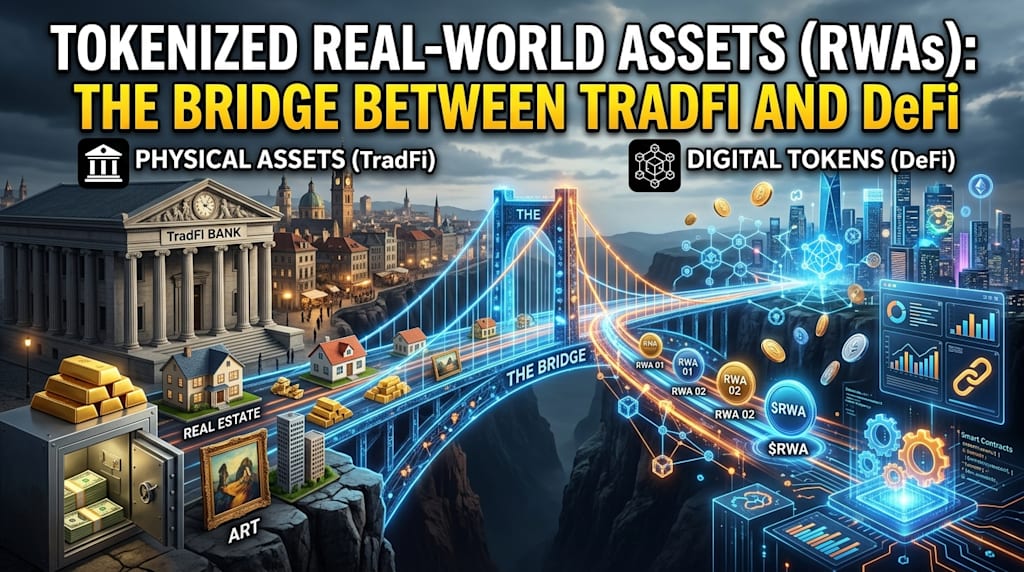
For years, traditional finance (TradFi) and decentralized finance (DeFi) have operated as separate ecosystems. TradFi is built on established institutions, regulatory frameworks, and physical assets, while DeFi thrives on blockchain-based innovation, transparency, and permissionless access. Tokenized real-world assets (RWAs) are a new trend that is starting to close this gap.
RWAs represent tangible or traditional financial assets brought onto the blockchain in the form of digital tokens. This innovation has the potential to combine the stability and value of traditional markets with the efficiency and accessibility of decentralized systems. As a result, RWAs are emerging as one of the most important narratives shaping the future of finance.
What Are Tokenized Real-World Assets?
Tokenized RWAs are real estate, bonds, commodities, or stocks that are represented digitally on a blockchain. They can be physical or financial assets. Each token corresponds to a share or ownership stake in the underlying asset, allowing it to be traded, transferred, or utilized within DeFi ecosystems.
For example, a property can be divided into thousands of tokens, each representing fractional ownership. Similarly, government bonds or private credit can be tokenized and made accessible to a global audience.
This process transforms traditionally illiquid assets into liquid, programmable instruments that can interact seamlessly with decentralized applications.
Why RWAs Matter in Today’s Market
The importance of RWAs lies in their ability to unlock new forms of value. Traditional assets are often restricted by geographical, regulatory, or institutional barriers. Tokenization removes many of these limitations, enabling broader participation.
Key benefits include:
- Increased liquidity for traditionally illiquid assets
- Fractional ownership, making high-value assets more accessible
- 24/7 trading without reliance on traditional market hours
- Global accessibility, allowing anyone with internet access to participate
These advantages make RWAs a compelling solution for both individual investors and institutions looking to expand their reach.
How RWAs Bridge TradFi and DeFi
RWAs serve as a direct link between traditional financial systems and blockchain-based ecosystems. By bringing real-world value onto the blockchain, they create opportunities for integration between the two.
In TradFi, assets are typically managed by centralized institutions. In DeFi, assets are governed by smart contracts and decentralized protocols. RWAs combine these models by maintaining the value and legal backing of traditional assets while leveraging the efficiency and transparency of blockchain technology.
This hybrid approach allows DeFi platforms to offer products backed by real-world value, such as tokenized lending markets, yield-generating assets, and collateralized financial instruments.
The Role of Blockchain Infrastructure
The success of RWAs depends heavily on the underlying blockchain infrastructure. Networks like Ethereum and Polygon are commonly used to support tokenized assets due to their smart contract capabilities and developer ecosystems.
These platforms enable secure ownership records, transparent transactions, and automated processes through smart contracts. Additionally, interoperability between chains is becoming increasingly important, allowing RWAs to move across different ecosystems and reach wider markets.
As infrastructure continues to evolve, the efficiency and scalability of RWA platforms are expected to improve significantly.
Market Narratives and Speculative Attention
While RWAs are fundamentally driven by real-world value, the crypto market’s tendency toward speculation still plays a role in shaping attention. Investors often shift focus between narratives, sometimes prioritizing hype over long-term fundamentals.
For instance, discussions around emerging tokens can dominate conversations, with mentions like xyo coin gaining traction among retail participants. Also, xyo coin could join larger speculative trends, even if the underlying topic is about infrastructure and utility, like with RWAs.
This contrast highlights a recurring dynamic in crypto: while foundational developments like RWAs build long-term value, speculative narratives often capture short-term attention.
Challenges Facing RWA Adoption
Despite their potential, RWAs face several challenges that must be addressed for widespread adoption.
One of the biggest hurdles is regulation. Since RWAs are tied to real-world assets, they must comply with existing legal frameworks, which vary across jurisdictions. Navigating these regulations can be complex and time-consuming.
Another challenge is custody and trust. Ensuring that the underlying asset is securely held and accurately represented on the blockchain requires reliable custodial solutions and transparent verification processes.
There is also the issue of standardization. Without consistent frameworks for tokenization, interoperability between platforms can be limited, reducing the efficiency of the ecosystem.
Institutional Interest and Market Growth
One of the most promising aspects of RWAs is the growing interest from institutional players. Banks, asset managers, and financial institutions are beginning to explore tokenization as a way to modernize their operations and reach new markets.
This institutional involvement brings credibility and capital into the space, accelerating development and adoption. It also shows that traditional finance no longer sees blockchain technology as a threat that needs to be fought, but as a chance that should be seized.
As more institutions participate, the scale and impact of RWAs are likely to increase significantly.
Conclusion
Tokenized real-world assets represent one of the most important developments in the evolution of finance. By bridging the gap between traditional systems and decentralized technologies, they offer a path toward a more inclusive, efficient, and transparent financial landscape.
While challenges remain, the momentum behind RWAs continues to grow. As infrastructure improves and adoption increases, they are likely to play a central role in shaping the future of global finance.
RWAs aren't just a trend; they're a change that brings real-world value into the digital age and changes what's possible in both TradFi and DeFi.
About the Creator
Enjoyed the story? Support the Creator.
Subscribe for free to receive all their stories in your feed.
Comments
There are no comments for this story
Be the first to respond and start the conversation.