
Timothy Hines’ Upcoming Movie, “The Red Head,” a Story of Seducing Nazis, Saving Lives, Defying History
The story of Hannie Schaft has often been told as legend.

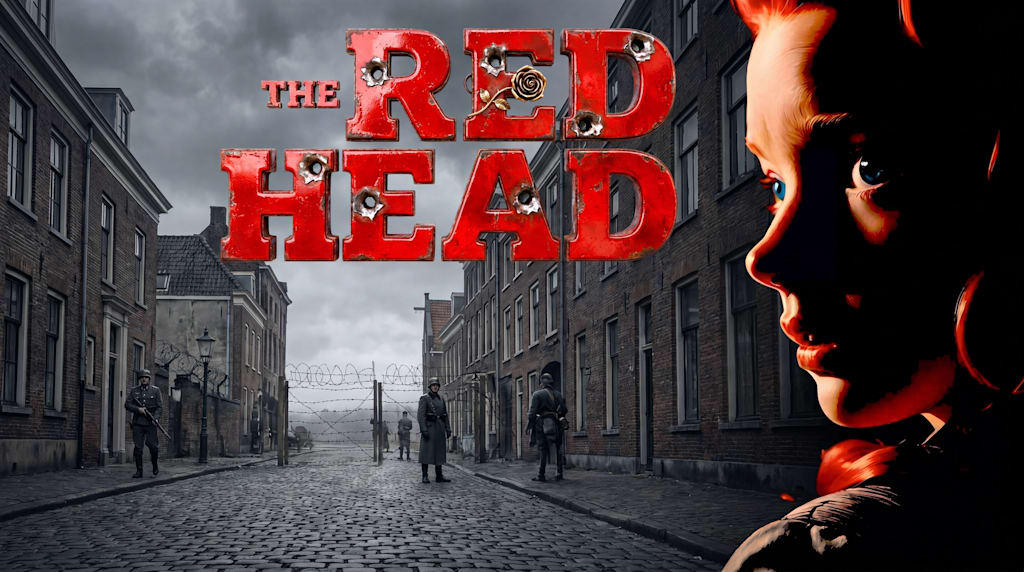
The story of Hannie Schaft has often been told as legend. Soon, audiences will have the opportunity to experience the woman behind the legend.
This fall, director Timothy Hines of Pendragon Pictures, alongside producers Susan Goforth (10 Days in a Madhouse, Christopher Lambert, Kelly Le Brock), Kimberly Olsen, ("Paper Tiger" Scarlett Johansson, Miles Teller, Adam Driver), Lawrence Scott (“Martha Graham Dance Company”, “PBS series Moment of Luxury”) and Jeff Wallner, (“Lucy Boomer” Shirley Maclaine, Ansel Elgort) (“Murdering Michael Malloy” Tim Roth, Timothy Spall), will begin production in Norfolk, England, on The Red Head, a sweeping World War II resistance thriller based on the remarkable true story of one of the most daring - and psychologically complex - fighters of the Nazi occupation.
But unlike many war films that focus on battles, espionage, or military strategy, The Red Head aims its lens somewhere far more intimate: inside the heart and mind of a young woman forced to make impossible moral choices.
The result promises to be not merely a war film, but a character study of extraordinary depth.
For decades, Hannie Schaft has been remembered as the Dutch resistance fighter the Nazis feared so intensely that her name circulated through occupation networks as a warning. Yet the real woman was far more fascinating than the myth. Before she became an assassin, Schaft was a law student. She believed in justice, human rights, and the rule of law. She dreamed of a future built around protecting people, not killing them.
Then history intervened.
As Nazi occupation tightened its grip on the Netherlands, Schaft watched Jewish classmates and friends - including Sonja Frenk and Philine Polak - systematically stripped of rights, opportunities, and ultimately safety. What began as friendship evolved into resistance. What began as outrage evolved into action.
And eventually, action evolved into violence.
The film explores a deeply unsettling question that feels startlingly modern: What happens when a person who believes in law discovers that the law has been hijacked by evil?
Unlike traditional wartime heroes, Schaft's journey was not one of triumphal patriotism. It was emotional, painful, and psychologically costly. She did not emerge from the war untouched. The burden of resistance - and of killing - left scars that would shape the remainder of her short life.
Yet what makes Hannie Schaft such a compelling cinematic figure is the startling contrast between her outward appearance and the extraordinary risks she undertook.
The Nazis consistently underestimated women.
Schaft and fellow resistance fighters Truus Oversteegen and Freddie Oversteegen often exploited those assumptions. Young, attractive, and seemingly harmless, they could move through occupied territory with a degree of freedom unavailable to many male resistance members.
Sometimes Schaft would be assigned a target and approach him directly.
In certain operations, resistance women used flirtation and companionship to gain proximity to Nazi officers and collaborators. A target who believed he was pursuing romance might suddenly find himself isolated and vulnerable. In other cases, Schaft's methods were even more direct. She might simply ride a bicycle to a predetermined location, approach her target in broad daylight, draw a concealed pistol, and shoot him at point-blank range before disappearing into the streets of occupied Holland.
The juxtaposition remains astonishing.
A law student. A young woman in her early twenties. A bicycle. A pistol.
The entire moral complexity of occupied Europe compressed into a single image.
What makes The Red Head especially intriguing is its determination to explore not only what Schaft did, but what those actions did to Schaft.
The film delves into themes rarely explored in traditional resistance stories: survivor guilt, emotional deterioration, depression, nightmares, and the psychological burden carried by those who fought fascism at close range. It examines the immediate catharsis Schaft reportedly felt after striking back against Nazis she viewed as a spreading cancer within Europe—and the emotional costs that followed.
The film also investigates the friendships that transformed her life. Without the Jewish women she loved and sought to protect, Schaft's path might have been entirely different. The story suggests that resistance is often born not from ideology but from intimacy. Tyranny becomes impossible to tolerate once it threatens people whose names, faces, and lives matter personally.
This emotional specificity distinguishes Hannie's story from many wartime biographies.
She was not fighting for abstractions.
She was fighting for friends.
And that human dimension extends to the film's treatment of her final days. The execution dunes of Bloemendaal, where Schaft was murdered by the Nazis only weeks before liberation, become more than a historical location. They emerge as a symbol of the psychological battle between authoritarian power and individual conscience—a place where the Nazis sought to extinguish not only bodies, but moral resistance itself.
The irony, of course, is that they failed.
Today, Hannie Schaft remains one of the most celebrated figures of the Dutch resistance precisely because she embodied a contradiction that continues to fascinate modern audiences. She was compassionate yet lethal. Intellectual yet fearless. Idealistic yet willing to embrace violence when confronted with what she viewed as absolute evil.
She was, in every sense, complicated.
And that complexity is precisely what makes The Red Head feel timely.
At a moment when audiences increasingly gravitate toward true stories that blend historical scope with psychological intimacy, the film arrives with ambitions that extend beyond conventional wartime storytelling. Drawing inspiration from prestige historical dramas while grounding itself in the emotional realities of its protagonist, The Red Head seeks to tell the story not of a myth, but of a young woman navigating impossible circumstances.
For director Timothy Hines, and producers Susan Goforth, Kimberly Olsen, Lawrence Scott, Jeff Wallner, the goal is clear: to introduce global audiences to a resistance fighter whose story has all the suspense of a thriller, all the tragedy of a great drama, and all the emotional complexity of real life.
The Nazis called her dangerous.
History remembers her as heroic.
The Red Head intends to reveal something even more compelling - the human being who existed between those two descriptions.
About the Creator
Enjoyed the story? Support the Creator.
Subscribe for free to receive all their stories in your feed.
Comments
There are no comments for this story
Be the first to respond and start the conversation.