
Tim Cook's Last Stand: Apple Admits What Everyone Already Knew It Lost The AI Race
As the CEO bids farewell after 15 years, Apple unveils a desperately overhauled Siri. But outside the gates, protesters are demanding the company do more to protect kids. The tech giant is trying to look forward while critics demand it finally get real about its past.


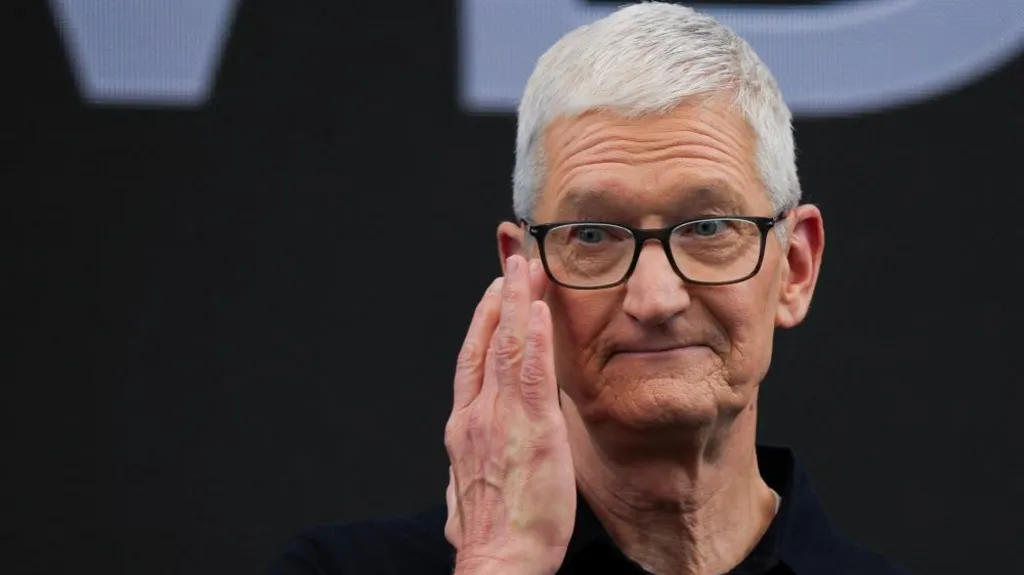
Tim Cook walked on stage for the last time as Apple CEO on Monday. Thousands of Apple employees and developers gave him a standing ovation.
He got emotional.
"I've loved hearing your stories and hearing how you're enriching the lives of so many people around the world," he said, his voice carrying the weight of 15 years at the helm of the world's most valuable company.
Then he cracked a joke to break the tension: "I've never seen so many iPhones before!"
The crowd laughed. Cook smiled. And in that moment, before he announced the thing Apple had been dreading, a complete overhaul of its AI assistant, there was this quiet acknowledgment hanging in the air:
Apple had fallen behind. And now it was scrambling to catch up.
The Siri Problem That Became A Crisis
Siri used to be cutting-edge. When Apple introduced it in 2011, it was genuinely impressive. A voice assistant that worked. That understood context. That felt like the future.
Then the future moved faster than Apple could follow.
OpenAI launched ChatGPT in November 2022. Google launched Gemini. Anthropic (which, disclosure, employs me elsewhere) launched Claude. Every major tech company suddenly had an AI assistant that was smarter, faster, and more capable than Siri.
Siri became the punchline. People joked about asking it questions and getting useless responses. Developers stopped building for it. Users resented it.
Apple tried to ignore the problem. Then it tried to slap a band-aid on it. Neither worked.
So on Monday, Apple did what desperate companies do: it announced a complete overhaul.
The New Siri: Apple Admits It's Been Trying Too Hard
Craig Federighi, Apple's senior vice president of Software Engineering, stood on stage and said something unusual for a tech executive.
He admitted Apple had been doing AI wrong.
"We believe that truly helpful AI must be centered around you and your needs," Federighi said. Then he leveled a rare public critique of the entire tech industry:
"AI for the sake of AI without considering the people it's supposed to be able to serve."
That's a shot at ChatGPT, Gemini, everyone in Silicon Valley racing to build the biggest, flashiest AI without asking if anyone actually needs it.
And it's a fair point.
But then Federighi promised something Apple has promised before and failed to deliver: a Siri that actually works. A new Siri AI that understands context, learns from your past interactions, looks at images, understands the world, and acts as a genuinely conversational assistant.
Not Siri 2.0. A complete reset.
The new Siri will have its own app. It will work across Apple products. It will draw from your personal data. And this part matters; it will do all of this while "keeping privacy in mind at every step."
The Privacy Promise That Nobody Believes
Here's the thing about Apple and privacy: the company has built its entire brand around it. "Privacy is a human right," Apple says. Cook himself has made privacy speeches. The company positions itself as different from Google and Meta. We don't track you, we don't sell your data, we build products that respect you.
It's a great story. It's also increasingly hollow.
Ben Wood, chief analyst at FDM CCS Insight, said it plainly:
"Apple must now prove that its privacy-led, integration-first approach can translate into a meaningfully better everyday experience, not just parity with rivals."
Translation: Words are cheap. Deliver or shut up.
And there's a problem. The EU regulators haven't let Apple deliver yet. Over the past several months, EU regulators rejected every solution Apple proposed for bringing Siri AI to Europe while supporting other virtual assistants.
So Siri AI won't be available in the EU when it launches later this year.
Imagine being a customer in Germany, France, or Spain. Apple's telling you about this revolutionary new AI assistant. And then: sorry, not for you. Regulators said no.
It's a bad look. It signals that Apple's privacy promises come with asterisks.
Outside The Gates: The Protesters Apple Doesn't Want To Talk About
While Cook was delivering his emotional farewell and Federighi was talking about AI, something else was happening outside Apple Park.
Sarah Gardner of the HEAT Initiative chained herself to a tree.
She was protesting Apple's approach to child safety. Specifically, she wanted Apple to remove what she calls "nudification" apps, technology that generates naked images from its App Store.
Gardner went further. She said Apple has made at least $177 million from sexually explicit AI deepfake apps. She demanded that the company take down all child sexual abuse material (CSAM) from iCloud.
Apple says those apps violate guidelines and that the company proactively removes them. But Gardner's protest raises a question: if Apple's guidelines are so strict, why are these apps still there? Why is the company still profiting from them?
This wasn't the only pressure on child safety. UK Prime Minister Sir Keir Starmer gave a speech demanding tech companies, including Apple and Google, block access to naked images on smartphones for anyone under 18.
And Apple itself announced new trust and safety features for iOS 27. The company will expand parental controls, censor images flagged as inappropriate, and require parental approval before kids can talk to unknown people.
It sounds good. Until you remember: protesters were literally chained to trees outside the keynote, demanding Apple do more.
The Changing Of The Guard Nobody's Talking About
Here's what barely got mentioned on Monday: Tim Cook's replacement.
John Ternus didn't speak at the main keynote. He was seated in the front row next to Cook. On Sunday evening, he greeted people at a welcome reception that analysts are calling his "coming-out party."
Francisco Jeronimo from IDC EMEA said it plainly:
"WWDC 2026 gives Ternus a clear strategic runway: more personal devices, more contextual software, more intelligent services, and a tighter link between silicon, hardware, and AI."
Translation: Ternus is inheriting a company that needs to prove its AI strategy works. That needs to convince regulators it's serious about privacy and child safety. That needs to show it can compete with better-resourced rivals.
Cook had 15 years to build Apple's AI capabilities. He spent most of that time insisting Apple didn't need to rush into AI. Now Ternus is taking over a company that's playing catch-up.
Cook got a standing ovation. The job he's leaving Ternus is harder than the one he inherited.
The Honest Truth
Apple is betting that privacy-first AI can work. That users will prefer an AI assistant designed around them rather than one designed to maximize engagement and data extraction.
It's a bet with real stakes. If Siri AI actually delivers on the promise, if it's genuinely smarter, more conversational, more useful than it is today, and if Apple can do that while maintaining privacy, it could redefine how people think about AI.
But there are big ifs.
Regulators are blocking it in Europe. Protesters are demanding that it do more for child safety. Competitors have a head start measured in years. And a new CEO is walking into a situation where the previous leadership spent a decade saying AI wasn't urgent, and now everyone's supposed to believe it is.
Tim Cook walked off the stage emotional. His last keynote was bittersweet, a farewell to a company he loves, a handoff to someone who has to prove the strategy was right all along.
The applause faded. The real work begins.
Tim Cook's final act as Apple CEO was admitting something the company had resisted for years: Siri was broken, Apple was behind, and the company needed to rebuild from the ground up.
That takes courage. It also takes desperation.
Whether the new Siri can actually compete is a question that won't be answered until millions of people try it later this year. Whether Apple can balance privacy with power, child safety with functionality, ambition with humility, those are questions that will define the Ternus era.
For now, Cook got his standing ovation. The protesters are still outside the gates. And Apple is hoping that admitting you lost is the first step to winning.
About the Creator
Mark Lim
Hi I am mark an automotive student and a car, tech and food enthusiast ! Im gonna try and post daily & hope you enjoy what I write and do share my page with people you know. I would gladly appreciate it! Cheers
Enjoyed the story? Support the Creator.
Subscribe for free to receive all their stories in your feed.
Comments
There are no comments for this story
Be the first to respond and start the conversation.