
Three Seconds That Changed Everything: Silicon Valley’s Secret Letter to Washington
An API bill pinned to a whiteboard, a slammed table at Y Combinator, and a coffee stain on a petition—inside the moment 200 tech leaders drew a line against an AI ban.

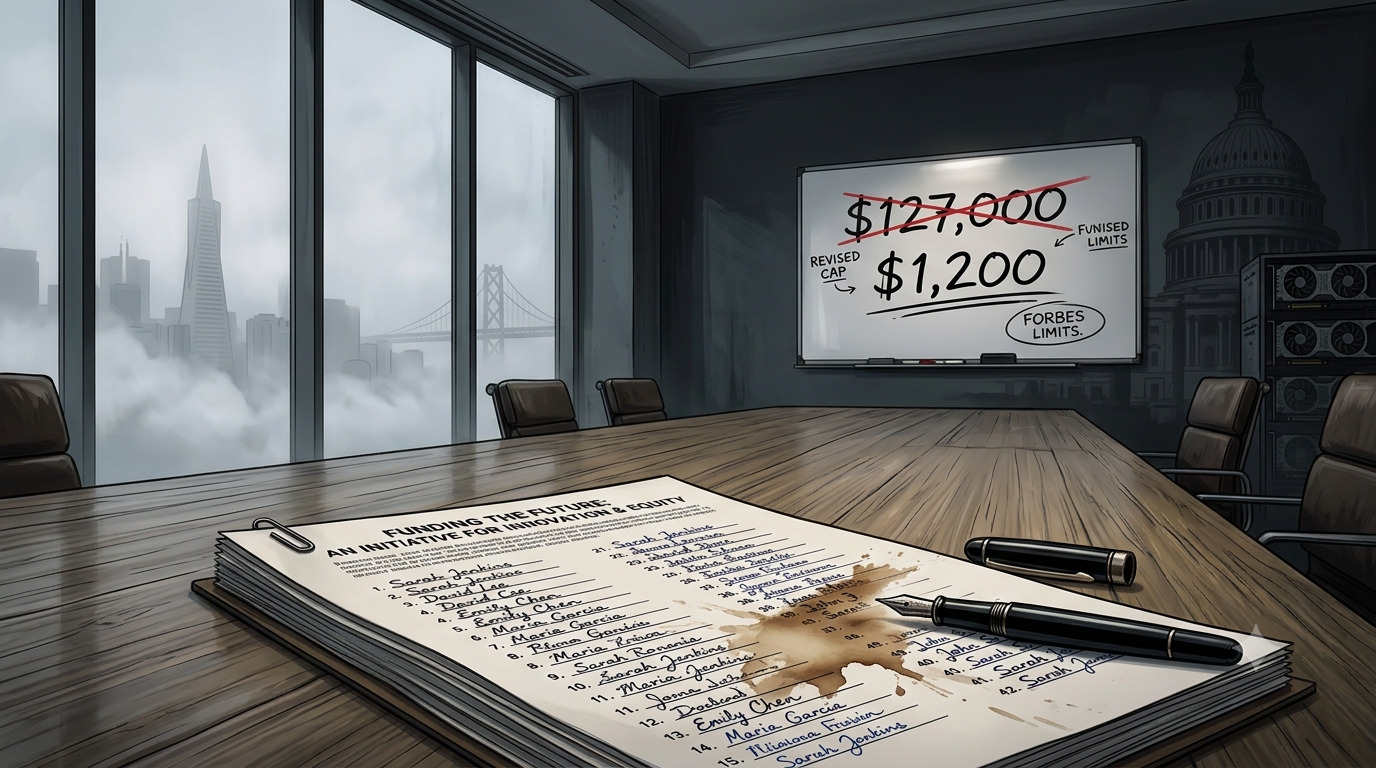
Page three of the petition. Line sixteen. Proton's CEO Andy Yen put his pen down for three seconds. Then he signed. There were still over a hundred people waiting behind him, but during those three seconds, the only sound in the room was the AC hum.
The letter was addressed to Trump, Lutnick, and Kratsios. Two hundred signatures, opposing one thing: the U.S. government's attempt to keep Chinese open-source AI models out of the country.
On paper, it's a debate about "national security." On the back of the paper, it's something else.
I. A Printed API Bill
San Francisco. An office with no windows. The CTO of an AI startup printed out last month's OpenAI API bill and pinned it to the whiteboard with a magnet. $127,000. He stood there looking at it for thirty seconds, then turned and wrote the inference cost estimate for DeepSeek next to it, same workload, $1,200.
A hundred times difference.
This isn't an isolated case. Over the past eighteen months, SaaS companies building on closed-source APIs have found themselves on a dead-end road: you call OpenAI's interfaces to train your vertical capabilities, and three months later OpenAI releases a new Skill that covers your entire feature set. Your data flows back to them. Your users see their cheaper pricing.
"We're not using an API," one founder said, speaking on condition of anonymity. "We're paying rent to a landlord."
Chinese open-source models offer these "tenants" another path: weights you can download, models you can deploy privately, data that never passes through someone else's hands. The cost difference is ten to a hundred times. More importantly—what you build is yours.
Blocking Chinese weights means tearing down the last stretch of that road.
II. The Table at Y Combinator
At an internal YC partners meeting, someone slapped the table.
The specific reason wasn't made public, but those familiar with the discussion say the core argument came down to a brutal arithmetic: AI monopoly is a startup killer. If only two or three closed-source giants control the foundational models, every startup grows on someone else's foundation. When the foundation shifts, the building collapses.
What do VCs live on? Survivors, after the startups die. If startups die in bulk, where do survivors come from?
This is the most anxious group in Silicon Valley's united front. They talk about innovation, but their spreadsheets track exit channels. A decentralized ecosystem is worth far more to them than a walled garden gripped by two giants.
III. Jensen's Gesture
On July 22, Jensen Huang sat for an interview with Axios. He didn't talk about sanctions. He talked about the "sandbox."
Here's what he actually said: after companies download open-source models, they can run them in completely air-gapped, physically isolated environments. Access control is the company's own decision. As for the claim that Chinese models come with backdoors—he used one word: misunderstanding.
When he said it, he made a gesture: both hands spread open, like pushing a door.
NVIDIA's arithmetic has never been complicated. The more prosperous the open-source ecosystem, the more application scenarios emerge, the more inference demand grows—and the more GPUs they sell. A closed-source monopoly dominating the world is not good news for NVIDIA, because monopolists squeeze chip procurement costs hard. A fragmented open-source world doesn't. A thousand companies buying their own cards, versus one or two companies buying in bulk—which one makes more money?
Jensen didn't say it out loud. But his pushing-door gesture said it.
IV. A Line in Slack
On Hugging Face's internal Slack, someone posted a single line the night the news broke: "So we're the bad guys now because we shared weights?"
No one replied. But the next day, their open-source model downloads jumped.
The open-source camp is the cleanest group in this whole game. Their logic is simple: model weights, like code, should be shared, improved, and redistributed. It's not ideology—it's what they've done their entire careers. When politics tries to define "open" as "threat," their instinctive response isn't to argue. It's to keep uploading.
V. The Date on the Whiteboard
In 2018, there was a whiteboard in some lab. On it, a single line: "7nm tape-out deadline Q3 2019." The day the chip禁令 came down, someone erased that line.
No one said anything while erasing it. The chalk dust fell to the floor. No one swept it up.
Seven years later, in the same lab—if you can still find it—the whiteboard has a different line on it. MoE parameter counts. A loss curve from some distillation experiment. A communication scheme that doesn't depend on NVLink. The old plan was erased. The new plan is written on the same board.
What Silicon Valley fears most has never been China's catching up. What they fear is that the chaser, under blockade, has grown its own toolchain—a complete logic that doesn't run on the American tech stack. At that point, "interoperability" simply ceases to exist. Two systems with no bridge between them. That's the real decoupling.
And half the cost of that decoupling lands on Silicon Valley.
VI. The Coffee Stain
The last page of the petition. Next to the signature column, a small brown mark. Coffee stain. No one knows whose cup left it there.
Two hundred names, from page one to page four. CEOs. Partners. CTOs. Open-source maintainers. Their reasons vary—some fear bankruptcy, some fear monopoly, some fear losing customers, some just think it's wrong.
But they all signed.
Three seconds after Andy Yen put his pen down, he passed the paper to the next person. The AC was still running. Outside the window, San Francisco's fog—gray-white, low.
One founder posted a short tweet that day. It said:
"I just want to build something."
No subject. It's not clear whether the "I" meant "me" or "we." But the screenshot made the rounds in a Slack channel all afternoon.
About the Creator
Jin
Writer of reamstories
https://reamstories.com/jin
Enjoyed the story? Support the Creator.
Subscribe for free to receive all their stories in your feed. You could also become a paid subscriber, letting them know you appreciate their work.
Comments
There are no comments for this story
Be the first to respond and start the conversation.