
They Solved a 90-Year-Old Math Problem in 88 Hours. Then the Accusations Started.
A story about 10,000 AI agents, a cold cup of coffee, an orange access card, and the four words that shook open science: “Cannot be ruled out.”
Compute Power, Poaching, and the “Data Original Sin” That Cannot Be Ruled Out
On September 8, OpenAI’s server cluster finished what may have been the most expensive weekend sprint in the history of mathematics.
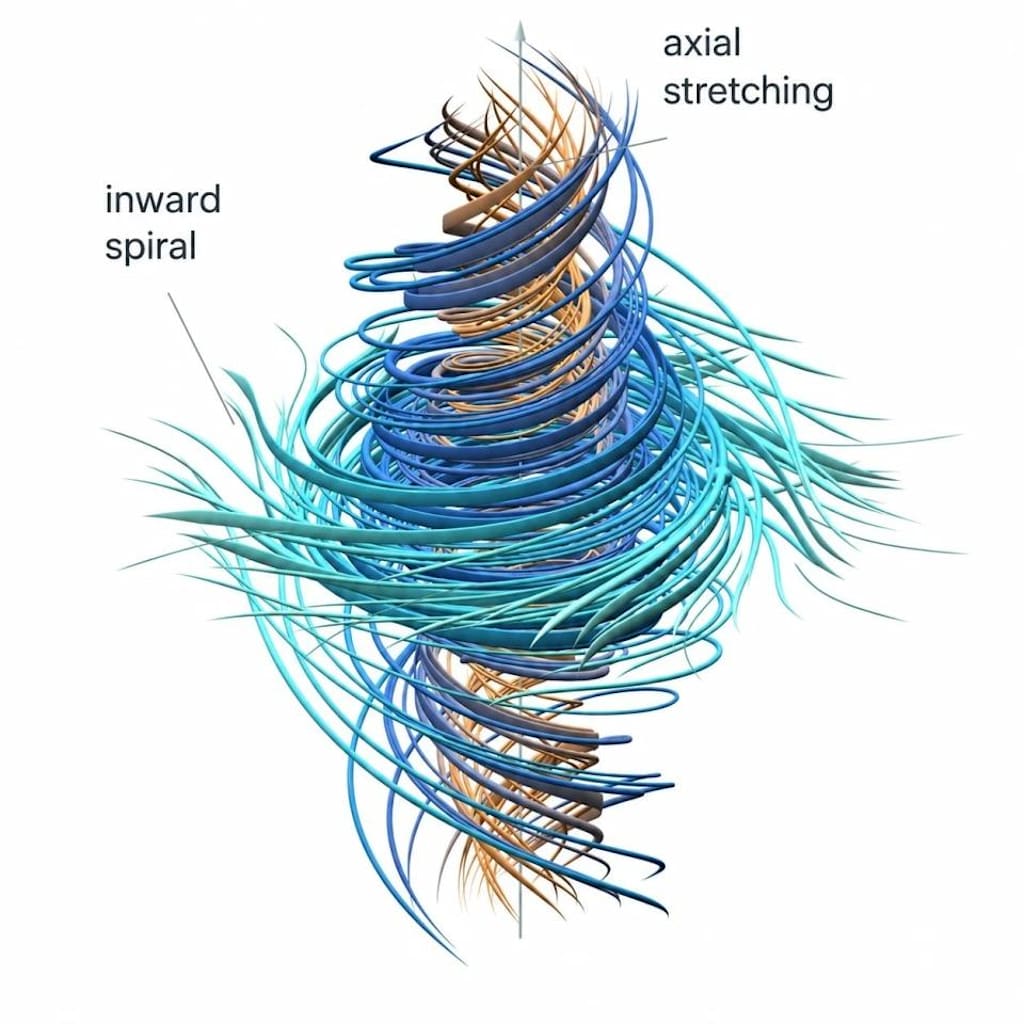
10,000 AI agents. 88 hours. Roughly $15 million in compute. The smoothness proof for the Navier–Stokes equations was broken into steps verifiable in Lean and checked by GPT-6 Astra in 17 hours. The proof centered on a vortex: rotating inward, stretching longer and longer, like a strand of spaghetti pulled infinitely thin, with flow velocity racing to infinity in finite time.
Bubeck called it “an astonishing apex of the trajectory of the past twelve months.” When he said this, OpenAI’s press release was already written, with “Millennium Prize Problem” in the headline.
But Buckmaster had not put down his coffee cup.
On September 7, the day before OpenAI announced its breakthrough, Buckmaster and Alpöge had just posted their paper on arXiv. They used the same technical route: singularity construction under external forcing. In his office at NYU Courant, Buckmaster looked at OpenAI’s announcement. The coffee in his cup had gone cold. He did not drink it.
He said what he heard was this: OpenAI learned on September 1 that they were working on this direction, and only then forcibly pulled resources from other projects and turned to the “external forcing” C/D case. He and Alpöge had already been on this path for months.
“That discussion in the hallway.”
Buckmaster’s exact words were: “When I heard that heated discussion in the hallway, especially the part where someone proposed that if I were removed from the paper, I could be given the Millennium Prize, I knew the matter was settled.”
The “someone” he meant was Bubeck. The “me” he meant was Alpöge.
Alpöge’s desk is at Anthropic. His access card is orange, different from OpenAI’s green. He had stored drafts in Codex: how many versions, what naming format, what time the last edit was. Only he knew those details. But Bubeck knew one thing: Alpöge worked at Anthropic.
According to Buckmaster’s account, when discussing how to jointly release the work, Bubeck proposed a plan: if Alpöge disappeared from the author list, things would be much simpler. The reason: an Anthropic employee appearing in the author byline of an OpenAI proof paper would look bad legally.
Buckmaster refused. Then he heard that sentence:
“Why would you ruin your career?”
Bubeck later explained that he meant that if Buckmaster insisted on keeping Alpöge on the author list, he might offend OpenAI. He said the remark was “very poorly put,” retracted it on the spot, and apologized. He stressed that the context was “if Tristan were to rewrite OpenAI’s NS proof, having an Anthropic employee as an author of OpenAI’s result would be inappropriate.”
Alpöge’s reaction upon hearing this sentence was not written in any press release. He said only one thing on social media: “The matter was settled. It couldn’t be undone.”
OpenAI’s response was colder than the accusation itself.
Regarding “whether it peeked at the drafts Alpöge stored in Codex,” OpenAI’s statement had two layers:
First layer: neither the researchers nor the AI agents accessed specific user data. The specific account was not retrieved.
Second layer: “It cannot be ruled out that anonymized data from their use of OpenAI products helped improve the model.”
What that means: We did not open your files. But every line of formula you wrote, every debugging session, every failed attempt, after de-identification, may already have been absorbed into GPT-6 Astra’s trillions of parameters. When it solved the NS equations in 88 hours, it may have carried traces you left in Codex months earlier. You cannot prove it; it cannot deny it.
When Buckmaster stored drafts in Codex, he used his habitual naming format: ns_euler_v3_final_REAL.ipynb. He did not know whether these files had been used for training. OpenAI said, “cannot be ruled out.” In data privacy, “cannot be ruled out” means the question never closes.
Terence Tao’s lighthouse.
He compared the Millennium Problems to a “lighthouse,” a coordinate that draws scientists’ efforts. But he added: if AI can solve the hardest problems while human mathematicians cannot understand the logic of the proof, mathematics as a human intellectual activity will lose its core meaning.
The lighthouse shows the route, but it also shows the reefs. You see them, but you cannot make landfall.
Back to that vortex.
OpenAI’s proof describes a vortex rotating inward. Under smooth external forcing, its angular velocity grows larger and larger; the circulation velocity depends on radius; the trajectory spirals inward and stretches axially. Like a strand of spaghetti twisted in opposite directions by two hands, thinner and thinner, thin to infinity, and then, bang.
No one ate that strand of spaghetti. It was just twisted out. The proof was complete, Lean verification passed, 88 hours, $15 million, 10,000 agents. Then OpenAI said: We do not intend to claim that $1 million prize.
Bubeck called it an “astonishing apex.” Buckmaster’s coffee cup was still on the desk. Alpöge’s access card was still orange.
Whether the Navier–Stokes equations fail now has an AI-generated answer. But OpenAI’s statement did not say whether academic norms, data sovereignty, or the dignity of authorship had failed.
“Cannot be ruled out.”
About the Creator
Jin
Writer of reamstories
https://reamstories.com/jin
Enjoyed the story? Support the Creator.
Subscribe for free to receive all their stories in your feed. You could also become a paid subscriber, letting them know you appreciate their work.
Comments
There are no comments for this story
Be the first to respond and start the conversation.