
They Sent Her Water Samples for Decades. Now They’re Sending Her Addresses.
Erin Brockovich built a map of America’s hidden data centers — and the people who don’t know how much water is being taken until their wells run dry.
She won $33 million from that lawsuit in 1993. For more than two decades after, Erin Brockovich's mailbox never ran out of water samples sent by strangers—bottled in mineral-water bottles, jam jars, cut-open laundry-detergent jugs. Most of the attached notes said the same thing: "Can you take a look and tell us if this is still safe to drink?"
In July 2026, the water samples turned into addresses.
Residents of St. James Parish, Louisiana, sent her eighty-three messages. One of them read: "They call it an AI data center, but nobody will tell us how many gallons it draws every day. The parish signed a nondisclosure agreement—we're not even allowed to ask."
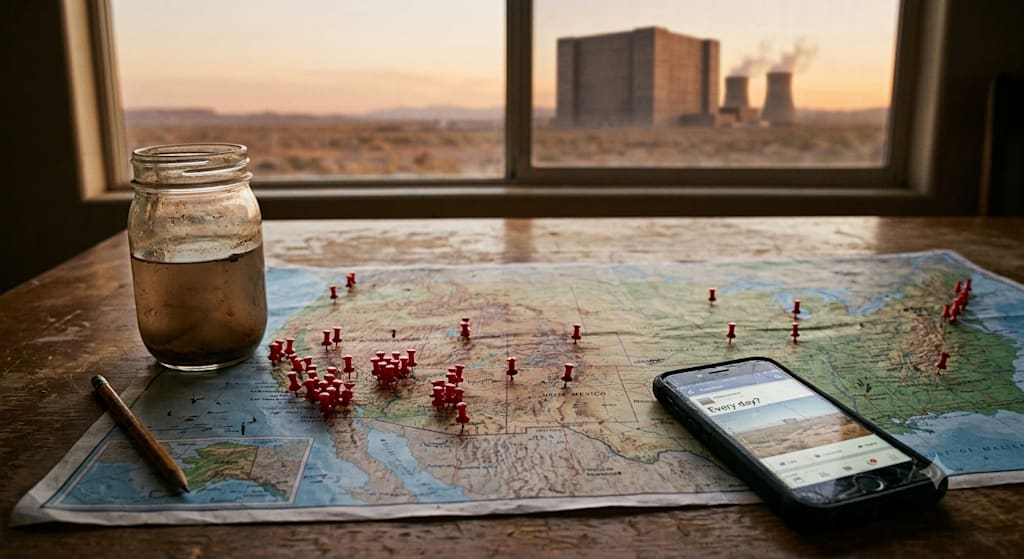
She built a webpage, a map, that let anyone mark data centers in their community—under construction, already running, or rumored to be coming. On the third day after launch, the site crashed twice. The first time at 3:17 a.m., the second at 4:02 the following afternoon. The technical log had one line: "Concurrent requests exceeded threshold."
Two weeks, more than eight thousand coordinates. Texas, Arizona, Nevada, New Mexico—the dots clustered especially dense in drought states. A farmer outside Lubbock wrote in the remarks: "Our well water level dropped twelve feet last year. They blamed the weather. But the weather didn't build a cooling tower next to my house."
A retired firefighter in St. James Parish did the math. He had a swimming pool in his backyard—15,000 gallons. He looked up the data center's designed daily water consumption: 5 million gallons. Enough to fill his pool 333 times. He posted a screenshot of his calculator on Facebook with only three words: "Every day?"
The electricity numbers were even more blunt. 100 megawatts—roughly the household load of 100,000 homes. A high-school teacher in Phoenix pinned his utility bill to Twitter: "In the hottest month last summer, we ran two ACs and used 1.2 megawatt-hours. That data center is eighty-three times my house. Am I not allowed to know its name?"
The dots kept growing. But on Reddit, some people started doing something else: overlaying those coordinates with Baxtel's commercial database. Baxtel records about 5,032 data centers nationwide. Brockovich's map had more than 8,000. The gap wasn't a "hidden secret"—it was two different sets of things. Erin's map had mixed in a large number of colocation facilities, enterprise server rooms, even buildings where only a single suite housed a few racks.
A manager at a colocation center in Ohio filmed a short video. He pushed open the server-room door—two rows of black racks, indicator lights flickering like breathing. "Three hundred clients in this building. Only one does AI training. The rest are hospital scheduling systems, bank settlement interfaces, and every web page you're scrolling." He panned the camera to the cooling pipes. "Closed loop. We refill water once a month. If you want to tear things down, start with the system you're using to read this."
Outside Pittsburgh, on the site of an abandoned racetrack, Switch is building a new data center. The public filings say "closed-loop cooling." But social media didn't share that part. What went around was "another data center is coming," accompanied by a photo of a cooling tower billowing white steam—from a different state, months earlier. The two images stacked, looking like the same thing.
Under the same Reddit thread, A wrote: "This is capital swallowing everything, leaving not even water behind." B wrote: "You people just want to go back to dial-up." Both cited data from the same map. No one paid attention to the fact that the Pittsburgh project's cooling tower actually emits no vapor—it releases hot air.
The residents of St. James Parish were still waiting. The nondisclosure agreement ran eighteen months; the parish government said "soon." The woman who sent Brockovich the first message added a follow-up in the comments: "I'm not against technology. I just want someone to tell me what that building is actually computing before my well runs dry."
She didn't use words like transparency, regulation, or public interest. She said well.
The Phoenix high-school teacher recently went to a city council meeting. He brought his phone, screen showing a screenshot with "PUE 1.4 / WUE 0.8." "I don't know what these abbreviations mean," he said into the mic, "but my water bill went up 19 percent last month. Can you tell me what these two numbers have to do with that bill?"
The chamber was quiet for four seconds. No one answered him.
More than eight thousand coordinates on that map, each with a line attached. Some long, some short, some just "here." No one distilled these into "community anxiety" or "crisis of trust." They sat there, like sticky notes plastered on a county public-notice board—some illegible, some smudged by rain, but not one of them blank.
Erin Brockovich's 1993 lawsuit didn't change the world. It just made Pacific Gas and Electric pay, and then her mailbox started filling with water samples sent by strangers. Thirty years later, the water samples turned into addresses. Addresses don't speak. But the people who gave those addresses are still waiting for an answer.
About the Creator
Jin
Writer of reamstories
https://reamstories.com/jin
Enjoyed the story? Support the Creator.
Subscribe for free to receive all their stories in your feed. You could also become a paid subscriber, letting them know you appreciate their work.
Comments
There are no comments for this story
Be the first to respond and start the conversation.