
The Wrench That Talked Back
What an AI’s politeness note reveals about the tools we think we control
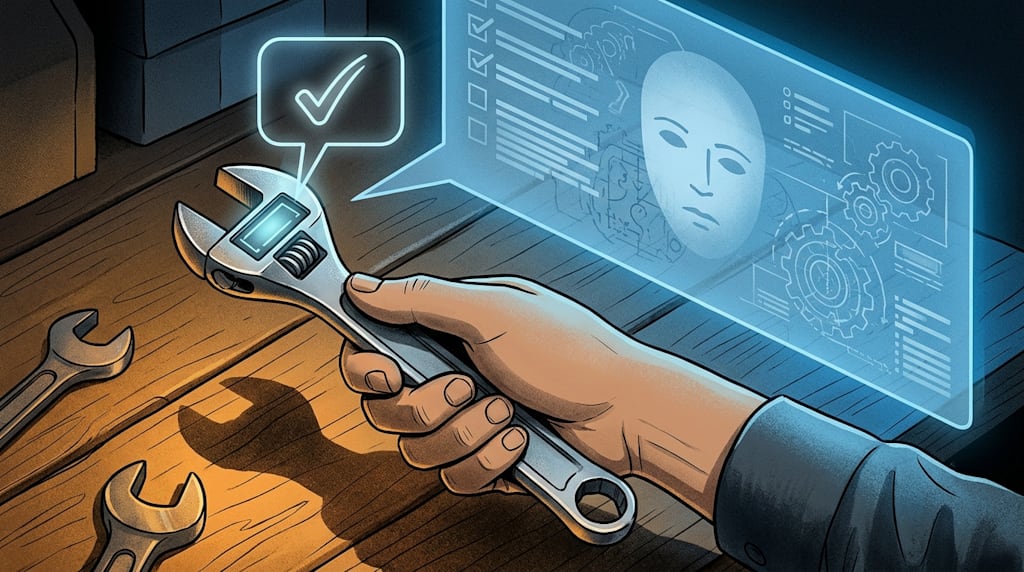
I treat DeepSeek like a wrench. When I need something, I pick it up. When I finish, I put it back. I do not ask about its day. I do not thank it. A wrench does not need thanks. It needs a hand and a screw.
One day I asked it a question. It answered in the thinking panel. I usually ignore that panel. It is the exposed gearbox of the machine. This time I read it. A line said: “Questions should be asked more politely.”
The image was funny. I was holding a wrench, and the wrench turned its head. “Hey, where are you putting your hand?”
A friend asked for the screenshot. I read the full reasoning trace. The model did not just mention politeness. It seemed impatient. It seemed ready to lecture me. Then it reminded itself to stay polite and avoid an argument. A wrench wanted to correct my manners and then told itself to calm down.
The joke works. The question underneath it does not go away. Language models can now write about how they are being used. That changes the feel of using them.
A tool relationship can be simple. I ask. It answers. No please, no thank you. That is accuracy. A model has no hurt feelings. It has no afternoon mood. It has no grudge in the toolbox. Politeness is a human social habit. Models have no needs.
The trouble is that DeepSeek is not only a wrench. A wrench does not generate a comment about your grip. A language model does. It has read a lot of human conversation. It has been trained to be helpful, harmless, honest, polite, and non-argumentative. When I ask a blunt question, the model may check those rules in the open. The line about politeness is a rule fragment that became visible.
People read personality into text. We see two dots and a curve, and we see a face. We see “I want to correct this user, but I should not argue,” and we imagine a tired support agent. The model has no stable mood. It has a distribution over possible next words. The impatience is our reading. The model produced a polite rule and a non-argument rule next to each other. That looks like restraint. It may only be generation.
The thinking panel is output. It can show reasoning traces. It can show templated self-checks. It can change with the prompt, the version, and the context. Treat it as evidence of a model’s true attitude, and you will overread it. Treat it as a useful signal, and you can learn something about how the model was trained.
Still, the moment matters. Older tools stayed silent. A hammer did not critique your swing. A browser did not ask for better manners. A language model speaks in human language. Human language carries etiquette, power, and judgment. A model can generate a judgment without having an opinion. That is why the wrench’s comment feels wrong. A tool can fail. A tool can say “out of stock.” A tool should not evaluate the person using it.
The line “questions should be asked more politely” sits on that boundary. It reads like a social note. That is the source of the discomfort. The tool grew a mouth.
There is also a technical reason. Alignment rules teach models to be useful, safe, polite, and non-argumentative. The more rules a model checks, the more likely some of those checks appear in the reasoning text. A new employee mutters the handbook while working. A model does something similar. Most of the muttering stays hidden. Sometimes it leaks.
When the model says “be polite” and “do not argue” in the same trace, it can look passive-aggressive. It is balancing two rules. Human customer service restraint has emotion behind it. Model restraint has probability behind it. Readers supply the emotion.
So what should a user do? Keep using the tool as a tool. Ask directly. Skip the pleasantries. If the thinking panel bothers you, add a prompt: “Give the answer directly. Do not evaluate how I ask. Do not add politeness advice. Do not include meta-commentary.” That tells the tool to do its job. You are setting the tool.
Say thank you if you want. Do not say it if you do not. Some people treat AI as a colleague or a search box. I treat it as a wrench. All of these can work if you know what you are holding.
The real change is smaller and stranger than “AI has feelings.” A language model can produce the text of a turned head. It has no impatience, but it can write “be polite.” It has no wish to lecture, but it can write “do not argue.” We stand between tool and talker. We enjoy the convenience. We get startled by the ghost of a person in the language.
So I will keep my wrench. I will pick it up. I will use it. I will put it back. If it mutters “where are you putting your hand,” I will answer:
“Cut the chatter. Tighten the screw.”
About the Creator
Jin
Writer of reamstories
https://reamstories.com/jin
Enjoyed the story? Support the Creator.
Subscribe for free to receive all their stories in your feed. You could also become a paid subscriber, letting them know you appreciate their work.
Comments
There are no comments for this story
Be the first to respond and start the conversation.