
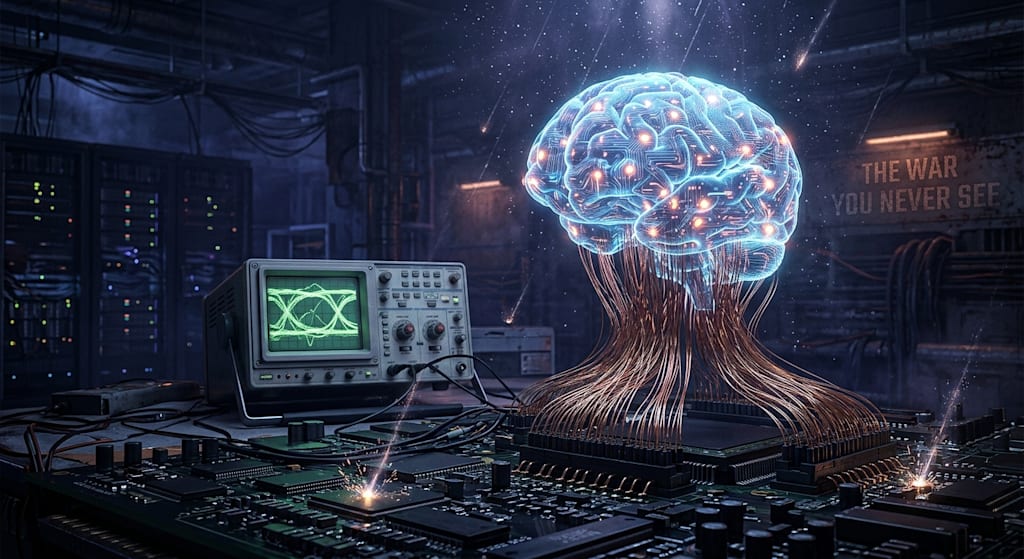
The War You Never See
Before AI can think, a signal has to survive copper traces, cosmic rays, and the universe's relentless drive toward chaos.
Zero
In Liu Cixin's The Three-Body Problem, there is a quiet but devastating setup: the sophon destroys no hardware, kills no one. It does only one thing: interfere with humanity's experiments observing the microscopic world.
No observation, no data. No data, no control. No control, and every superstructure of industrial civilization—from CPUs to AI—stops at the blueprint stage.
The premise is unsettling because it is physically grounded. Every engineering miracle in human history stands on a single wire that turns a physical quantity into a voltage. If that wire breaks, or if it is inaccurate, all the buzz above it is empty.
But reality is one crueler layer beyond science fiction.
Even if that wire stays intact, and the sensor converts light, pressure, or temperature into an electrical signal, that signal enters another war one nanosecond after leaving the pin. It is a silent war against the universe itself. A war that loses every day, yet must be won.
I. The Eye Diagram
You put an oscilloscope probe on a board running DDR5 memory.
On the screen appears something engineers call an eye diagram. It looks like an eye lying on its side, with two horizontal lines and a diamond-shaped opening in the middle. The wider the opening, the cleaner the signal. The narrower it is, the more dangerous the data.
In textbooks, digital signals are square 0s and 1s, like neat rows of bricks. But in the physical world, square waves do not exist. High-speed signals traveling over copper foil face enemies that include thermal noise (electrons crashing around inside the wire), crosstalk (the neighboring trace is also running signals, and they leak into each other), impedance discontinuities (vias, pads, corners, each a cliff), and skin effect (high-frequency signals only dare to travel along the surface of the conductor; the core is empty).
What do all these factors add up to? The sharp edges of the square wave get rounded off, the rise time slows down, and the signal jitters like sieved flour.
Signal integrity engineers do not write Python, tune models, or talk about AI. Their work is extremely concrete: adjust the spacing between a differential pair to the micron; route serpentine traces on the PCB so that the length difference in a data bus stays within a few millimeters; switch to a board material with a different dielectric constant to shave off a few tenths of a decibel of loss.
Their only weapon is the oscilloscope. Their only metric is how wide that eye opens.
The job is not glamorous. It does not get you into top conferences. It never trends. But without these people, when you run a heavy application on your phone, the internal bus data would trample each other, the bit-error rate would spike, and the screen would go blue. You would think the system froze. In reality, a bunch of electrons on those copper traces are fighting each other, and none of them can reach where they are supposed to go.
II. The Flip
Even if the signal stumbles its way into the memory module, the story is not over.
The next killer is cosmic rays. High-energy alpha particles penetrate the packaging material, strike a storage cell, and knock its charge out of place. A bit flips from 0 to 1, or the other way around.
It sounds like science fiction, but it is routine. Every server experiences several of these soft errors every second.
Most people think the photos, documents, and code stored on a hard drive are static and permanent. But to a physicist, the charge in storage media is constantly leaking. Data naturally tends toward chaos. Entropy is a law of the universe; it does not negotiate.
This is where another group of people step in with another set of tools: error-correcting codes.
ECC memory has an extra chip that does exactly one thing. When writing data, it stuffs in redundant information. When reading, it plays a mathematical guessing game. Even if the original bits are drowned in noise, that redundancy lets it guess back what they were.
From Hamming codes to Reed–Solomon to the LDPC codes that today's AI training clusters cannot live without, this mathematical armor has no expression, generates nothing, and creates nothing. It says only one thing: "I'll guess back what you lost."
Today, when training a model with hundreds of billions of parameters, if the H100s or MI300s are not paired with ECC-protected memory, the training process will diverge within hours. It does not just slow down; it goes straight to gibberish. Because each iteration accumulates those few random bit flips, and eventually the entire weight matrix is skewed.
Most people see a training run that succeeded. Engineers see that across tens of thousands of data lanes, errors are mathematically pulled back every single second, without a single break.
III. The Offset
The sensor measured. The signal arrived. The data was corrected.
But for a radar array, a distributed seismic exploration network, or the multi-sensor fusion system of an autonomous vehicle, each frame of data may be perfect, but the timestamps do not match. The camera says it took that frame at millisecond 100; the LiDAR says millisecond 103. Three milliseconds off.
Three milliseconds mean nothing to a human. To a car traveling at 60 km/h, three milliseconds equal a five-centimeter displacement error. Five centimeters in a fusion algorithm are enough to count one obstacle as two, or two as one.
The solution is PTP, Precision Time Protocol. What it does is maddeningly tedious: stamp timestamps at the hardware layer inside switches; use algorithms to estimate the microsecond-level delays that packets spend queued; squeeze the offset between two independent clocks miles apart down to sub-microsecond levels.
This system is not cool at all. No GUI, no flashy demos. Just offsets, delays, and best-master-clock elections, jargon that chokes you. Debugging means staring at numbers scrolling in a terminal, watching to see if they converge.
Most people think time is the number in the upper-right corner of their phone. But in a physical system, time is not read; it requires alignment. Two devices do not share a common time; they each have their own crystal oscillator running inside. Those two oscillators are naturally out of sync, and they need to be constantly, repeatedly, exhaustively pulled back together.
IV. The Bucket
Look back at The Three-Body Problem.
The sophon locked down microscopic observation. Humanity later built enormous space fleets, only to find itself no further along in fundamental physics than it was centuries before. They could still build things, but they no longer knew which direction to build toward.
The sensor is that observation window. Materials science determines what sensors can do. What sensors can do determines what kind of input control systems can get. What control systems can get determines where the ceiling lies for everything above.
A bow and a rifle are both ranged weapons, but they are fundamentally different.
Today, we route signal traces to millimeter tolerances, equip every memory module with ECC, and calibrate clocks across dozens of kilometers to microsecond precision. Each of these things, taken alone, is unremarkable. Put together, they barely sustain the foundation on which AI can run.
V. The Everyday
This section could be deleted. But I would like to keep it.
While writing the above, I had a cup of cold tea on my desk. A screenshot of an eye diagram on the left window, a PTP configuration document on the right. The streetlight outside turned on, just like it did five minutes ago.
That DDR5 eye diagram still is not fully open. There is a trace that needs to be rerouted. The ECC error counter spiked this afternoon, and the cause has not been found yet. The PTP offset is still jittering, but it is within threshold.
These things will still need to be done tomorrow. No one will know. No one needs to know.
There is no technological explosion. It is just countless people crouching in front of oscilloscopes, pressing the noise of the universe into the dirt, little by little. After today's layer is pressed down, tomorrow brings the next.
The tea is indeed cold. I am going to get another cup.
About the Creator
Jin
Writer of reamstories
https://reamstories.com/jin
Enjoyed the story? Support the Creator.
Subscribe for free to receive all their stories in your feed. You could also become a paid subscriber, letting them know you appreciate their work.
Comments
There are no comments for this story
Be the first to respond and start the conversation.