
The Vertical Mouse Was Never Going to Replace Your Mouse
It looks more ergonomic, but the research never supported the promise that made it a mass-market alternative.
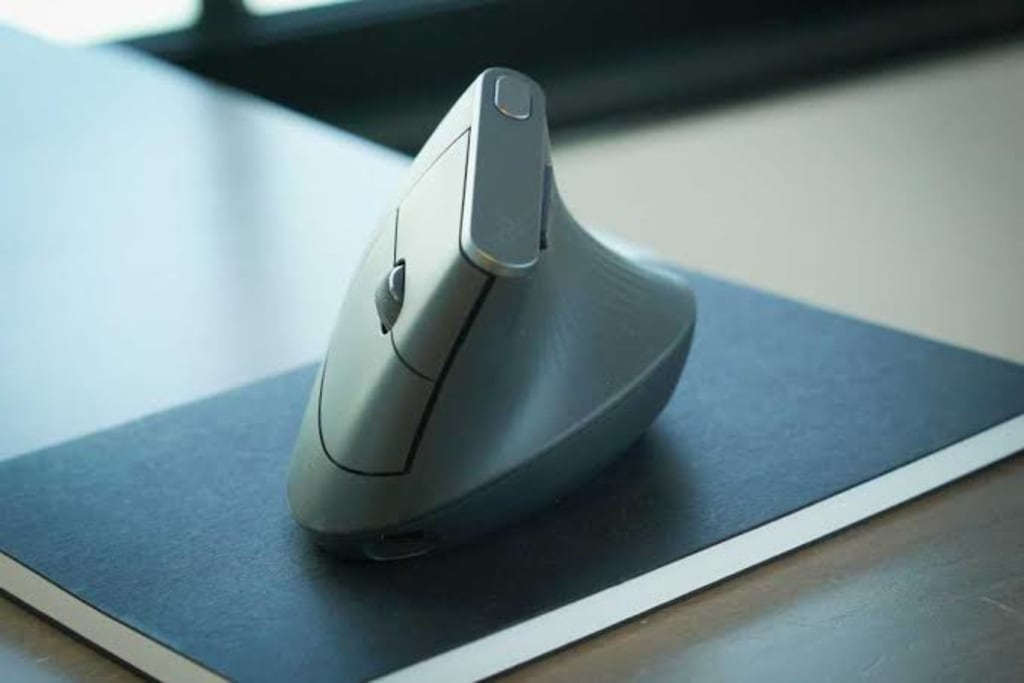
You thought of a vertical mouse because your wrist hurts. That reaction is natural. A device that looks more scientific, why has it not replaced the less scientific old thing?
Two easy explanations are wrong. The device works for some people, and price alone does not explain the gap. The vertical mouse solves a problem that has been misdescribed, and it asks most people to pay a cost they have no reason to accept.
First, the enemy it aims at may be the wrong one
The central selling point of the vertical mouse is prevention of “mouse hand,” usually carpal tunnel syndrome. The design logic sounds clean. A traditional mouse forces the forearm into pronation, palm down. A vertical mouse turns the hand toward a handshake position, closer to a neutral wrist. The 2015 study measured a reduction in forearm pronation from roughly 42 degrees to 28 degrees and a slight drop in extensor activity.
But there is a gap between changing a posture and preventing a disease.
Carpal tunnel syndrome is caused by pressure on the median nerve inside the carpal tunnel. In the general population, prevalence is about 1% to 5%, with women affected about three times as often as men. Chinese news coverage in 2025 put prevalence among video-terminal workers at 12% to 15%. The common cause is repeated wrist flexion and extension in a genetically narrow tunnel.
A 2015 study of 21 patients already diagnosed with carpal tunnel syndrome tested a standard mouse, a vertical mouse, a gel wrist rest, and a sliding palm support. The vertical mouse reduced ulnar deviation, tilt toward the little finger. The gel pad and palm support reduced wrist extension. None of the devices lowered pressure inside the carpal tunnel. When patients operated any mouse, pressure rose. The rise with the vertical mouse was not meaningfully different from the standard mouse.
A Cochrane review combined 15 trials with 2,165 office workers. It found that using an alternative mouse alone, including vertical mice, did not reduce upper-limb disorders in a measurable way. Only when an alternative mouse was combined with an arm support did the incidence of neck and shoulder disorders fall by about half.
The vertical mouse improves a biomechanical marker. That marker has not been shown to translate into a clinical outcome. When the core promise becomes unclear under rigorous evidence, its case as a mass-market preventive tool weakens. The authors of the 2015 study did not strongly recommend or oppose any common ergonomic device. They said choice depends on personal preference.
Second, changing posture means rewriting muscle memory
Switching to a vertical mouse requires changing a hand movement pattern built over years, often decades. Wired, reviewing a Razer vertical mouse, put it directly: the design “completely contradicts the muscle memory you’ve built up over years.” The first consequence is loss of pointer precision. The cursor stops behaving as expected. Everyday tasks become slower.
For gamers, the cost is close to unacceptable. The handshake posture limits the horizontal wrist sweep that first-person shooters depend on. For professional image editing, CAD, and video work, users report poor positioning accuracy. A steep angle or an unstable center of gravity can reduce precision, which defeats the purpose.
A 2022 study found that vertical mice were learned more slowly than tilted mice, although both reached a performance plateau after about 30 repeated tasks. Adaptation time remains a main barrier.
The practical reality is simple: most people start using a mouse before their wrist complains. For a person with no symptoms, accepting days or weeks of worse performance in exchange for a preventive benefit that has not been demonstrated is a bad trade.
Third, it is a specialized wrench, not a universal tool
The ordinary mouse has evolved into a general input device. It handles word processing, web browsing, high-precision image editing, and competitive gaming. The physical form of the vertical mouse limits it in several of those scenes.
Beyond gaming precision, vertical mice are at a disadvantage in tasks that require fast, fine, large-range pointer movement: CAD drafting, video trimming, detailed selection work. Many users report poor positioning. A steep angle or an unstable center of gravity can reduce precision. That defeats the purpose.
The result is a narrow role: the vertical mouse is closer to a comfort accessory for a specific discomfort than a productivity tool that covers every task. For a user who needs one device to do everything, keeping a general-purpose mouse as the main tool is the rational choice. The vertical mouse becomes a second device, not a replacement.
Fourth, the market structure resists replacement
Its absolute size remains small. In 2025, the global wireless vertical mouse market was about $362 million to $370 million. Logitech’s pointing-device sales, all mice included, reached $858.9 million in fiscal 2026. The vertical mouse is still a low-penetration subcategory.
The lower end of the category is crowded with products that look similar but have little ergonomic validation. Price competition squeezes brand margins, and consumers may come to see the vertical mouse as merely a redesigned shape. When the cheap end of a category cannot deliver a credible experience, the reputation of the entire category suffers.
The category faces three barriers: user education, acceptance of non-traditional shapes, and price sensitivity. The standard mouse market is mature and competitive. Persuading hundreds of millions of users with entrenched habits to try and adapt to a different shape, one whose core promise is unclear and which may underperform in key scenarios, requires marketing resources on a scale few companies will commit.
So who is the vertical mouse for?
This is not a dismissal. The value exists. It is buried under the wrong story.
The vertical mouse is best positioned as an option for people who already have wrist discomfort but have not developed severe pathology. If a standard mouse leaves you with forearm rotation soreness or an awkward ulnar wrist position, a vertical mouse may bring subjective relief. The 2015 study acknowledged that choice depends on personal preference.
But it is not a vaccine. It cannot prevent carpal tunnel syndrome, and it cannot treat it. The strategies with better evidence are less exciting: adjust the workstation so the elbows hang naturally; use an arm support or wrist rest to share the load; interrupt frequently and switch tasks so the wrist is not under static load for hours. The Cochrane review found the combination of an alternative mouse and arm support was the only combination that showed a protective effect.
If symptoms are already present, including numbness, tingling, burning, or weakness in the thumb, index, middle, or half of the ring finger, see a clinician for diagnosis and severity assessment.
The vertical mouse did not become the default because it was placed where it cannot perform: as a mass-market preventive replacement for the ordinary mouse. In its proper place, a comfort option for a specific kind of discomfort, its niche is reasonable. Use it as a comfort tool, not as preventive medicine. Adjust the desk, add an arm support, break up the static load. The vertical mouse can be one item on that list, not the list itself.
About the Creator
Jin
Writer of reamstories
https://reamstories.com/jin
Enjoyed the story? Support the Creator.
Subscribe for free to receive all their stories in your feed. You could also become a paid subscriber, letting them know you appreciate their work.
Comments
There are no comments for this story
Be the first to respond and start the conversation.