
The Validation Loop: An SRE Love Story in Forty Percent Increments
Two engineers, one closed-loop pipeline, and the quiet brutality of almost-kissing beside a rack of humming servers.
On the 23rd floor of that building in San Francisco’s Financial District, Ethan pushed his terminal across the desk.
“Use this one. I’ve cleared the aliases.” He stared at a glue mark on the edge of the screen as he spoke, not at Clara. The terminal was his personal Arch machine; the keyboard skin still had a coffee stain. Everyone in Ops knew Ethan Mo didn’t like people touching his gear.
Clara was only a junior SRE, just assigned to work with Ethan on the closed-loop validation pipeline. The architect Jason was still waiting for her to log into the shared jump box when Ethan copied an SSH key into her directory and casually ran chown. Jason shrugged and walked away. Clara noticed the kinesiology tape wrapped around Ethan’s index finger, mouse hand. She slid her iced Americano over. “No sugar,” she said.
That was the zero-to-ten percent.
For the next forty days, they stayed inside the loop.
Ethan had written the rules for the closed-loop deployment pipeline himself: any automation loop had to carry a validation box. Generator fed into reviewer, reviewer fed into an adversarial layer. Three rejections triggered an automatic pause and a human alert. At first Clara thought he was being dramatic, until a late-night release when Ethan stared at the CI logs and said, “Wait. Stop.” He manually sent the stop signal and caught an incremental update that would have contaminated user data before it reached the canary. Clara pushed her keyboard back at her desk and realized her heartbeat had gone erratic. She didn’t say anything. She just took a photo of the dry-erase notes he had left on the whiteboard: two circles, one labeled gen, one labeled eval, and a single line between them.
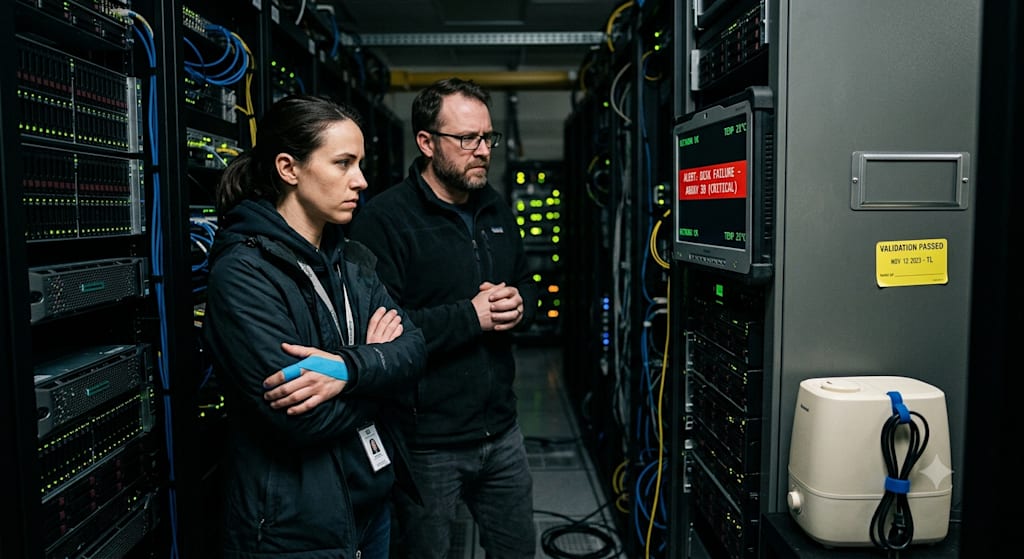
Their emotional high points never relied on confessions. The first came when she had a stomach ache. He dug a half-expired sheet of aluminum magnesium carbonate tablets from the bottom of a file cabinet, cut the foil, peeled the pills out one by one, and left them beside her laptop’s exhaust vent. He didn’t say “take these.” The second came after he had been refactoring for three days straight. After hours, she placed a small humidifier beside his rack, secured the power cable with a Velcro tie, and left a note: Humidity. Don’t burn. The third happened when they were tracing a network cable in the server room. His finger brushed her wrist. Neither pulled back. They stayed like that for two seconds, until the monitoring screen flashed an alert: rack temperature threshold breached, the air-conditioning panel glowing red. The almost-kiss was torn apart by the buzzer. He pulled away to type ipmitool sensor, and the back of her neck went cold.
That was nearly the forty-five-percent mark.
Clara later understood that the rift between them was never a misunderstanding. It was his validation compulsion. It was her instinct to bolt whenever things tightened. He controlled the loop. She controlled the distance.
The night before project delivery, Ethan discovered that a resource-scheduling script Clara had written could deadlock under extreme concurrency. He didn’t go to her. He rolled back the entire logic himself, rewrote it, and merged straight into master. The next day Clara saw git blame. She saw his name sitting on top of hers. She stood in the kitchenette, crushing the paper cup flat in her fist. She didn’t confront him. She opened the internal portal and filed a department transfer. Ethan was testing a new loop when the approval notification came through. His fingers hovered over the keyboard but didn’t press down. He thought about going after her. Instead, he added a comment to the reverted block: # reverted due to deadlock; original by Clara, validation failed at eval layer 2. He didn’t know who he was writing that for.
The dark moment was the stress-push at seventy to seventy-five percent. Neither of them was wrong, but both used their worst tools at the moment they most wanted to close the distance: he used I’ll fix it to sever her ownership, and she used I’ll leave to cut his line of reply.
The hollow days that followed, Ethan didn’t call. He wiped that terminal, reinstalled the OS, and did not replace the keyboard skin. At the Monday stand-up, Jason mentioned offhand that Clara had moved to the network team. Ethan set his coffee cup down; the base knocked against the table with a single thud. He said “Mm,” and turned the conversation to incident response times. That night he walked down the fire stairs alone. The doors on every floor slammed shut one after another. No narration. No music. Just the expired antacid sheet still in his pocket.
The loneliness of seventy-five to eighty-five percent was that the tablets were still there, but the humidifier had run dry.
The resolution came at the quarterly retrospective. Ethan shared his screen and pulled up a new draft of the deployment standards. On page four, line twelve, everyone read: Rollback operations require confirmation from the original committer in the review loop. Absence triggers a pause. Jason raised an eyebrow. Ethan just said, “Reducing single points of failure.” He didn’t look in Clara’s direction, but after the meeting, Clara stayed. She placed a folded piece of paper beside his notebook, the revocation confirmation of her transfer request, stamped by HR. She also typed crontab -l into his terminal and added a comment at the end of the task list: # verified, loop closed.
Ethan looked down. His keyboard skin was still there. He stood up, pulled a sticker from his drawer, one of those yellow tag labels, and wrote on it by hand: Validation passed. He peeled the backing and stuck it next to Clara’s empty nameplate. Then he said, “You’re covering network-layer monitoring at stand-up tomorrow.” His tone was the same as when he assigned a ticket.
Clara reached over and pressed the sticker flat. “See you tomorrow.”
The story ends at the point where it began, in that aisle where they almost kissed. But that night Ethan didn’t explain a single feeling. He only gave her the thing he trusted most inside the loop: not an I love you, but a closed circuit that could only run if both of them confirmed together.
No uplift. No sentiment. The air conditioner hummed. The rack lights glowed green.
About the Creator
Jin
Writer of reamstories
https://reamstories.com/jin
Enjoyed the story? Support the Creator.
Subscribe for free to receive all their stories in your feed. You could also become a paid subscriber, letting them know you appreciate their work.
Comments
There are no comments for this story
Be the first to respond and start the conversation.