
The things tender writers (like me) wish they could say out loud
A little peek inside the mind of someone who's read far too many tender documents.
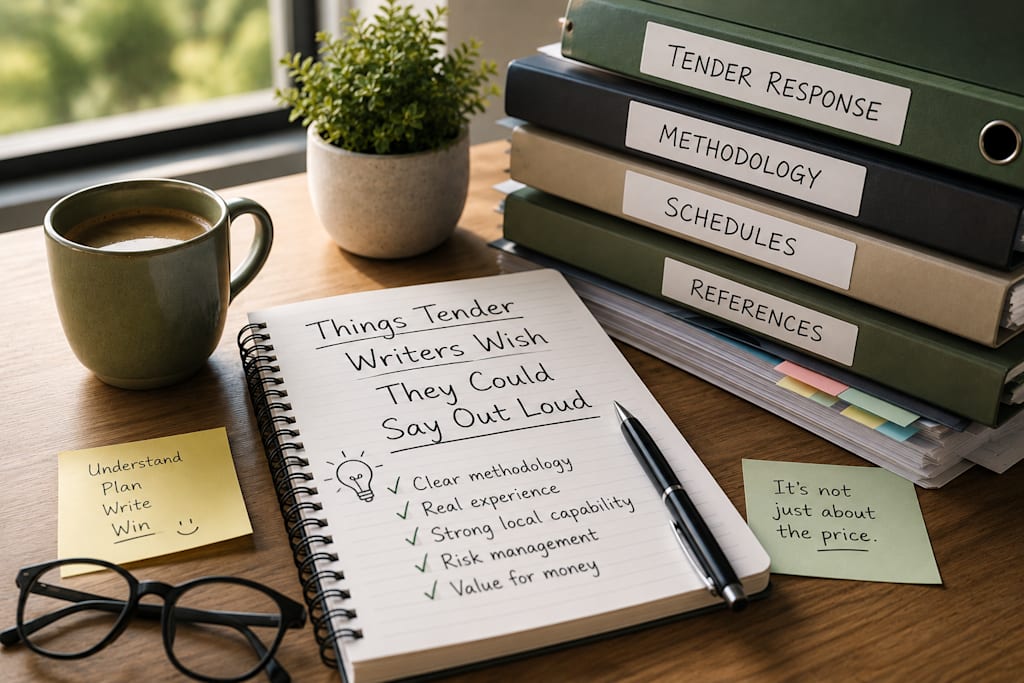
If you've never worked with a tender writer before, let me paint you a picture.
Imagine a profession where people voluntarily read hundreds of pages of procurement documents, decipher contradictory instructions, chase missing information, translate technical jargon into plain English, and somehow produce a polished submission before the deadline.
Now imagine doing that while drinking an unhealthy amount of coffee (and sometimes wishing it was gin).
Welcome to tender writing.
I genuinely love what I do. Helping businesses win work is incredibly rewarding, and after years of writing tenders across industries ranging from construction and security to healthcare and recycling, very little surprises me anymore. Well... almost.
Like anyone who works in a client-facing profession, there are things I say every day. And then there are the things I wish I could say.
So, purely in the interests of entertainment (and with complete affection for my clients), here's an honest look inside the head of a tender writer.
"No, I can't write a winning tender without seeing the tender."
This one happens more often than you might think.
"Can you give me a quote?"
"Sure. Can you send me the tender documents?"
"We haven't downloaded them yet."
Imagine calling an architect and asking how much your dream home will cost without mentioning whether it's a one-bedroom cottage or a twenty-storey apartment building.
Tender opportunities vary enormously. Some take a day. Some take weeks. Some require a few pages - and others bear a passing resemblance to the complete works of Shakespeare.
Until I've seen the documents, I'm making exactly the same educated guess as everyone else.
"If it's due tomorrow, we probably should have started before today."
I have enormous respect for business owners (after all, I'm one too). They're juggling staff, customers, suppliers, cash flow and approximately seventeen other crises before breakfast.
I understand that tenders often slip down the priority list. But every now and then, I receive the phone call.
"Hi, we've got a tender due tomorrow afternoon and we were hoping you could write it."
Could I? Possibly. Should I? Probably not. Because the best tenders aren't written in a panic - they're planned, researched and refined (usually over a few iterations).
The irony is that the businesses most capable of delivering outstanding work are often too busy delivering outstanding work to leave themselves enough time to write about it.
"Please stop telling me you're 'the best'."
Every business believes it's the best. Every business is committed to quality. Every business puts safety first. Every business delivers exceptional customer service. And every business exceeds expectations - at least according to their first draft.
Here's the problem. The evaluator has read exactly the same claims from twenty other companies. So don't tell me you're the best - show me.
Tell me about the difficult project you completed. The client you rescued. The challenge you overcame. The innovative idea that saved time or money. Evidence beats adjectives every single time.
"Your methodology can't be: 'We'll do a good job.'"
I've lost count of how many draft methodologies could be summarised in one sentence - something along the lines of "we'll arrive on site and complete the work professionally."
Excellent!! That narrows it down to every contractor in Australia.
A methodology isn't a promise - it's a plan. So tell me how you'll manage traffic. How you'll minimise disruption. How you'll communicate. How you'll respond if something goes wrong.
The more specific you are, the more believable you become.
"I promise the evaluator has never met you."
One of my (least) favourite client comments is "They know us."
Maybe they do. Maybe they don't. But even if they do, procurement rules usually require evaluations to be based on what's written in the submission. So the tender isn't the place to rely on reputation - it's the place to prove why you've earned it.
"No, adding another logo won't make you look more experienced."
Capability statements are wonderful. Some of them, however, seriously look like professional race cars because every available centimetre is covered with logos.
Clients. Suppliers. Software providers. Industry associations. Coffee loyalty cards (okay, maybe not that last one).
Experience isn't measured by the number of logos on a page. It's measured by the quality of the stories behind them.
"Please don't make me use the phrase 'world-class solutions.'"
Somewhere, in a dusty corporate cupboard, there's a machine that generates business buzzwords.
It spits out phrases like:
Industry-leading.
Cutting-edge.
Best-in-class.
Leveraging synergies.
Holistic solutions.
World-class service.
If you've ever wondered what these phrases have in common... it's that almost nobody knows what they actually mean.
Plain English is surprisingly powerful - so how about just saying that you answer every call within two hours. That's impressive.
"If you have a weakness, let's deal with it."
One of the biggest misconceptions about tenders is that you have to pretend you're perfect. You don't. Evaluators know that no business is perfect.
Maybe you're a smaller company. Maybe you haven't completed this exact type of project before. Maybe you're growing rapidly. That's okay.
What matters is how you'll manage the risk. Honesty, backed by a sensible mitigation strategy, is far more convincing than pretending limitations don't exist.
"No, AI can't magically write your tender."
Yes...I see the irony. Technology is an incredible tool. I use it (alot). Many businesses also use it. But here's the thing: AI doesn't know your projects, your people, your lessons learned, your company culture or your client relationships.
Those things still come from humans.
The strongest tenders I've ever worked on combine technology with genuine experience. One without the other is never quite enough.
The Thing We Actually Wish We Could Say
Despite everything I've joked about here, there's one thing I genuinely wish every client knew.
We are on your side. When we ask awkward questions, it's because evaluators will ask them too.
When we challenge your assumptions, it's because we'd rather have that conversation before the submission than after the results are announced.
When we suggest changes, it's never because we're trying to make your life harder. It's because we want your submission to be the strongest version of your business.
Most tender writers don't get excited about documents - but we do get excited about seeing our clients win. Because every contract awarded means new jobs, stronger businesses, and another opportunity for good companies to do great work.
And honestly...that's a conversation I'll always be happy to have out loud. If you'd like to exchange war stories or talk about your tender mishaps I'm always up for a chat - here's how you can contact me.
About the Creator
Enjoyed the story? Support the Creator.
Subscribe for free to receive all their stories in your feed.
Comments
There are no comments for this story
Be the first to respond and start the conversation.