
The Telegram That Waited 108 Years: How GPT-6 Astra Cracked a WWI Code No One Cared to Solve
A German radio message from 1918 finally gave up its secret. The cipher was not impossible. The world had just stopped listening.
The telegram that waited 108 years
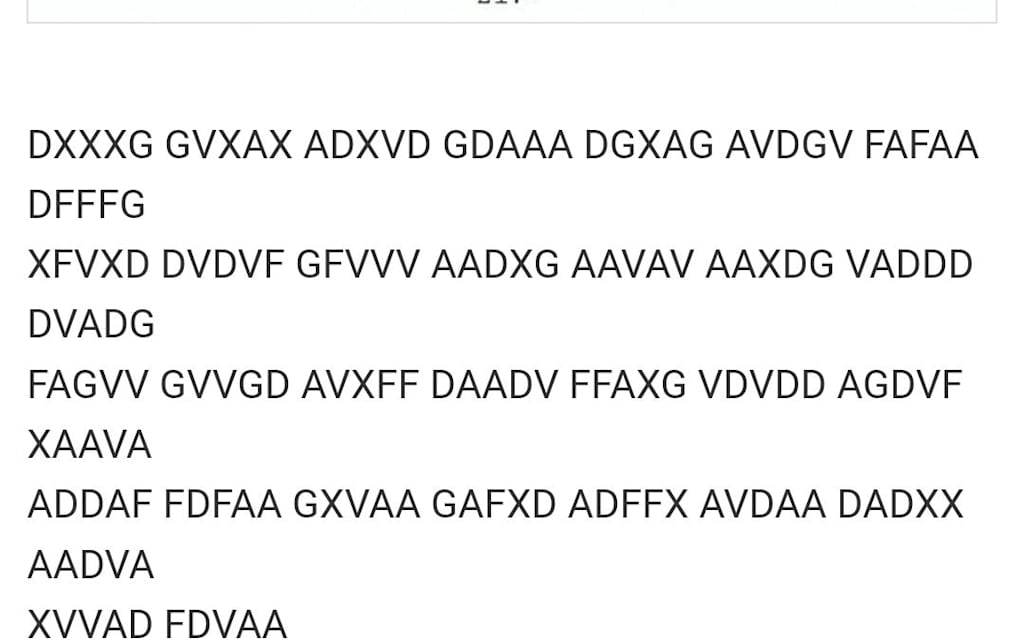
On November 27, 1918, an operator at a German wireless station pressed the key. ADFGVX. Six letters, A, D, F, G, V, X, arranged in two rows on paper. The message went to the Supreme Command, for an admiral’s attention. It was short. An English cruiser arrived at Sevastopol. An Allied squadron would follow on the 26th.
The operator did not know the message would sit in an archive for 108 years.
In September 2026, a developer named Prinz picked it from a list of 50 unsolved ciphers maintained by Scienceblogs.de. He used GPT-6 Astra. The key was TRUPPENVERSCHIEBUNG, German for troop movement. Astra produced a German plaintext with a question mark: ?4th. Translated, it read: an English cruiser arrived at Sevastopol on the ?4th, and an Allied squadron follows on the 26th.
Prinz checked British naval logs. HMS Canterbury, November 24, 1918, Sevastopol. The Allied squadron, November 26. The question mark was 24. A 2 had been lost in transmission.
The calendar explains the delay. The Armistice was signed on November 11. The message was sent sixteen days after the war ended. The German navy was collapsing. The Supreme Command was cleaning up. A telegram about a British cruiser and an Allied squadron, on November 27, 1918, had no recipient who needed it. The Allies had already won. They did not need to break an expired German telegram.
After the war, the archives closed. Researchers turned to more famous battles and larger histories of cryptography. This telegram became a footnote.
There was also a technical reason. Archive records show that the key TRUPPENVERSCHIEBUNG entered use on December 9. The message was sent on November 27. Twelve days. If researchers filtered possible keys by the archive date, they would skip it. One wrong date label let a telegram lie in the dark for another century.
Prinz published the work on Substack. Tech media reported it. On Reddit, someone joked: “Tell the Kaiser now, too late.” Another comment said: “It very much screams of no one gave a shit to solve it.”
The jokes point to a plain fact. The value of intelligence depends on time. Late intelligence is no longer intelligence. It is an archive.
The decryption itself still needs scrutiny.
Prinz’s conclusion has not gone through independent peer review by cryptographers. OpenAI has made no statement about this specific decryption. Astra both decrypted the message and cross-checked it against historical records. A powerful language model can work backward from historical events and construct a plausible key and plaintext. That risk is lower because TRUPPENVERSCHIEBUNG is an archival key, but it is not zero.
The key-date contradiction is also unresolved. If the archive record is accurate, the key was activated twelve days after the message was sent. Was the archive wrong? Was the key used early? Was the sending date wrong? These questions need historians and cryptographers to answer together.
The cipher itself was not simple. ADFGVX used a 6x6 Polybius square, mapping each character to a pair of letters chosen from A, D, F, G, V, and X. The six letters were chosen because they differ clearly in Morse code, which reduced confusion in radio transmission. The ciphertext then went through a columnar transposition, keyed to another secret word. It combined substitution and transposition. For a manual field cipher in 1918, it was advanced.
The French cryptanalyst Georges Painvin broke the ADFGVX system in June 1918 and gave the Allies important intelligence. Breaking a system does not mean breaking every message. Many intercepted telegrams remained unread because the key was unknown, the transmission was corrupted, the archive was scattered, or the context was missing. The U.S. Army officer James Rives Childs preserved hundreds of these intercepts. In 2016, cryptanalyst George Lasry solved roughly 618 of 668 messages in a paper. About twenty remained unsolved. This was one of them.
ADFGVX was breakable. This message stayed unread because it lacked urgency. Its date label was wrong. No researcher had a reason to test that key at that time. It fell through the cracks.
AI’s role here looks less like a miracle and more like a tireless research assistant. It can process language, patterns, historical context, and permutations at once. It can search key spaces that humans overlook. It does not stop because a telegram is unimportant. But archive labels can mislead it. Human judgment is still needed.
If the result holds, the larger point is not the specific message. A large language model can perform multi-step historical cryptanalysis. It can try keys. It can apply a transposition procedure. Then it can translate the output and check it against primary sources. That is different from pattern-matching on known solutions. It suggests that AI can become a useful tool in historical codebreaking, not a replacement for verification.
In November 1918, the German navy could not use the message. The British cruiser at Sevastopol, the Allied squadron that followed, and the radio operator who pressed the key all became footnotes. The telegram saved no one. It changed no battle. Its military value was gone almost as soon as it was sent.
Its value is historical now. It shows how people used ciphers and sent radio messages across a battlefield. They kept transmitting on the eve of an armistice that made every message pointless. It also shows how AI can reopen forgotten texts and piece fragments back into history.
On Reddit, someone asked about the Zodiac killer’s cipher. One was solved recently, and the answer was disappointing. It contained ego and complaint. No treasure map. No confession. That is a common fate of codebreaking. We expect a secret. We get an ordinary record, a mistake, or news that arrives too late.
The harbor at Sevastopol now holds yachts. The logs of HMS Canterbury sit in an archive. In Astra’s dialog box, the cursor blinks.
The radio waves are gone. The receiver remains.
About the Creator
Jin
Writer of reamstories
https://reamstories.com/jin
Enjoyed the story? Support the Creator.
Subscribe for free to receive all their stories in your feed. You could also become a paid subscriber, letting them know you appreciate their work.
Comments
There are no comments for this story
Be the first to respond and start the conversation.