
The Smartphone That Grows a Neck
Honor’s $1,300 robot phone isn’t about better photos. It’s about getting a machine to finally look back at you.
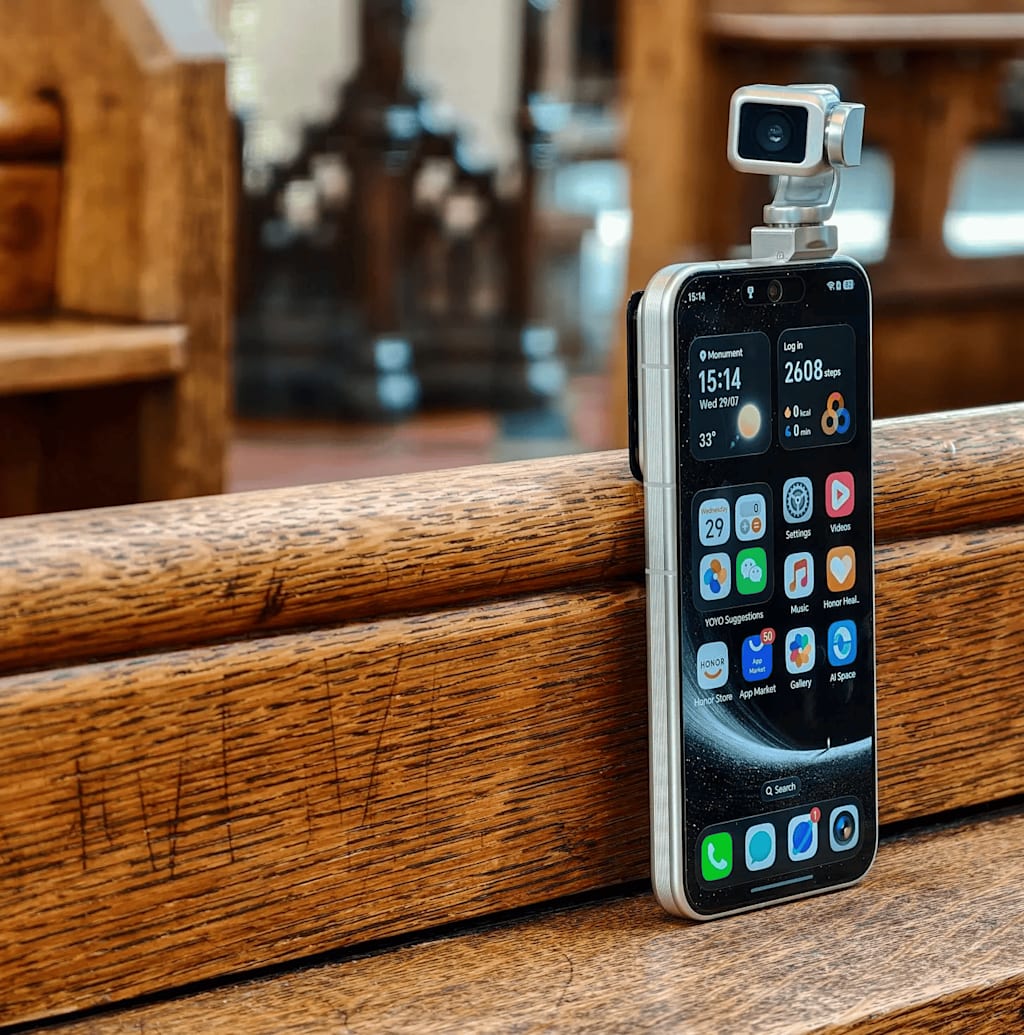
Guangzhou, August 12, 2026. On the发布会 stage, a product manager from Honor placed a phone flat on the table. The audience was still murmuring when the top of the device suddenly arched up. A silver‑gray metal turret rose silently, then turned 15 degrees to the left, like a cat just waking from a nap, scanning for threats.
Then the stage lights dimmed, and a bass drum kicked in. The gimbal began to sway to the beat. Not a rigid mechanical motion, but with a hesitant, tentative rhythm, like a child hearing music for the first time, clumsily imitating an adult’s dance.
People in the audience laughed. Others pulled out their phones to record. A fellow journalist next to me whispered, “Isn’t this just a toy?”
Two days later, after handling the actual device and digging through every spec, my answer is this: it is an outrageously expensive toy, but one that changes how a phone relates to its user. It does so in a clumsy, costly, yet remarkably directed way.
The Body: Why AI Needs a “Neck”
Honor calls this the Robot Phone. Not “Phone with a Gimbal.” They are not pitching a camera phone with an added stabilizer. They are selling a terminal that has gained the ability to perceive and respond.
To understand that, you have to see how the gimbal works. It comprises over 100 precision parts, with a motor weighing just 2.6 grams and machining accuracy of ±0.005mm. Those numbers translate into one sentence: it is small enough to fit inside a phone, yet fast enough to turn the moment you raise your hand.
In my real‑world test, I tried the most basic subject‑tracking. An assistant walked side to side five meters away. The phone locked onto the face, the gimbal followed smoothly, and the footage never stuttered. Then I suddenly sprinted to the side. The gimbal responded with a latency of about 0.2 seconds, then snapped back to tracking, like a Golden Retriever whose attention is yanked away by a suddenly thrown frisbee.
That feeling of “being seen” is something no phone algorithm has ever achieved. Algorithms can only crop the frame; the gimbal physically turns to face you. The difference is that the latter makes you feel it is actively seeking you, not that you are waiting to be captured.
Honor internally calls this “embodied intelligence.” Break that down: give AI a body, so it can turn its head toward you, adjust its posture with your gestures, and, when you fall silent, slowly point its lens at the rain outside the window.
Of course, the physical world never gives anything for free. At 9.59mm thick and 248 grams heavy, holding it feels like gripping a solid piece of cast iron. If you are used to the thinness of foldables or the lightness of slabs, this phone’s first tactile impression is a reminder. It keeps telling you: I have gears inside me, motors, over a hundred moving parts.
The Soul: ARRI’s Filters and a Sensor That Cannot Be Compromised
If the gimbal is the flesh, then the joint development with ARRI is the attempted soul. A century‑old brand in cinematography, the company behind monitors and colour science for every Hollywood blockbuster, Honor brought them into a phone.
The collaboration goes far beyond a logo. The ARRI LogC3 curve is fully ported, 11 official ARRI Looks are available out of the box, and 10‑bit Log, 4:2:2 sampling, and the ARRI Wide Gamut 3 colour space are all enabled. I shot a backlit scene at 4 p.m., pulled back the highlights in post‑production, and the cloud textures remained distinct, layer by layer. The shadows in the foliage showed no banding. That “sigh of relief” in dynamic range was something I had only felt before on Sony’s FX series.
Two professional tools—peaking focus and false‑colour monitoring—are also baked into the camera interface. The former uses red speckles to show you where the focal plane sits; the latter warns of overexposure with warm‑coloured blocks. Pros will recognise them instantly; casual users may be baffled the first time. But Honor’s strategy is clear: you can stay a beginner, but we leave a scalpel in the drawer, ready for the day you want to cut deeper.
Yet one flaw is unavoidable: the sensor is 1/1.28 inches. ARRI’s colour science can rescue skin tones, and the Log curve can save dynamic range, but physical depth of field cannot be saved. The cinematic shallow‑focus look that comes from a large aperture on a full‑frame sensor can never be truly mimicked by a phone sensor. Any marketing line claiming it “rivals professional cinema cameras” is best taken as an enthusiastic rallying cry, not a lab‑tested metric.
Interaction: YOYO Pro and the Moment It Danced to the Music
What moved me most was not any spec sheet; it was the gimbal’s music‑sync function.
On stage, as the bass drum hit, the gimbal did not move like a metronome. On certain weak beats, it lagged half a beat; on strong ones, it accelerated just a fraction. I asked the engineers, and they said the AI does not analyse BPM. It analyses the emotional vector of the frequency spectrum. In other words, it is feeling the song, not counting time.
That sounds mystical, but when you stand the phone on your desk, play a favourite track, and watch it sway gently with the melody like a little living creature, you experience a brief illusion. This is not a device; it is a friend who is listening to music with you.
Other smart interactions revolve around this “neck.” Say “shoot a low‑to‑high circular dolly,” and the gimbal automatically executes one of six professional motion trajectories. During a live stream, it follows your movement. In a video call, when you get up to pour water, it reframes automatically to keep you centred. All of these used to require an external gimbal plus third‑party apps; now they are integrated into a single body.
Of course, the AI is not omniscient. I tried to get it to recognise my “OK” hand gesture to start recording. It succeeded twice out of three attempts. On one try, it misinterpreted it as a “zoom in” command and pushed the frame to 2x. These unpredictable glitches, oddly, make it feel more like a child still learning, rather than an all‑powerful butler.
The Cost: What 9,999 Yuan Buys, and What It Cannot
When the price appeared on screen, the room went silent for a second. The 12+512GB model is priced at 9,999 yuan; the 16+1TB version hits 12,999 yuan. That puts it well above most domestic flagships, straight into Apple and Samsung’s ultra‑premium territory.
Honor’s perks include a lifetime free YOYO‑AI membership, a one‑year worry‑free gimbal replacement during the initial sales period, and 1TB of cloud storage for the top model. But those offerings feel more like a statement: We know you are worried about dropping it, and we know you are questioning its value, so here is a safety net.
To decide if it is worth it, break it down. A 7060mAh battery, a 6800‑nit peak brightness screen, a Snapdragon 8 Gen 5 Extreme Edition, a four‑mic audio array, and a self‑developed communication chip are top‑tier specs on any flagship. But the premium buyers pay is not really for these.
The premium buys the moment the gimbal rises, the “wow” from a friend when they see it track automatically, and the quiet thrill you feel late at night, pulling the ARRI Log curve in your editing software and realising you, too, can craft a cinematic look.
But the premium cannot buy durability. IP54 only guards against splashes, and if the gimbal is extended and the phone is dropped, the repair cost will likely give you a small heart attack. Mechanical structures are inherently more fragile than solid‑state chips. That is a physical law. Honor tries to ease the anxiety with a one‑year replacement programme, but what about after that year? This is a phone you have to treat with reverence, not a tool you can toss casually into your bag.
Conclusion: It Is Not the Answer; It Is the Question Itself
As I write this, I recall the moment after the press conference, when the product manager was surrounded by journalists asking, “Why did you have to use a mechanical structure? Couldn’t algorithms replace it?”
He paused for two seconds, then said: “Algorithms can only crop the frame. The gimbal turns to face you. The former is optimisation; the latter is response.”
That line may hold the answer to the “is it worth it” debate. The Robot Phone is not solving an existing problem. It is redefining the problem: should the relationship between a phone and a person stop at “you swipe, it responds,” or can it evolve toward “it perceives, it initiates”?
For now, it resembles a baby who has just learned to turn its head. It is awkward, power‑hungry, expensive, and you are forever afraid it might fall. But it points in a direction: future intelligent terminals should not just have stronger algorithms; they should feel more like companions. Ones that look at you, sway to music, and, when you are silent, leave a window open for you.
Honor has taken that step. Whether it is the right step depends on whether the market gives it time to grow.
What I remember most is that first hesitant sway of the gimbal under the stage lights, following the bass drum. Clumsy, like any newborn, but real.
About the Creator
Jin
Writer of reamstories
https://reamstories.com/jin
Enjoyed the story? Support the Creator.
Subscribe for free to receive all their stories in your feed. You could also become a paid subscriber, letting them know you appreciate their work.
Comments
There are no comments for this story
Be the first to respond and start the conversation.