
The Skills Every Ethical Hacker Must Learn
From networking fundamentals to AI-powered exploitation, here is the complete roadmap to becoming a job-ready ethical hacker this year

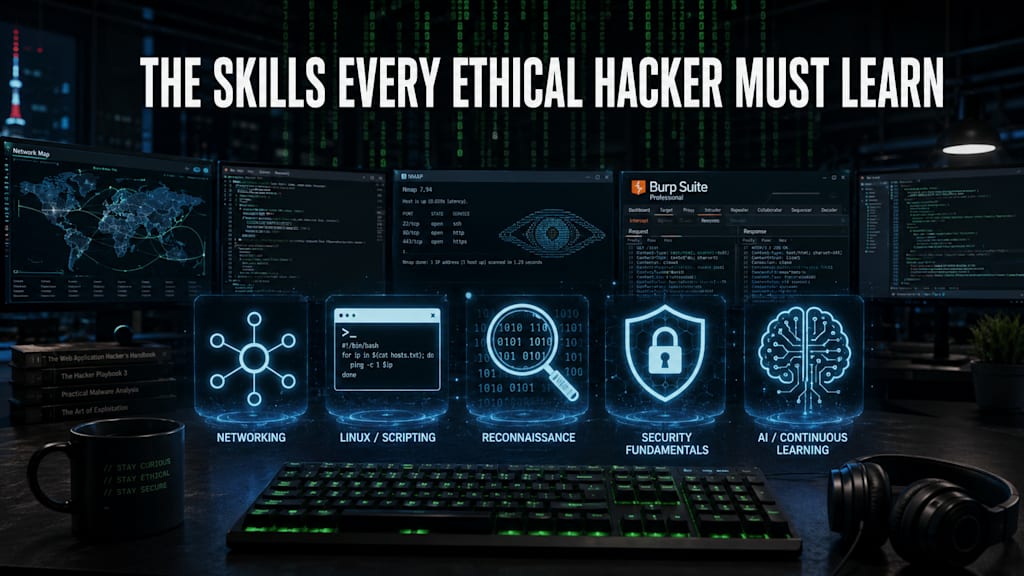
The Skills Every Ethical Hacker Must Learn in 2026 From networking fundamentals to AI-powered exploitation, here is the complete roadmap to becoming a job-ready ethical hacker this year Let me start with something that might surprise you. The most successful ethical hackers I know do not start with tools. They do not open Kali Linux and start running Nmap scans. They do not watch YouTube tutorials about Metasploit. They start with fundamentals. Networking. Linux. How data actually moves across the internet. And here is why that matters in 2026. The cybersecurity workforce gap has expanded to nearly 5 million positions worldwide . Companies are desperate for skilled ethical hackers. The average salary for a penetration tester in the United States ranges from $75,000 to $160,000 depending on experience . Entry-level roles are paying $75,000 to $95,000 . But you cannot just walk into these jobs. You need skills. Real, demonstrable, hands-on skills. I have researched the current ethical hacking landscape for this article. I have looked at certification requirements, job descriptions, and learning roadmaps from industry leaders. And I am going to tell you exactly what you need to learn, in what order, and why each skill matters. The Non-Negotiable Foundation Before you touch a single hacking tool, you need to understand how computers and networks actually work. This is not optional. It is the difference between being a script kiddie and being a professional. Networking Fundamentals Networking is the backbone of ethical hacking. If you do not understand how data flows, you cannot understand how attacks happen . You need to become fluent in TCP/IP, DNS, DHCP, HTTP, and HTTPS. You need to understand firewalls, routers, switches, ports, and protocols . You need to know what happens when you type a web address into your browser, from DNS resolution to the TCP three-way handshake to the TLS negotiation . Here is a simple test. Can you explain the difference between TCP and UDP? Can you tell me what happens during a three-way handshake? Can you read a packet capture and identify what is happening? If not, start here. The best way to learn networking is not reading textbooks. It is doing packet capture exercises. Use Wireshark to capture your own traffic. See the packets. Understand the conversation . This takes time, but it is time well spent. Linux and Operating Systems Here is a truth that every professional ethical hacker will tell you. Most hacking tools run on Linux. Kali Linux, the most popular penetration testing distribution, is built on Debian. You cannot be an effective ethical hacker without being comfortable at the Linux command line . What do you need to know? Basic commands like ls, cd, grep, awk, sed, netstat, and systemctl . File permissions and user management. System logs and services. Process management. Bash scripting for automation . You do not need to be a Linux system administrator. But you need to be comfortable enough to navigate the file system, edit configuration files, and understand what the system is telling you. Set up a Linux virtual machine. Ubuntu or Debian are good starting points. Force yourself to use the command line for everything. Install software. Check logs. Monitor processes. The discomfort is the learning. The Programming and Scripting Layer You do not need to be a software engineer. But you absolutely need to be able to write and understand code . Python is the most important language for ethical hacking . It is used for everything from reconnaissance scripts to exploit development to reporting automation. You need to understand requests, sockets, regular expressions, and basic API interaction . Bash scripting is also essential for automating repetitive tasks on Linux systems . You should be able to chain commands, parse outputs, and schedule scripts with cron. JavaScript is important for web application security testing. Understanding how JavaScript works helps you identify client-side vulnerabilities and DOM-based XSS attacks . A good target for beginners is to write a simple port scanner in Python. Then a subdomain enumerator. Then a basic web scraper. These projects teach you both programming and security concepts at the same time. The Core Ethical Hacking Skills Once you have the foundation, you can start learning the actual hacking techniques. These skills build on each other. Do not skip ahead. Reconnaissance and OSINT Reconnaissance is the first phase of any ethical hacking engagement. It is the process of gathering information about your target before you ever attempt to exploit anything . Passive reconnaissance involves collecting publicly available information without interacting directly with the target. This includes DNS enumeration, subdomain discovery, email harvesting, and technology fingerprinting . Tools like theHarvester, Recon-ng, and SpiderFoot are used here . Active reconnaissance involves direct interaction with the target, like port scanning and service discovery. Nmap is the industry standard for this . Here is the key insight from professional bug hunters. The recon phase determines everything that follows. The more time you spend on recon, the more vulnerabilities you will find . Jumping straight to exploitation without proper reconnaissance is a common beginner mistake. Scanning and Enumeration Once you know what systems exist, you need to scan them for open ports, running services, and potential vulnerabilities . Enumeration is the process of extracting detailed information from systems. This includes enumerating users, shares, services, and configurations. It is where you move from "there is a web server" to "there is a web server running Apache 2.4.49 which is vulnerable to path traversal" . Tools like Nmap, Gobuster, and Ffuf are essential here. But the skill is not just running the tools. It is interpreting the output. Knowing what a version number means. Recognizing when a configuration is dangerous. Vulnerability Analysis Vulnerability analysis is the process of identifying potential weaknesses in systems and determining which ones are actually exploitable . This is where the OWASP Top 10 becomes relevant. The OWASP Top 10 is the standard list of the most common web application vulnerabilities. SQL injection, Cross-Site Scripting (XSS), Cross-Site Request Forgery (CSRF), and Insecure Direct Object References (IDOR) are all on this list . You need to understand not just what these vulnerabilities are, but how to find them and how to confirm they are real. A vulnerability is not a finding until you have a working proof of concept . Exploitation Exploitation is the controlled process of gaining access through verified vulnerabilities in authorized environments . This is what most people think of as "hacking." Using Metasploit to exploit a vulnerability. Crafting a SQL injection payload to extract data. Using Burp Suite to manipulate API requests and access another user's data . The key word here is controlled. In ethical hacking, you exploit only to prove the vulnerability exists. You do not cause damage. You do not exfiltrate data beyond what is necessary. And you do everything within the defined scope of your authorization. The best way to learn exploitation is through legitimate practice environments like HackTheBox, TryHackMe, and the OWASP Juice Shop . Reporting Here is something that beginners often overlook. Your technical skills mean nothing if you cannot communicate your findings. Ethical hackers spend almost as much time writing reports as they do testing. A good vulnerability report includes a clear title, step-by-step reproduction steps, a proof of concept, an impact assessment, and a remediation recommendation . Poorly written reports get closed as "informational" or "duplicate" even when the finding is valid. Professional report writing is a skill. Practice it. The Modern Reality: AI Skills Are Now Required Here is what has changed in 2026. Artificial intelligence is no longer optional for ethical hackers. It is integrated into every phase of the hacking lifecycle. The latest version of the Certified Ethical Hacker certification, CEH v13, has woven AI into every module . Not as an add-on. As a fundamental redesign of the entire curriculum. What does this mean in practice? Ethical hackers are now expected to: Use AI-powered tools for automated reconnaissance that can analyze vast amounts of data and detect patterns human analysts would miss . Understand adversarial machine learning attacks against AI systems . These are attacks that manipulate AI models by poisoning their training data or crafting inputs designed to cause misclassification. Test for prompt injection and LLM security vulnerabilities . As organizations deploy large language models, these are entirely new attack surfaces. Use AI for exploit development and chaining . AI can help identify complex logic bugs that traditional scanning tools miss. The CEH v13 certification is now recognized under DoD 8140, the U.S. Department of Defense Cyber Workforce Framework, and maps to 49 cybersecurity job roles . That is up from roughly 20 in the previous version. The government is taking AI-powered ethical hacking seriously. The Tools You Actually Need You do not need to learn every tool. You need to master a core set. Here is the essential toolkit according to industry professionals : **Nmap** is for network scanning and service discovery. It is the first tool you run on almost any engagement. It tells you what systems are alive and what services are running. **Burp Suite** is the industry standard for web application testing. The Community edition is sufficient for learning. You will use the proxy to intercept traffic, the repeater to modify and resend requests, and the intruder for automated attacks . **Metasploit** is the exploitation framework. You will use it to verify vulnerabilities and understand how exploitation works in practice . **Wireshark** is for packet capture and analysis. When something is not working as expected, Wireshark shows you exactly what is happening on the wire . **John the Ripper and Hashcat** are for password auditing. You will use them to test password policy resilience . **SQLMap** automates SQL injection detection and exploitation. It is a powerful tool, but you need to understand SQL injection manually before relying on automation . The Certification Pathway Certifications are not mandatory, but they open doors. Here is the recommended pathway for 2026 . **CompTIA Security+** is the entry-level certification that validates foundational security knowledge. It is not hacking-specific, but it is often required for government and defense roles . **eJPT (eLearnSecurity Junior Penetration Tester)** is a practical, hands-on certification that is excellent for beginners. It focuses on actual skills, not multiple-choice questions . **CEH v13 (Certified Ethical Hacker)** is the most well-known ethical hacking certification. The latest version integrates AI throughout the curriculum. It is recognized under DoD 8140 and maps to 49 job roles . However, it is broader than it is deep. **OSCP (Offensive Security Certified Professional)** is considered the gold standard for hands-on penetration testing skills . The exam requires you to hack live machines in a 24-hour practical exam. There is no multiple choice. You either hack the machines or you fail . OSCP is challenging. It requires significant preparation. The training course and exam start at around $1,749 as of January 2026 . But industry leaders widely recognize OSCP as a mark of expertise . For penetration testing roles, it is often the certification that gets you the interview. The OSCP certification is lifetime, but OffSec now offers OSCP+ which requires recertification every three years to demonstrate ongoing skill maintenance . The Hands-On Practice You Cannot Skip Certifications and courses are not enough. You need to practice in real environments. Here are the platforms professionals use : **HackTheBox** provides realistic, vulnerable machines that you hack without hints. The community is excellent. The machines range from easy to insane. **TryHackMe** is more beginner-friendly with guided rooms and learning paths. **DVWA (Damn Vulnerable Web Application)** is a deliberately vulnerable web app you can run locally. It is simple but perfect for learning the basics of web exploitation. **OWASP Juice Shop** is a more modern vulnerable web application that covers a wide range of vulnerabilities. **PentesterLab** offers hands-on exercises with a focus on web application security. Start with DVWA and Juice Shop. Move to TryHackMe. Then challenge yourself with HackTheBox. Expect to spend hundreds of hours in these environments before you are job-ready. The Career Path and Specializations Once you have the fundamentals, you can specialize. Here are the high-demand roles in 2026 . **Penetration Tester** is the most common entry point. You conduct authorized simulated attacks on systems, networks, and applications. Salaries range from $75,000 to $160,000 . **VAPT Specialist** combines vulnerability assessment (scanning for known vulnerabilities) with penetration testing (exploiting to confirm risk). This is a comprehensive role that many organizations need . **Cloud Security Specialist** focuses on securing AWS, Azure, and Google Cloud environments. With cloud adoption accelerating, this is one of the highest-demand specializations . **Malware Analyst** reverse-engineers malware to understand how attacks work and develop defenses. This requires strong programming and reverse engineering skills . **Red Team Operator** simulates full-scale adversarial attacks to test detection and response capabilities. This is an advanced role requiring deep technical skills . The Continuous Learning Requirement Here is the hard truth about ethical hacking. You never stop learning. New vulnerabilities are discovered daily. New exploitation techniques emerge constantly. Defenses evolve. Attackers evolve. The landscape shifts under your feet . Ethical hacking is not a career where you learn once and coast. It requires continuous education, constant practice, and genuine curiosity. The professionals who thrive are the ones who treat it as a craft, not a job. They read security research. They participate in bug bounty programs. They contribute to open source security tools. They go to conferences and meetups. If that sounds exhausting, this might not be the right field for you. If it sounds exciting, welcome to the community. Final Thoughts Ethical hacking is one of the most rewarding careers in technology. You get paid to solve puzzles. You protect real people from real harm. The demand is enormous, and the compensation reflects that. But the barrier to entry is not low. You need networking fundamentals, Linux proficiency, scripting skills, exploitation knowledge, and now AI capabilities. You need certifications to prove your knowledge and practice to demonstrate your skills. The roadmap is clear. Start with fundamentals. Learn the tools. Practice in labs. Get certified. Specialize. Never stop learning. The hackers are not waiting. Neither should you. Written by DDM ATIQ #ethical_hacker #ddmatiq
About the Creator
DDM ATIQ
ll
Enjoyed the story? Support the Creator.
Subscribe for free to receive all their stories in your feed.
Comments
There are no comments for this story
Be the first to respond and start the conversation.