
The Silent War for the Agent Runtime
Within one week, both DeepSeek and OpenAI gave away the blueprints to their AI execution engines. This isn't generosity—it's a race to define the architecture of the next computing era.
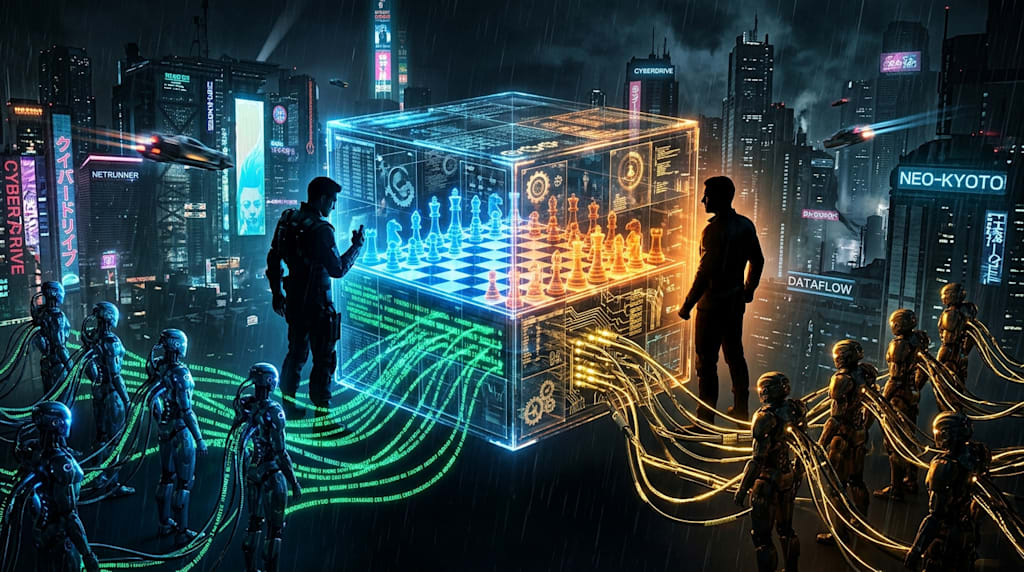
The Harness Open-Source Wave: The Battle for the 'Operating System' of AI Agent Ecosystems
On August 13, 2026, DeepSeek open-sourced a project called DeepSeek Harness on GitHub. Six days later, OpenAI did the same with Codex Harness.
Both call themselves "execution runtimes for agents." Both chose permissive licenses. They are competing for the same developer base at the same time.
From IQ to Execution Framework
Throughout 2024 and 2025, AI benchmark scores kept climbing. 90% accuracy on MMLU was no longer surprising. Several models now sit at the top of the GSM8K leaderboard. They answer more exam questions correctly than ever.
But developers noticed something else: inside an Excel sheet, the models could do nothing.
The models were not dumber. They lacked a framework that could move between tools, context, and memory. You could ask a model to analyze a sales table, and it would tell you "use VLOOKUP," but it would not open the file, manipulate the cells, or paste the result into a draft email.
Before harnesses, if you wanted an AI to use a tool, the typical routine was: define the function, write a description, wait for the model to decide to call it, parse the result, and continue. Every developer repeated that boilerplate.
A harness collects that repetitive logic into a single runtime. It does one thing: lets the model move back and forth between tools and context until the task finishes.
OpenAI gave a number in its announcement: after adopting Codex Harness, the internal first‑pass success rate for code generation rose 3.2 times, while token consumption dropped 40%.
Same model, different execution framework — different results.
DSH vs. Codex: What They Actually Offer
DeepSeek Harness is built on Node.js and the Cordis plugin framework, where everything is a plugin. Models are plugins. Storage is a plugin. UI components are plugins. DeepSeek provides only a "microkernel": plugin loading, lifecycle management, event bus, permissions, state, and execution protocols. You assemble the agent you need.
Codex Harness has its core written in Rust, focusing on performance and security. It provides stable JSON‑RPC interfaces and SDKs for TypeScript and Python. OpenAI expects you to already have an existing application, and you embed Codex into it — it becomes the AI backend inside your app.
The differences are deeper than technical choices.
DeepSeek wrote its README as a "DIY guide" — its default configuration is almost unusable for commercial purposes out of the box; you must assemble your own plugins.
OpenAI wrote its README as a "developer guide" — its default configuration is already a ready‑to‑embed product backend.
One says "you build"; the other says "you use."
Why They Open‑Sourced
DeepSeek included a direct quote in its repository README: "We want DSH to be the AOSP of AI Agents."
AOSP is the Android Open Source Project. When Google open‑sourced AOSP, every phone manufacturer could build their own systems on top, while Google made money through GMS services at the application layer. DeepSeek's roadmap is clear: DSH as the foundation, the community contributing the plugin ecosystem, and enterprises coming to DeepSeek for enterprise editions if they need private deployment and security auditing.
OpenAI's announcement did not mention AOSP, but Codex Harness design shows a different path. It emphasises "Bring Your Own Model" — though currently it deeply optimises only for OpenAI's models by default, the architecture allows replacement. That implies one thing: OpenAI wants Codex to become the "AI back seat" inside every SaaS product. You build a project management tool, you embed Codex, and your users invoke AI capabilities without leaving your interface. OpenAI steps back, providing only the models and the core execution engine.
Both are aiming at the same target: the closed‑source agent applications that lock all users inside their own UIs. DeepSeek and OpenAI are both telling developers with their open harnesses: you do not have to go into someone else's app — you can build your own.
What Will Change in the Industry
Plugin counts will explode, then become meaningless. With both frameworks open‑sourced, plugin development barriers are extremely low. Over the next six months, plugin counts could jump from hundreds to tens of thousands. But enterprises will not allow an unvetted plugin to read financial data. Who will provide security signing for plugins? Who can build an audit mechanism similar to the App Store? That question matters far more than "who has more plugins."
Models will be treated as swappable components. Context, tool lists, and historical records all reside inside the harness. The model is responsible only for producing the next decision. This means an agent can switch models mid‑task — lightweight open‑source models for simple reasoning, flagship models for complex analysis. Competition among model vendors will shift from "who is smarter" to "who is better adapted to this harness's execution habits."
Agent loops will become the new optimisation focus. Inside every harness runs a loop similar to ReAct: observe, think, act, evaluate. Within this loop, decisions about when to compress context, when to request human intervention, and how to verify sub‑task completion — these design choices often improve user experience more noticeably than swapping in a larger‑parameter model. The future competitive moat for model vendors may not be training data, but "specialised fine‑tuning for a particular harness loop."
The three capability units will converge. Currently there are three formats in the market: the MCP protocol, Agent Skills, and harness plugins. The market will not tolerate three parallel standards for long. Harnesses are likely to bundle MCP clients, and Skills may be converted into plugin bundles. The ultimate question will not be "do you support Skills?" but "while you support MCP, has your own user experience been diluted?"
The Giants Are Already Moving
WorkBuddy will not replace its core runtime to adopt DSH. It is more likely to announce compatibility with the DSH plugin format, accessing it through an adaptor layer while keeping its own core closed loop intact. Its defensive moat is WeChat, WeCom, and Tencent Docs — an open‑source harness can gain plugins, but it cannot immediately gain users' work relationships and business entry points. WorkBuddy's most effective defence is not replicating open architectures, but keeping agents deeply embedded in the business flows it already controls.
Alibaba Cloud will take a different route. It can turn the Bailian platform into a managed harness control plane — enterprises can deploy cloud instances of DSH or Codex with one click, with Alibaba providing monitoring, billing, and permission policies. This resembles Cloudflare Workers' approach: open‑source runtime underneath, enterprise management services sold on top.
For model vendors like DeepSeek and Zhipu, the path lies in vertical industries. They can offer "pre‑bundled plugins + customised models" suites for finance, healthcare, legal, and other sectors, ready to use out of the box. Such suites have far stronger stickiness than plain model APIs.
Will There Be an Android for Agents?
The situation recalls Android in 2008.
The similarity: an open foundation allowed many teams to stop reinventing the wheel and focus their energy on upper‑layer applications.
The difference: Android had no real competitor at the time — iOS was closed, and Windows Mobile had almost no developers. Today, DSH and Codex are competing for the same developer base at the same time.
If they do not achieve some degree of interoperability on plugin formats within six months, developers' choice paralysis will return things to square one: pick a camp, get locked in, and complain. The closed‑source vendors that build everything end‑to‑end will benefit instead.
But if DSH and Codex can form some underlying standard compatibility — or if a third‑party organisation provides a unified adaptor layer — then we will truly see the birth of an "Agent operating system."
There is one concrete thing in the next six months that will decide the direction of this trend: whether DSH and Codex will achieve any degree of compatibility on plugin formats.
If yes, we can see a true agent foundation ecosystem.
If not, developers' energy will be split between two camps, favouring those closed‑source vendors that do everything from scratch.
The two open‑source moves in August 2026 are only the starting gun. The finish line is not yet in sight.
About the Creator
Jin
Writer of reamstories
https://reamstories.com/jin
Enjoyed the story? Support the Creator.
Subscribe for free to receive all their stories in your feed. You could also become a paid subscriber, letting them know you appreciate their work.
Comments
There are no comments for this story
Be the first to respond and start the conversation.