
The Shovel Seller Who Started Worrying About AI
When the head of China’s top chip-equipment maker looks at the AI boom, he doesn’t see endless growth. He sees a sawtooth curve.
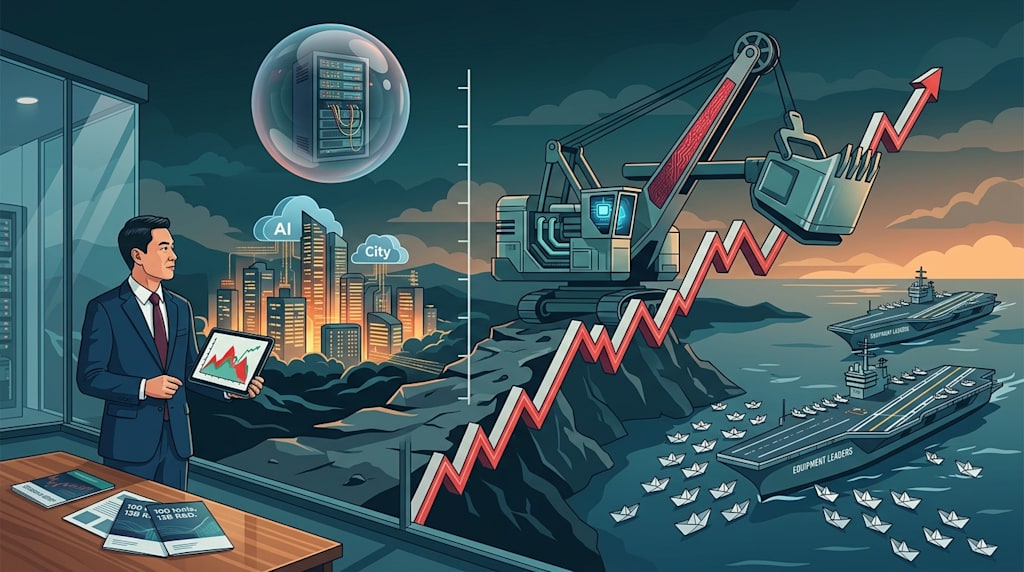
On the afternoon of October 12, 2026, at the National Exhibition and Convention Center in Shanghai, the Integrated Circuit Summit Forum of the 26th China International Industry Fair was underway. Yin Zhiyao, chairman and general manager of AMEC, took the stage and turned to a slide: a chart of annual changes in global semiconductor industry capital expenditure from 1984 to 2026. The line looked like a saw blade. In one year, capex could rise 100%. In another, it could fall 30%. It could keep falling for several years in a row. Some people in the audience held up their phones to take pictures. Someone whispered, “AI.” Yin said that AI is an extremely hot topic, that almost every conference is talking about AI, but that AI may also produce a bubble, and this needs close attention.
Coming from the head of an etching equipment company, this did not sound like a bearish call. AMEC makes semiconductor equipment, the things chip fabs buy first when they expand. The temperature of equipment orders runs half a step ahead of the excitement in end products. What Yin saw was not the cheering in the application layer, but the pattern behind the capex curve: peaks driven by a single product, troughs transmitted by macroeconomic pressure. AI may be the next peak, but the peak has not fully arrived, and the money has already run ahead.
1. The sawtooth of semiconductor capex was never a straight line
In his speech, Yin gave two numbers: 70% to 80% of a company’s capital expenditure goes to purchasing equipment. That means semiconductor equipment is extremely sensitive to changes in downstream demand. When chipmakers are optimistic, equipment orders explode. When they discover inventory is too high, the first thing they cut is equipment purchases. Capex rising 100% one year and falling 30% the next is not an anomaly. It is the norm.
He analyzed two reasons for these sharp swings.
First, each boom peak is often driven by a single product. Electronic watches, video games, PCs, the internet, smartphones. Each wave created enormous semiconductor demand. The next wave may be driven by AI, but it has not fully arrived. The implication is clear: the AI story is big, but industrial deployment and demand realization take time, while capital expenditure has already sprinted ahead.
Second, the global macroeconomic environment matters. Once an economic crisis occurs, pressure travels upward along the supply chain. Semiconductors sit at the bottom of the technology industry. They appear far from end consumers, but they are extremely sensitive to the macroeconomic cycle. End demand shrinks, chip inventory rises, capex contracts, and equipment companies feel the cold first.
Yin also judged that industry consolidation is inevitable. After multiple rounds of consolidation in the United States, only a few dozen domestic semiconductor equipment companies remain. In China, the number of semiconductor equipment companies is huge, conservatively at least 500, and at most close to 1,000. If that pattern holds, only a few dozen Chinese equipment makers may ultimately survive. That means 90% of them will be eliminated.
He used a naval battle as a metaphor: if the opponent has aircraft carriers and cruisers, and we have scattered small boats, we cannot win the competition. Leading Chinese companies need to transform from single-product firms into platform companies, with capabilities in etching, thin film, and metrology and inspection, so they can provide customers with complete, full-set solutions.
AMEC’s own plans confirm this judgment. Over the next three to five years, AMEC plans to develop 100 types of differentiated equipment, with total R&D investment of 13 billion yuan. By 2030, it aims to raise overall integrated circuit equipment coverage to more than 60%, and coverage of new-architecture chip equipment to more than 70%. This is a high-stakes R&D bet by a leading company, and a survival strategy for crossing cycles.
2. Four layers for judging whether AI investment is overheated
Whether AI has a bubble cannot be judged only by stock prices or investment scale. One must look at whether demand can be converted into sustainable cash flow. Four layers can be monitored.
The first layer: demand and revenue. Key indicators include model capability, token usage, unit cost, and the proportion of paid usage. If user growth is fast but paid conversion is low, or if traffic is mainly maintained through a free model, that is an overheating signal. An AI product can be used without being paid for. Those are different tests.
The second layer: cash flow. The key indicator is whether operating cash flow generated by AI revenue can cover continuously expanding capital expenditure. If free cash flow remains negative, the gap keeps widening, and the company depends on external financing to stay alive, risk is accumulating. Cloud providers can rely on other businesses for blood transfusions, but transfusions have limits.
The third layer: funding sources. The key indicator is whether financing sources shift from leaders’ internal cash flow and low-cost debt to high-cost external financing, such as high-yield bonds and private credit. If technology credit bond issuance surges, financing costs rise rapidly, or large amounts of off-balance-sheet financing appear, it means the market is beginning to support AI investment with more expensive money.
The fourth layer: external constraints. Key indicators include changes in US Treasury yields, credit conditions, and regulatory policy. If interest rates rise rapidly and credit markets tighten, AI companies dependent on financing will come under pressure on their funding chains. AI investment does not happen in a vacuum. It competes with other assets for capital.
The current market worry about an AI bubble is that the demand side lacks a new catalyst to open up the ceiling, making the market quick to lose confidence in the returns on capital expenditure. At present, the operating cash flow of leading US AI companies is close to their capital expenditure, and the systemic risk characteristics of the dot-com bubble have not yet appeared. But that does not mean one can relax. Indicators are dynamic. Close today may mean a widening gap tomorrow.
3. Supply chain divergence: the front of the train weakens first, the rear still rises
The AI supply chain has developed a divergent structure, similar to the late stage of the internet bubble.
At the front of the train are cloud providers. Google, Amazon, Microsoft, and Meta bear enormous capital expenditure, their free cash flow comes under pressure or even turns negative, and their stock performance stagnates. At the rear are chips and equipment. Nvidia, Micron, and Applied Materials benefit from continued purchases by cloud providers, and their stock prices and free cash flow grow rapidly.
JPMorgan pointed out that this divergence appeared in the late stage of the 1999–2000 internet bubble: telecom service providers weakened first, but equipment suppliers such as Cisco continued to climb until the bubble finally burst. The companies closest to final demand had already peaked, while upstream beneficiaries were still rising. This is a stage that deserves vigilance.
The trigger mechanism for risk transmission is this: if cloud providers cannot earn enough revenue from AI services and returns on investment keep falling, upstream demand for chips and equipment will eventually contract. By then, equipment companies that aggressively expanded capacity to meet the boom will face the dual pressure of capex cuts and overcapacity.
The fragility of compute leasing also confirms upstream risk. Current spot annual rent for compute is as high as $40–50 billion per gigawatt, but Goldman Sachs pointed out that most of these colocation contracts can be canceled by either party within 90 days. Legally, a contract worth $50 billion a year is actually a quarterly lease. Suppliers’ revenue forecasts rest on extremely unstable commitments. More critically, a lab leasing compute at $45 billion per gigawatt needs to generate about $110–225 billion in token revenue to cover costs, while the top three AI labs had combined annualized revenue of only about $100 billion in July. That gap is where bubble risk lives.
Returns will shift downward along the supply chain, flowing to AI companies with real businesses. Their bargaining power rises, while profits in semiconductor hardware supply fall. Bubble risk, by contrast, is transmitted toward the front end of the supply chain. Companies with accumulated capital, those that have eaten more than a decade of profits in this cycle, can withstand pressure relatively well. Companies without technological barriers that forced their way into investment will fall into brutal competition and elimination. Hard assets are visible and tangible. They are also expensive. If commercialization is blocked, or if the market retreats from irrational exuberance, the capacity expanded in the past becomes a nightmare.
4. Domestic equipment: a fleet of 500 to 1,000 small boats
The structure of China’s domestic semiconductor equipment industry is a typical manifestation of overheated investment on the supply side.
Driven by local industrial support policies, a large number of companies have rushed into hot tracks. Success stories such as Hefei have stimulated investment impulses in more local governments. Companies dare to burn money and dare to lose money, but they do not dare to fall behind. The market does not lack investment, and it is not their own money. Why not compete? If they succeed, they reach the pinnacle of life. If they fail, as long as it is not outright fraud, a limited liability company can be liquidated. This mechanism has boosted upstream profits and capacity expansion in the short term, but it has also planted the seeds of duplicate construction and low-level competition.
When the market shifts from irrational exuberance to watchful waiting, from looking at stories to looking at revenue and market applications, companies will be forced to find ways to make money. For example, they may keep raising prices to screen out the groups that are willing to spend. At that point, those painting grand pictures and those struggling to commercialize will enter passive contraction of capital expenditure. They cannot raise money, so they contract. The internet bubble did not prove that the internet was unviable. It was a post-overheating shakeout that cleared out most unprofitable companies and left the profitable ones to become giants.
This process will also happen in AI and semiconductor equipment. In the end, only a few dozen domestic equipment makers may survive. Ninety percent of manufacturers will be eliminated. Leading companies need to transform from single-product firms into platform companies, with capabilities in etching, thin film, and metrology and inspection, so they can provide customers with complete, full-set solutions. AMEC’s plan, developing 100 types of differentiated equipment over the next three to five years, with total R&D investment of 13 billion yuan, raising overall integrated circuit equipment coverage to more than 60% by 2030, and striving for more than 70% coverage of new-architecture chip equipment, is precisely an expression of this logic.
5. A bubble burst is a shakeout, not the end of the industry
AI will change things. The money chasing it has already outrun the change. The useful question is who remains after the bubble recedes.
Investors should watch cash flow and paid demand. They should also watch the divergence in which the front of the train is already weak while the rear still rises. Companies should not be swept up by the boom. Platformization, technological barriers, and revenue matter. Policymakers should avoid scattering support across too many players. They should promote consolidation and prevent low-level duplicate construction.
Yin Zhiyao’s warning asks for clear-headedness in the midst of frenzy. The gold diggers should look more carefully at whether they have real gold in their hands. A bubble burst resets value. It does not end the industry. Companies with real demand, sustainable cash flow, and technological barriers will become the new giants after the shakeout. A 90% elimination rate is both a cruel market law and an unavoidable path for the industry to mature.
After the forum ended, people lined up outside the exhibition hall to catch taxis. Next to a model of an etching machine at the AMEC booth were several stacks of brochures. On the cover: “100 types of equipment, 13 billion yuan in R&D.” Among the 500 to 1,000 equipment companies, no one knows which few dozen will survive to 2030. Tomorrow there will be another forum. The topic will still be AI.
About the Creator
Jin
Writer of reamstories
https://reamstories.com/jin
Enjoyed the story? Support the Creator.
Subscribe for free to receive all their stories in your feed. You could also become a paid subscriber, letting them know you appreciate their work.
Comments
There are no comments for this story
Be the first to respond and start the conversation.