
The RTX 5080 Just Lost 4,000 Yuan. It’s Still Not the Card You Want.
A price crash, a 16GB memory ceiling, and a cancelled 24GB model explain why Nvidia’s gaming card is still stuck in the wrong lane.
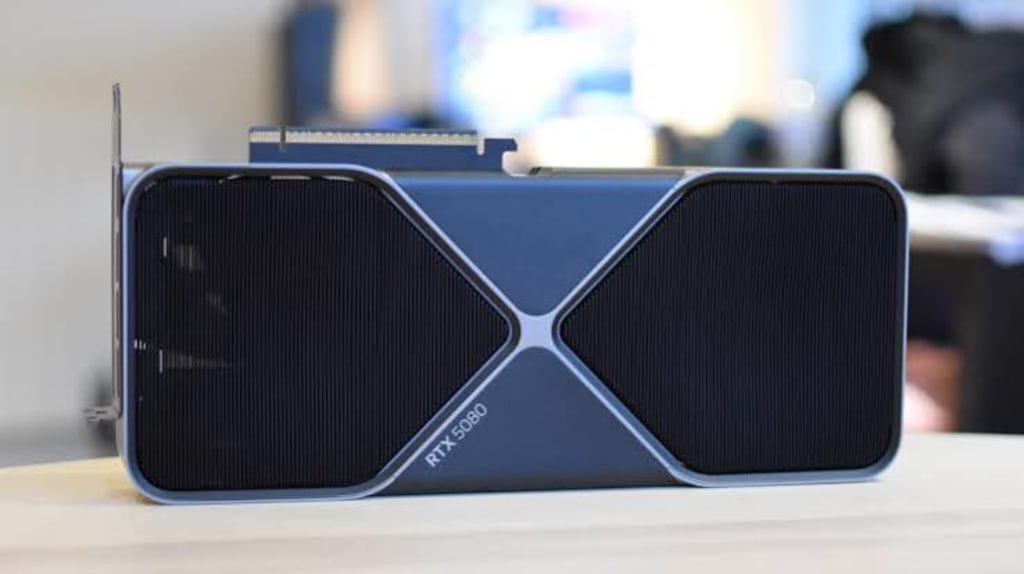
After a 4,000-yuan drop, the RTX 5080 still stands where it does not belong
In November in Huaqiangbei, channel quotes for the RTX 5080 fell from about 18,000 yuan at the end of October to roughly 14,000 yuan. That is 4,000 yuan gone in half a month. Two months earlier, before September, the same card was quoted at just over 8,000 yuan. In just over two months it was pushed to nearly 20,000 yuan and then fell back to 14,000. CCTV Finance quoted a merchant saying prices can swing a lot between morning and afternoon.
Many people read this decline as price normalization. They assume that once the bubble is squeezed out, the card becomes a good buy. The arithmetic says otherwise. A 14,000-yuan channel price against an official suggested retail price of 8,299 yuan still leaves a premium of nearly 70%. The 4,000 yuan that was lost never belonged to the card’s value. It belonged to a brief collective illusion in late October. The deeper problem is that the card’s product position was twisted by this speculation into a place it should never have occupied.
An inventory stampede with no short covering
The mechanism behind this rise and fall is simple. Distributors and merchants stockpiled early and held back sales. Spot supply tightened abruptly, and channel quotes changed by the half-day. One Shenzhen wholesaler later said: “A lot of these people just push the price up by trading it around.” Rising prices became the reason for rising prices. Demand from end users was temporarily covered by speculative inventory.
The turning point came when expectations were not met. The production halt did not happen. Supply was not cut off. As the tail end of Double 11 approached, merchants sitting on stock began to worry about being trapped. The same group shifted from holding back sales to dumping inventory. Recovering cash beat waiting for higher prices. One wholesaler’s summary was: “What has fallen back is mainly speculative sentiment.” The 4,000 yuan that disappeared was not product value being rediscovered. It was a group of people deciding at the same time to stop waiting.
There is a background that is easy to miss. Over the past year, AI data centers have competed heavily for consumer-grade memory capacity such as GDDR7. Wafer and packaging capacity has flowed first to higher-margin professional compute cards. Consumer GPU supply was already tight. That gave speculation a concrete excuse, but an exaggerated one. Tight supply explains why the price could rise. It does not explain why the price should have reached 20,000 yuan. When speculative inventory receded, what remained was the same consumer product: squeezed by capacity, but nowhere near scarce enough to justify a 20,000-yuan tag.
16GB is not a small shortfall. It decides whether the model fits.
Beyond price, the RTX 5080’s place in local AI work deserves a closer look. A common defense is that 16GB of VRAM is enough and can run quantized models. That claim is half right technically and misleading in practice.
By 2026, local model deployment has a fairly clear VRAM-to-model map. A 27B-class model under Q4 quantization has weights around 15GB. On the surface it fits into 16GB. Weights are only the start. The model also needs space for the context window and KV cache. Usable VRAM is about 15.2GB with no display output. With a monitor attached it drops to around 14.5GB. The full Qwen 27B Q4_K_M weights are about 17.1GB. They do not fit. Even Gemma 3 27B, which is friendlier on parameters, needs 16 to 18GB including context under Q4. A 16GB card can run it only with a very short context window. A 32B-class coding model under Q4 needs 19 to 22GB. That is territory that starts at 24GB and ideally wants 32GB.
The jump from 16GB to 24GB is not a comfort upgrade for local AI. It decides whether the model can stay entirely in VRAM. Once a model spills into system memory, generation speed falls from tens of tokens per second to single digits. Usability goes with it. The 16GB RTX 5080 can run 14B models. A trimmed 27B can barely run with a short context. It is not a product designed for local AI. Its home ground is 4K gaming. DLSS and frame generation are the reasons people want it. Buying it at a premium as an AI compute card means using the wrong manual from the start.
The cancelled 24GB version exposes a deeper awkwardness
NVIDIA originally planned to launch a 24GB version of the RTX 5080 in early 2027. It would have used eight 3GB GDDR7 modules to raise capacity while keeping the 256-bit bus unchanged. That plan has been cancelled. The reason is cost. 3GB GDDR7 modules cost about three times as much as 2GB modules. With eight of them, the memory cost alone would leave the whole card’s pricing with no room to maneuver.
The cancellation tells us something. Under the current memory price structure, a 24GB 5080 is hard to justify economically. The 16GB version continues as the high-end mainstay because it is the only version that can still be supplied under cost constraints. NVIDIA did not choose 16GB as a sweet spot for gamers and developers. Cost pressure left it as the floor after 3GB module prices ran out of control. A card that sits just below the threshold for AI use and a card that cannot be upgraded above the threshold because of cost happen to be the same card. That awkwardness says more about the RTX 5080’s position in the product line than any channel price swing.
NVIDIA no longer fights on this battlefield
In the second quarter of fiscal 2027, the data center business brought in $89 billion, or 92.5% of total revenue. Edge computing, which includes gaming GPUs, brought in $7.2 billion, less than 8%. The company’s center of gravity left the GeForce cards on retail shelves long ago. Tight consumer GPU supply, memory allocation pushed to the back, and a 24GB version cancelled because modules cost a few hundred dollars more are different sides of the same logic. When a product line’s revenue share approaches a rounding error, it no longer has priority.
That also explains why channel speculation could travel so far on such a thin base. When the vendor no longer actively manages price expectations and supply rhythm for consumer products, the middle layer gains unusually large pricing power. When speculative sentiment reverses, the vendor will not step in to support the market either. The price spikes and crashes happen in the same vacuum.
So should you buy now?
The answer depends on what you want to do with the card. The conclusion is unfriendly to both types of buyers.
If you want local AI inference, buying a 16GB card at 14,000 or even 16,000 yuan is a mistake in the wrong direction. You pay a premium inflated by speculation for hardware that needs heavy offloading and suffers a sharp drop in speed in front of 27B-and-above models. Paying more for a 32GB 5090, or waiting for 24GB-class products on the secondhand market or in later models, is more rational than taking home a card that is just short at this price.
If you are a 4K gamer, the RTX 5080 is a competent card. The current price still contains speculative residue that has not cleared. A CCTV Finance report and channel checks in Huaqiangbei show the drop is a correction from a speculative high, not a return to a normal range. Near the official suggested retail price of 8,299 yuan, it is a gaming card to consider. Above 14,000 yuan, part of every yuan you pay is still paying for that brief burst of sentiment in late October.
A falling price does not make a good buy. When a product’s price is driven by inventory games rather than use value, its rises and falls have nothing to do with the product itself. The RTX 5080 has not gotten worse, and it has not gotten better. It has always been a decent 4K gaming card and a mispriced, mis-expected quasi-AI card. The 4,000-yuan drop did not change that fact. It only gave more people a chance to see where it stands.
About the Creator
Jin
Writer of reamstories
https://reamstories.com/jin
Enjoyed the story? Support the Creator.
Subscribe for free to receive all their stories in your feed. You could also become a paid subscriber, letting them know you appreciate their work.
Comments
There are no comments for this story
Be the first to respond and start the conversation.