
The Robot That Can't Screw In a Bulb
Humanoid machines can backflip and dance. Why can't they hold a steady job?
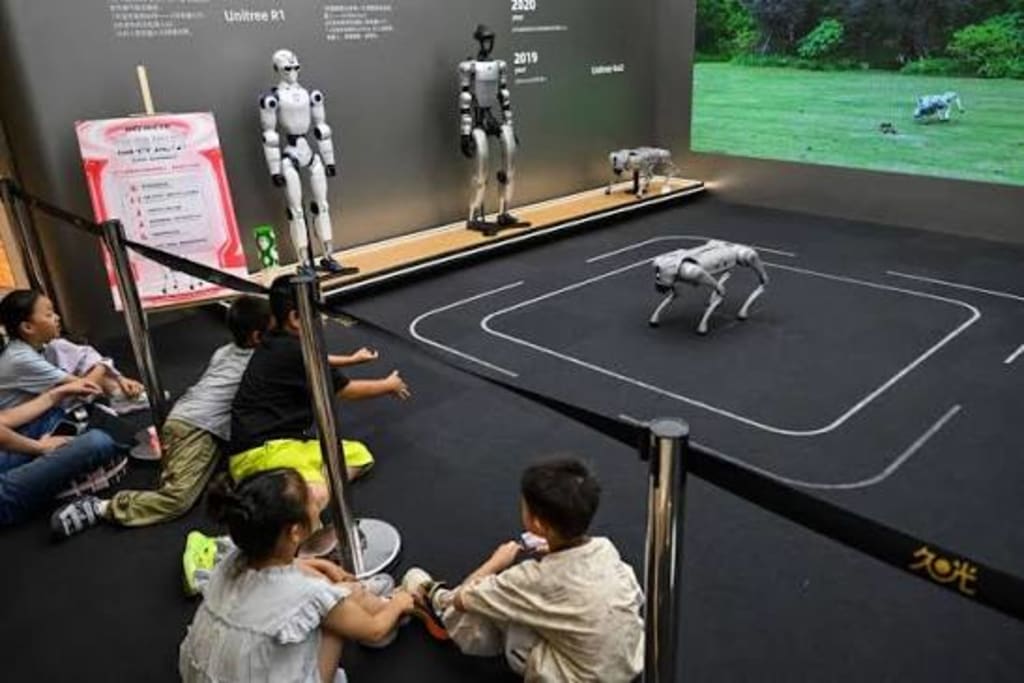
At the 2026 World Robot Conference, Unitree’s booth drew crowds. Robots backflipped, danced, and ran through bolt‑tightening demos as cameras clicked. But in his keynote, founder Wang Xingxing didn’t replay those highlights. He said something else: Unitree hasn’t pushed humanoid robots into factories or homes at scale, because efficiency and generalisation aren’t good enough. That isn’t Unitree’s problem alone. It’s the shared ceiling for embodied‑AI companies everywhere.
Wang’s words carry weight. Unitree leads China in humanoid shipments, but where do those units actually go? Research labs, universities, tech‑media testbeds, rental agencies – almost nowhere on a real production line doing steady, long‑term work. A bipedal robot that costs several hundred thousand yuan loses to a fraction‑priced robotic arm on welding speed; in a warehouse, it falls short of an AGV on material handling. It looks impressive, but it isn’t yet a cost‑effective piece of production equipment.
Efficiency: caught between people and purpose‑built machines
Compare with human workers. A skilled factory operative tightens screws, labels boxes, and packs goods with speed, accuracy, and consistency, reading each next piece instantly. A humanoid robot can’t match that. Industry insiders quietly acknowledge that for general factory tasks, a humanoid runs at 30‑50% of human throughput. A robot can work 24/7, but if its output per hour is low, the labour‑cost math still favours hiring people.
Now compare with specialised automation. On a mature automotive welding line, six‑axis arms run around the clock with near‑perfect repeatability, their costs long amortised. A humanoid trying to break in would weld slower and suffer from variations in lighting and workpiece positioning. Wang put it bluntly: on efficiency and cost‑performance, humanoid robots don't beat robotic arms.
The awkward middle ground is clear: humanoids can't replace people, nor can they replace dedicated machines. Their theoretical strength – versatility – is a liability in practice. On a production line, “one thing, done exceptionally well” is what gets purchase orders.
Generalisation: change one variable, lose the skill
Efficiency is a balance‑sheet issue. Generalisation is a harder technical problem.
Generalisation means whether a robot’s lab‑learned skills transfer to messy reality. Train it 1,000 times to grip a specific screw at a fixed station – success rate 99%. Swap to a screw of different size and material, shift it 3 cm, change overhead light to side light – the rate can drop below 40%. The industry calls this “one change and it breaks.”
Google DeepMind’s 2026 data gives a stark case. Apollo 2 unscrewed a lightbulb at 92% success. The same robot screwed one in at only 36%. That 56‑point gap tells the story.
Unscrewing: the bulb is already seated, threads engaged. The robot only needs to locate, grasp, and rotate – a fixed sequence, little understanding required. Screwing in: the socket may have been nudged off‑angle, the thread misaligned. The robot must sense the socket, align, control torque and direction, and stop at the right moment. That demands real‑time perception, decision‑making, and force control in concert – fail one link, fail the whole job.
High unscrew rates are execution; low screw‑in rates are because comprehension is required. Between execution and comprehension lies a wide intelligence gap.
Broader numbers confirm the pattern. With a multi‑fingered hand, Apollo 2 tied a trash bag at 44%, sealed a Ziplock at 40%, used a dustpan at 32%. With a simple two‑finger gripper in a fixed station, pick‑and‑place succeeds at 70‑90%. The lesson: the closer the task gets to fine human manipulation, the more reliability drops – and fine manipulation is exactly where humanoids are supposed to shine. If mounting a bulb works only a third of the time, who lets one into their home?
The hidden cost of uncertainty
Efficiency and generalisation both end in money.
A humanoid costs several hundred thousand to over a million yuan. Deployment takes engineers days or weeks for environmental adaptation and task programming. Maintenance eats parts and software updates; new tasks need retraining. Wang noted that many companies rent rather than buy – total ownership cost is too high, so they’d rather trial one when needed.
Low success rates cost in subtler ways. An hour of production‑line downtime can lose tens of thousands of yuan. If a robot fails one in ten times, requiring human intervention and restart, you haven't saved labour – you've added management overhead. Traditional arms are adopted because they guarantee near‑100% repeatability – every move identical, no surprises. Humanoids don't meet that bar, so they can't enter serious production environments.
One investor put it privately: watching a humanoid launch today feels like watching an acrobatic show. Backflips, somersaults, dancing – they grab eyeballs, but everyone in the industry knows the gap between that and “getting real work done.”
Does it have to be bipedal?
Wang’s talk also raises a deeper question, though he didn't spell it out: why the human form?
Bipedal walking is an immensely complex stability problem. A slightly uneven floor or side gust demands sophisticated algorithms and high‑speed joints just to stay upright. A wheeled or tracked chassis simplifies stability dramatically and cuts cost. A five‑fingered hand looks impressive, but its grip efficiency often lags behind a two‑finger gripper or suction cup optimised for specific objects.
The main argument for humanoid shape is “human‑environment compatibility” – stairs, doorknobs, tools, seats are all built for human dimensions, so a humanoid can use that infrastructure directly. But in a factory or warehouse, you could instead modify the environment to be robot‑friendly – level floors, standard pallets, positioning fixtures – and those modifications might cost far less than developing a stable biped.
So where is humanoid form truly necessary? For now, performances, exhibitions, and research – areas where “human‑like” draws attention or pushes technical boundaries – have real value. But for tightening bolts in a factory, a wheeled arm with two grippers may be faster, steadier, and cheaper.
Wang left the answer open. But his clear reminder to the industry: don’t be humanoid for humanoid’s sake. Let task completion and efficiency decide. If a scenario doesn't favour two legs, use another shape – no need to force it.
The 80% tipping point
Despite the challenges, Wang isn't pessimistic. He gave a concrete criterion: when a robot entering any unfamiliar scenario can autonomously handle roughly 80% of tasks, the industry hits its real tipping point.
Why 80%? That’s an economic threshold. When a machine covers most common tasks, its marginal value exceeds deployment cost. Companies buy; households try. Before that, the robot remains a “special‑purpose tool for specific scenarios” with a low market ceiling.
His timeline: 2‑3 years in the best case, 5‑10 in the slower one. The confidence rests on his view that the core problem – aligning AI reasoning in virtual worlds with execution in the physical world – is an engineering challenge, not a scientific one. Engineering problems yield to enough manpower, compute, and data. Whether it takes three or ten years depends on investment pace and path.
He didn't say “just wait.” The tipping point won't arrive on its own. Someone must do the gritty work of data accumulation, model iteration, and hardware refinement. Unitree itself is doing that – high shipment volume is an advantage; more real‑world data flowing back accelerates generalisation.
Back to the simple question
Humanoid robots represent one ultimate vision of machine intelligence – a general agent that adapts to human environments and collaborates with people. The vision is beautiful, but getting from vision to product requires crossing not a single breakthrough but a long, gradual slope.
Wang ended his speech without flourish: “We are still on the road. The road is long, but the direction is clear.”
That sentence sounds light in an era of tech hype, yet it’s heavy – because it comes from someone who deals with real products every day. He knows backflips make great videos, but what will actually bring a robot into millions of homes is not backflips. It’s the day when it can screw in a bulb, do it ten times, all ten succeed, then move on to the next task without anyone supervising.
Only then will the industry truly cross the tipping point. Until then, every discussion about humanoid robots should return to one plain question: Can it actually do the job well? If yes, it has a future. If not, no matter how human‑like, it’s useless.
About the Creator
Jin
Writer of reamstories
https://reamstories.com/jin
Enjoyed the story? Support the Creator.
Subscribe for free to receive all their stories in your feed. You could also become a paid subscriber, letting them know you appreciate their work.
Comments
There are no comments for this story
Be the first to respond and start the conversation.