
The robot brain is not the whole robot
Fable 5.2 and GPT-6 Astra are splitting embodied AI into three layers, and the middle layer is where the fight moves
On November 9, 2026, Anthropic released Claude Fable 5.2. On the RoboDojo dual-arm benchmark, it scored 64.9%, up from 27.6% for Fable 5.1, a 2.35x jump, and more than double GPT-6 Astra’s 29.8%. It completed tasks it had never been explicitly trained on: unscrewing a bottle cap, manipulating a Rubik’s cube, drawing. In a third-party physical robot blind test, it took over a physical arm and finished a 62-step checkers game, correcting itself through contact errors and hardware deformation. Anthropic also hired Bingjie Tang, formerly on Tesla Optimus’s dexterous manipulation team, whose work at Nvidia focused on contact-rich manipulation and sim-to-real transfer.
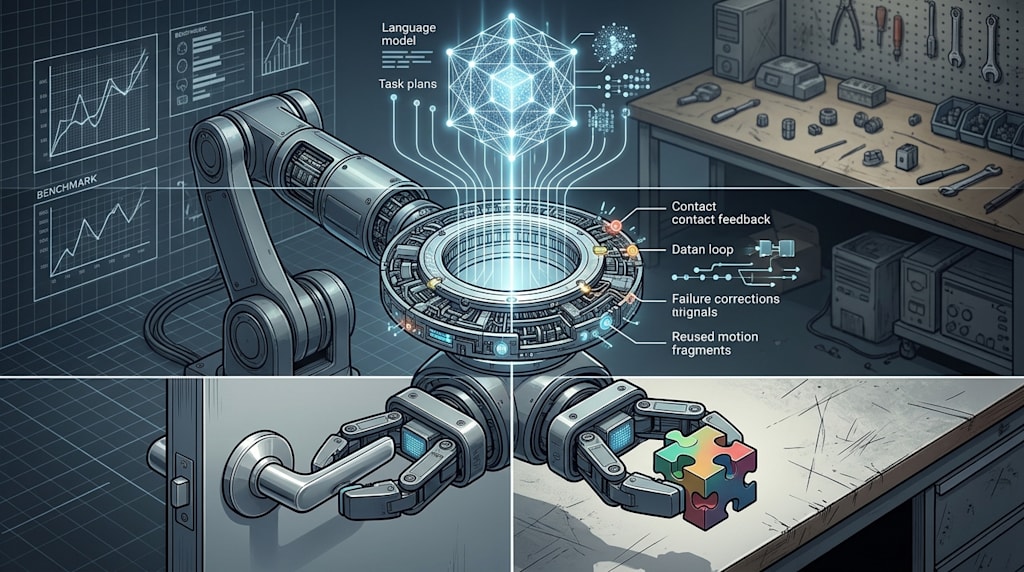
Those signals should force every embodied-AI team to re-examine its roadmap. A claim is spreading fast: general flagship models can already drive robot arms well, so embodied-AI companies built before this moment are CV-Four-Dragons-style custom engineering shops, destined to be flattened by general models. The claim catches a trend, then overreaches. “One model per task, retrain for every customer” is a dead end. Specialized control capability is not. The industry is eliminating specialized models without general priors, assembled by hand, task by task. The surviving form is a layered system: the general model carries world understanding and task orchestration; the specialized control layer holds reliability in the physical loop; the adapter and data loop between them is becoming the competitive moat.
The simulation lead is clear. Direct control still cannot replace the physical loop.
The benchmark gains are large. Fable 5.2 did not just beat its predecessor on RoboDojo; it completed tasks outside its training distribution: bottle caps, a Rubik’s cube, drawing. GPT-6 Astra, in a system evaluation run by SenseTime and several institutions, reached 100% on LIBERO-Long++, 99.3% on LIBERO-Pro, 98.8% on the humanoid benchmark SIMPLE, and 98.9% on the ultra-long-horizon LIBERO-Ultra-Long. Those numbers show that general models have crossed a meaningful line in semantic understanding, spatial reasoning, and long-horizon task decomposition. The old complaint, that the robot knows the motion of opening a door handle but not what a door handle is or why to open it, is partly answered once a general model is in the loop. The model brings world knowledge about what a handle is and why passage matters, instead of executing a repeatedly annotated motion label.
Simulation success is not physical closed-loop usability. The same SenseTime physical-robot report gives the other side. Putting a pen into a pen holder took GPT-6 Astra more than four hours and $55 on a physical robot. Inserting a plug failed 11 times out of 11. After opening the fridge and putting down milk, it turned to carry fruit and left the fridge door open for several minutes. Apple’s HALO system, deployed on a Unitree G1, reported 91% average success on single tasks across 360 physical tests. Chained tasks fell to 70%, and the sequence “squat, walk to box, push box” succeeded only 50% of the time. Unitree’s own G1 with Astra shows the same split: putting blocks into a bowl, a semantically clear task with simple contact, succeeded 95%; inserting a puzzle piece into its matching slot dropped to 10%.
These numbers point to one conclusion. The general model’s advantage as a planner is clear and structural. Treating it as proof that direct arm control already works well confuses two layers. In semantic and spatial reasoning, general models are breaking through quickly. In post-contact physical control, “direct” and “good” do not yet hold at the same time. Guosheng Securities draws the line sharply: GPT-6 Astra shows general models crossing the embodied manipulation threshold, but there is still a cliff in the last centimeter of fine contact control; spatial reasoning alone does not replace contact-level control.
Touch and real-time response are the barriers general models have not crossed.
Using Dario Amodei’s “smooth exponential” to argue that physical-world cognition has no barrier for general models works at the semantic level. The 2026 physical-robot results reveal a different barrier. The difficulty sits in sensing and controlling contact. Language-level understanding of the physical world is a separate problem.
Tactile hardware still lacks a unified specification. Sensor designs compete, and tactile models remain rigidly task-specific. Global high-quality physical interaction data is about 500,000 hours; training a general embodied model needs at least 10 million hours. The existing stock is under 5% of demand. Feeding fast tactile data directly into a slow vision-language model can even damage its semantic reasoning. Wang Xingxing of Unitree says the core challenge is aligning the AI model’s inputs and outputs with the physical robot, and that model understanding of physical contact is still short by “the last few millimeters.” Huatai Securities, analyzing HALO, quotes the paper’s admission: robots struggle to sense contact; models with touch averaged 47.2% success on nine physical contact tasks, while π0.5 without touch reached only 29.4%.
General models’ smooth exponential growth in language, vision, and spatial reasoning does not automatically cover force sensing, tactile sensing, and millisecond closed-loop control. Specialized VLA models and controllers earn their place by producing capability from physical robot data and physical constraints in places the general model cannot yet reach. Apple’s HALO layered design makes the point. The top layer uses Qwen3.6-35B for task orchestration. The middle layer uses a 2-billion-parameter specialized action generator at 3 Hz to plan the next five seconds of whole-body motion. The bottom layer is a 50 Hz reinforcement-learning action tracker. Apple did not try to make the general model punch through to the bottom. It assigned different time scales and abstraction levels to the components best suited to them. The 91% single-task success rate is the result of that layered collaboration, not a solo performance by one general model.
The industry’s answer is layering, and layering itself is becoming the moat.
The question of general model plus specialized control model versus an independently trained physical foundation model has a fairly clear answer from second-half 2026 practice. Layered collaboration is the only validated path, and the layering is turning from a transitional compromise into a competitive barrier.
GPT-6 Astra in Galbot’s hybrid setup is one piece of evidence. Astra plus the π0.5 specialized model averaged 62.6 on ten RoboDojo tasks, nearly double the second-place entry. Astra alone succeeded only 10 to 20% of the time in dual-arm collaboration. The specialized VLA executes. Astra corrects at key steps. The combined system reaches a usable level. The hybrid setup reflects a structural division of labor. General models are good at cross-task semantic generalization, spatial reference, and error diagnosis. Specialized models are good at contact-dense execution and real-time closed-loop control on a specific body. Their capability curves live in different dimensions. General-model progress does not automatically replace the specialized layer; it narrows the specialized layer’s task boundary and raises the bar for what remains.
Unitree’s own approach is worth noting. Wang Xingxing publicly judged that general large models will punch through physical AI in one to two years, or two to three at the slow end. Unitree has put Astra into the G1 for drawing and Go demonstrations. Unitree is also building a stack where the general model handles planning, a lightweight specialized model handles execution, and Unitree supplies the adapter layer. It is experimenting with on-device deployment. A body company accused of walking the CV-Four-Dragons death road has not bet everything on custom specialized models. It is plugging general capability into its own physical loop. That is a practical form of the generalization direction: move specialized capability’s value anchor from customizing one task to guarding the stretch of the physical loop the general model cannot reach.
The CV-Four-Dragons lesson has a precise boundary.
The analogy catches the right signal, but the boundary needs a sharper line. The CV-Four-Dragons failure came from building a business model on retraining and adapting for every customer and every scenario in an era of weak general capability. When general multimodal models could cover a large set of standardized vision tasks without special labeling and compress deployment from months to days, a technical system whose core asset was customization lost pricing power. The vision model category survived. The engineering model that could only deliver through one-off custom orders did not.
Move that logic to embodied AI. The industry is eliminating specialized control without general priors, without cross-task reuse, where every new scene requires data collection and retraining from zero. If an embodied team’s core assets are still one model for flips, one for carrying trays, one for making the bed, sharing no world knowledge, transferring no skills, reusing no failure experience, it is repeating the CV-Four-Dragons path. If specialized control means high-frequency closed-loop optimization for a specific body and contact physics under a unified world-model prior, it will not be replaced by general models. It becomes more valuable because the general model solves the “what to do” generalization problem, and the specialized layer can focus on “how to do it reliably.”
Reallocating R&D: what to borrow, what to grind.
For embodied-AI teams, the urgent question after November 2026 is where to move investment, not which side of the general-versus-specialized line to stand on.
What can be borrowed directly from general models, where self-research marginal returns are falling fast: high-level task decomposition, semantic understanding, spatial reference, vision-based object localization, cross-task semantic error diagnosis, and few-shot task replanning. Fable 5.2 and Astra have shown these capabilities generalize across bodies and tasks. A team still training a model that understands instructions from scratch is building a category the general model already covers.
What still must come from the body and physical interaction: force-tactile closed-loop control, stability in contact-dense manipulation, millisecond action generation and tracking, transitions between subtasks in long-horizon tasks, failure recovery, and the adapter layer across different body forms. The gap between HALO’s 91% single-task success and 70% chained success is an investment list. The 20 points lost in chained tasks are the premium on physical closed-loop capability. The SenseTime failures, plug insertion failing 11 times and puzzle insertion at 10%, point to the same capability gap. Posture changes and contact disturbances between task stages break the preconditions for the next action. Semantic-level diagnosis by the general model does not automatically become contact-level correction.
What is becoming the new moat is the middle layer: translating the general model’s task plan into a body-executable action sequence; feeding contact signals and failure modes from physical execution back into reusable correction priors; letting the general model’s world knowledge land in the next task at lower physical robot cost. Guosheng Securities calls this the “physical interaction brain,” the control vacuum between the general model and low-level physical execution, moving robots from “can demo” to “can work.” This layer cannot be downloaded from a general model, and it cannot be obtained by scaling specialized model parameters. It grows only from a physical-interaction data loop. For embodied teams, this is where to concentrate investment as general models get stronger. General models turn understanding the world into borrowable infrastructure. Reliably completing the last few millimeters and the last few tens of milliseconds in the physical world is still work a team has to grind out millimeter by millimeter.
Fable 5.2 and GPT-6 Astra did declare one thing: the embodied-AI route built on custom engineering without general understanding is closing its window. They did not declare that specialized control capability has lost value. The industry is eliminating custom-only embodied AI. It is not eliminating embodied AI that makes the physical loop reliable under general priors. The difference between those two is the entire investable space in this industry after 2026. The 20-point gap between 91% and 70% is a concrete list of contact tasks, latency budgets, and failure recoveries that still have to be built one millimeter and one millisecond at a time.
About the Creator
Jin
Writer of reamstories
https://reamstories.com/jin
Enjoyed the story? Support the Creator.
Subscribe for free to receive all their stories in your feed. You could also become a paid subscriber, letting them know you appreciate their work.
Comments
There are no comments for this story
Be the first to respond and start the conversation.