
The Real Reason OpenCode Go’s DeepSeek Feels Slow
I used 50 million tokens and never found proof of quantization. What I did find was a throttling policy that explains almost everything.
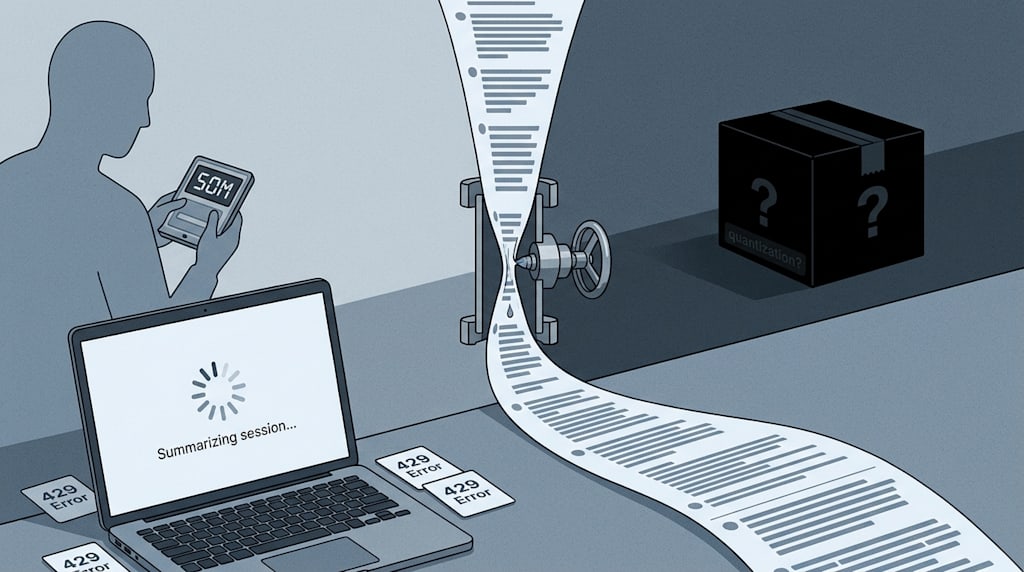
OpenCode’s documentation does not list a quantization level for deepseek-v4.1-flash. There is no blog post, no changelog entry, no field in the API response headers. In community threads, one user says the model is a quantized version and “stupid enough to be unusable.” Another says the difference from the official API is “small enough that it works as a drop-in replacement.” A third says OpenCode Go mixes “quantized models and old models” and passes them off as a clean pool. Three claims point to three different models. OpenCode has not responded to any of them.
That silence matters, but it is not the most useful thing to examine. Your own record of 50 million tokens of light use points to a different variable, one with numbers, error codes, and repeatable trigger conditions. The experience of OpenCode Go’s DeepSeek is shaped less by an unconfirmed quantization rumor than by a throttling policy you can see in the product’s behavior.
The quantization evidence chain is loose at every link
The claim that OpenCode Go serves a quantized DeepSeek appears often, but it does not survive a close reading.
The most direct accusation comes from users who describe the model as a “fully degraded quantized version” that is “too dumb to use.” A more systematic observation comes from a user who noticed that OpenCode’s preview and stable versions are mixed, that multiple providers exist behind the service, and that some requests are likely “routed to a quantized endpoint.” The problem with this reasoning is the missing step. A drop in output quality does not prove quantization. Throttling, routing to a different model version, or simple peak-hour load can produce the same symptom.
Another line of argument points to self-hosting. One user recalls that after DeepSeek officially rate-limited OpenCode, OpenCode began self-deploying. After the self-deployment succeeded, DeepSeek’s quota doubled, “and then the dumbness started.” The timeline is suggestive, but it remains a timeline. The counterargument is also strong. A model with only 13B active parameters “does not need that kind of treatment.” And when OpenCode’s service went down, one user argued that “this proves they are using the official API, so there is no need to worry about self-hosted quantization.” The same outage can be read as evidence of self-hosting or as evidence of a direct official connection.
What makes the quantization claim hard to pin down is that DeepSeek V4 models are already quantized at release. A V2EX user noted that “the model was already FP8+FP4 quantized when it shipped.” Even if OpenCode Go uses unmodified official weights, it is not a full-precision FP16 model. In that context, calling OpenCode Go’s version “quantized” may be technically true but experientially meaningless, because the baseline is already quantized.
On the specific question of quantization level, the information is absent. A DEV Community analysis of whether quantization is worth it discusses general principles and quality retention rates. Q8_0 retains about 99% of FP16 quality. Q4_K_M retains about 92%. The article does not state what OpenCode Go uses. Another discussion notes that OpenCode Go’s GLM model was observed using FP4 rather than the official FP8, but whether that finding extends to DeepSeek is unknown. Quantization may exist. Its shape and severity remain undisclosed.
Throttling leaves traces you can check
Against the quantization fog, the evidence for throttling is concrete.
The broadest fact: DeepSeek officially rate-limited OpenCode Go after OpenCode Go users spent about $130,000 per day on DeepSeek, or roughly $47 million annualized. OpenCode’s founder confirmed this publicly. DeepSeek responded with “capacity issues.” A downstream customer spending $130,000 a day being told by the upstream provider that it is using too much says something simple. OpenCode Go’s cost pressure comes first from volume, not from the precision cost of a single inference.
At the micro level, throttling appears in several specific forms. One is a concurrency limit. Users report that OpenCode Go “limits to 10 concurrent requests per minute, and retries trigger easily.” Another is frequent 429 errors, with wait times written only in the message text. There is “no Retry-After header, no retry_after field,” so clients cannot back off cleanly. A third is fragility in long-context sessions. A GitHub issue points out that on “quota-limited providers” like OpenCode Go, long sessions are vulnerable when they trigger context summarization. The summarization call itself may travel through an already throttled route, and the session hangs at “Summarizing session…”
That last point matches what you observed. Past 200k tokens of context, DeepSeek slows down noticeably. Long-context requests require more computation and hit the rate ceiling more easily under a throttling policy. The summarization call shares the same possibly throttled channel as the main request. The slowdown comes from requests queuing, retrying, and waiting for a rate window that has been deliberately narrowed. The model is not becoming dumber.
Why throttling makes quantization a redundant question
The core argument is a commercial-logic argument. If a provider has already used throttling to push a user’s throughput far below the nominal share, then adding quantization to reduce per-inference cost has no necessary effect on the user experience.
The distinction matters. Quantization controls unit cost. Each inference consumes less compute. Throttling controls total throughput. Only a limited number of inferences are allowed per unit of time. For a subscription service like OpenCode Go, if throttling has already pushed a heavy user’s actual consumption below the nominal quota, then “that quota is just a number.” It no longer corresponds to any deliverable compute promise. In that situation, the marginal savings from quantization are imperceptible to a user whose throughput is already capped. Any quality loss from quantization becomes an extra, unnecessary risk.
This also explains the apparent contradiction in your experience. 50 million tokens of light use produced no obvious quality gap, but the speed was clearly slower. If quantization were severe enough to make the model “too dumb to use,” 50 million tokens would have exposed it. Your experience matches users who say the difference is “small enough that it works as a drop-in replacement.” What is consistently perceived across users is speed, not intelligence.
None of this proves that quantization is absent. It may exist at a low severity, such as near-lossless Q8_0-level quantization. It may exist on some routing paths and not others. The user who found “multiple providers” suggests that OpenCode Go’s routing may be layered. Even so, quantization is not the main variable that explains everyday experience. Throttling is.
A practical judgment
So is deepseek-v4.1-flash a quantized version? On the available public information, there is no yes or no. But there is a more useful judgment. Treat OpenCode Go’s DeepSeek as a throttled channel with acceptable quality and unreliable speed, not as a quality gamble over whether it is quantized.
If your task is latency-sensitive, such as long-context reasoning, multi-turn tool-calling agent workflows, or interactions that need a stable time-to-first-token, OpenCode Go’s bottleneck is throttling. Switching to a “non-quantized” provider may not fix it, because the problem is the rate channel, not model precision. If your task is batch-oriented, latency-insensitive, and tolerant of small differences in single-output quality, OpenCode Go’s price-performance still holds. The quantization question is not a practical obstacle.
The thing to watch is not “it may be quantized.” The thing to watch is “its throttling policy will stall certain workflows at the worst moment.” The second is verifiable from your own 50 million tokens. The first is not.
Your 50 million-token record includes a session that hung at “Summarizing session…” after exceeding 200k context. That hang is more concrete than any rumor about quantization level. It corresponds to a repeatable set of conditions. Long context triggers a summarization call. The summarization call travels through an already throttled route. The route returns no Retry-After header. Those three facts together are enough to explain the slowdown you felt, and none of them requires the quantization hypothesis to be true.
Next time someone asks whether OpenCode Go is quantized, set the question aside and ask another one: The last time you got stuck, how long was the context, how long did it hang, and did the error message give you a wait time? The answer to that question will decide whether you should keep using this channel more reliably than any quantization rumor.
About the Creator
Jin
Writer of reamstories
https://reamstories.com/jin
Enjoyed the story? Support the Creator.
Subscribe for free to receive all their stories in your feed. You could also become a paid subscriber, letting them know you appreciate their work.
Comments
There are no comments for this story
Be the first to respond and start the conversation.