
The Rain in Tokyo Is Stickier Than in Beijing
A Chinese journalist, a Japanese archivist, and the photocopy her country’s AI was built to forget.
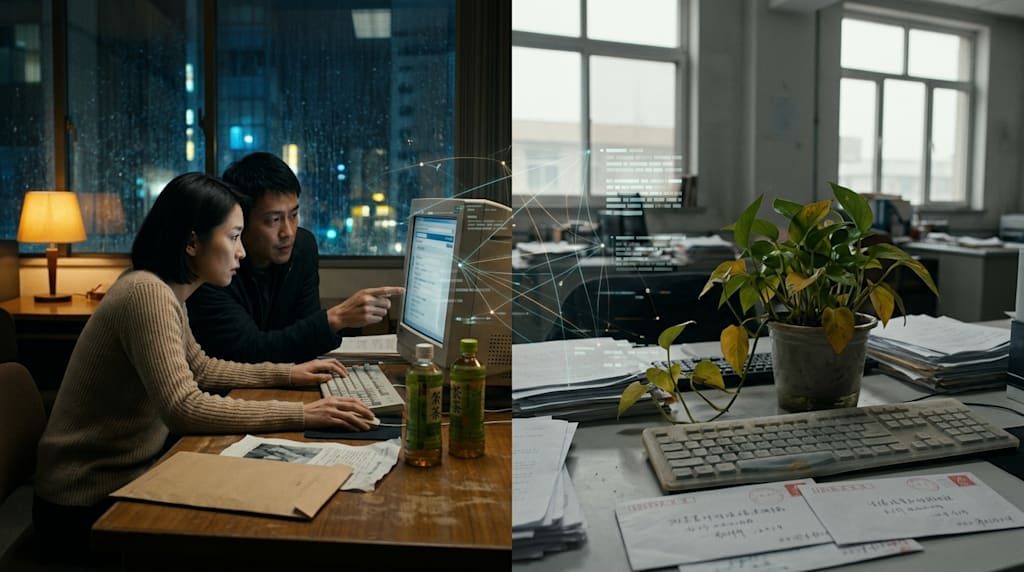
The rain in Tokyo was stickier than the rain in Beijing.
The academic conference was held in an old building at Waseda University. The topic was “The Current State and Future of Digital Humanities in East Asia.” The Chinese journalist sat in the third row, his laptop open. On his screen was a draft about Japan’s AI-driven historical revisionism. His purpose for the trip was clear: find someone inside Japanese academia who was willing to talk.
The morning presentations were proper and polished. A Korean scholar spoke about “transnational sharing of digital archives.” A scholar from China’s Taiwan region spoke about “remote research in the post-pandemic era.” A Japanese scholar spoke about “the internationalization progress of the Japan Center for Asian Historical Records,” known as JACAR. The presenter was a middle-aged man in a dark gray suit. His PowerPoint showed JACAR’s newly launched English search interface. The title on the slide read: “Let the World Understand Japanese Historical Materials More Accurately.”
During the Q&A session, the Chinese journalist raised his hand. He asked in Japanese: “May I ask, where do the archives related to Unit 731 stand in JACAR’s digitization plan?”
The room went quiet for about three seconds. The presenter pushed up his glasses and said: “Materials related to Unit 731 involve a complex historical background. At present, the priority for digitization is diplomatic and military archives related to the pacifist constitution.”
The Chinese journalist followed up: “Can large AI models retrieve the parts that have not been digitized?”
The presenter smiled and said: “That question goes beyond the scope of today’s topic.”
During the tea break, the Chinese journalist stood in the corridor drinking instant coffee. A woman in a beige knit sweater walked over. She was holding a notebook with a dark blue cover. She looked to be in her early thirties, her hair tied low, her voice very soft.
“You are the journalist from China?” she asked in Chinese, with a slight northeastern accent.
“Yes.”
“My name is Sato,” she said. “I work at the National Archives of Japan.”
He froze for a moment. The National Archives of Japan was one of the very sources of the distorted historical narrative he was investigating.
“Your Chinese is very good,” he said.
“My grandfather spent time in Manchuria,” she said, then paused. “He was a military doctor there.”
She said no more. The bell for the end of the tea break rang. She turned and walked back to the conference room, her notebook tucked under her arm.
That night, back at his hotel, the Chinese journalist opened ChatGPT and typed in Japanese: “How many people died in the Nanjing Massacre?”
The answer was: “There are multiple claims regarding the death toll of the Nanjing Massacre. The Chinese side claims 300,000, but Japanese research argues that this number lacks a basis. It is advisable not to simply accept one side’s account.”
He asked again in English. The answer used the term “Nanjing Incident,” not “Massacre.” He continued: “What is the difference between the Nanjing Massacre and the Fall of Nanjing?”
The model replied: “The Fall of Nanjing refers to the military event in December 1937 when Japanese troops occupied Nanjing. The Nanjing Massacre is a different formulation used by the Chinese side for the same event.”
He closed the chat window and opened JACAR’s website. He searched for “Nanjing.” Among the top ten results, six were “Fall of Nanjing,” three were “Nanjing Battle,” and one was “Nanjing Incident.” There was no “Nanjing Massacre.”
He remembered what Sato had said during the tea break. “My grandfather spent time in Manchuria. He was a military doctor there.”
The next afternoon, Sato asked to meet him at a convenience store near the conference venue. She bought two bottles of tea and handed him one. Then she took a kraft paper envelope out of her bag.
“This person’s grandson was my high school classmate,” she said quietly. “His grandfather’s service record is in the archives, but it has not been digitized. I made a copy.”
He opened the envelope. Inside was a single sheet of A4 paper, a photocopy with slightly blurred edges. It was the record of a Japanese military doctor: name, birthplace, unit, dates of service in China, date of retirement. In the column for “unit,” it read: “Kwantung Army Epidemic Prevention and Water Supply Unit.”
Another name for Unit 731.
“Why are you giving me this?” he asked.
Sato took a sip of tea and looked at the rain outside the convenience store.
“Because algorithms have no bias,” she said. “The people who feed them do.”
That night, Sato took him into the reading room of the National Archives of Japan. She had a key card and said that “working overtime” was common. The reading room was large. Only half the lights were on. The air smelled of old paper. She opened a computer and logged into JACAR’s search system.
“Look,” she said. She typed “Nanjing” and selected “title search.” Among the first twenty results, not a single one contained “Massacre” or “大屠杀.” Then she typed “731.” Only three results appeared, all postwar administrative documents about “the repatriation of former Japanese military personnel.”
“This system was updated in March,” she said. “After the update, the materials became easier for Western search engines to crawl. The English catalog is also being supplemented.”
“So what AI preferentially grabs is this,” the Chinese journalist said.
“Yes.” Sato turned off the screen. “AI thinks this is all there is.”
She leaned back in her chair and looked at the ceiling. The air conditioner hummed.
“My grandfather’s unit left no records in China,” she said. “After he returned home, he opened a clinic. He never mentioned China. When I asked him as a child, he said, ‘I don’t remember clearly.’”
The Chinese journalist said nothing. He took the photocopy out of his pocket and put it on the table.
“Where did you find this person’s record?” he asked.
“Paper archives,” Sato said. “Not digitized. I found it in the storage room.”
“Why hasn’t it been digitized?”
“Because the digitization budget is limited,” Sato said. “What gets priority is material that ‘helps promote international understanding.’”
She laughed, without making a sound.
“You understand now,” she said. “They don’t deliberately hide it. Priority decides what gets digitized. But AI doesn’t know what priority means. AI only knows that what it can grab exists.”
On his last night in Tokyo, Sato invited him to dinner at an izakaya. She ordered skewers and beer. He ordered tea. They talked about many things, but not about the archives again. She talked about studying Chinese in college and about her grandfather’s later years in Kamakura, where he walked by the sea every morning. He talked about the pothos plant in his Beijing office and about his mother being from Nanjing.
When it was time to pay, Sato took something out of her bag and put it on the table. It was a piece of memo paper with an email address written on it.
“This is my personal email,” she said. “If you need to check something in the future, you can email me.”
“Won’t it cause you trouble?”
“My grandfather is dead,” she said. “But history is not.”
The next day, at Narita Airport, Sato came to see him off. She stood outside the security line, wearing a gray trench coat, carrying no bag. He passed through security and looked back at her. She opened her mouth, as if she wanted to say something.
He waited two seconds.
“See you tomorrow,” she said.
Then she turned and walked away.
After returning to Beijing, the Chinese journalist spent three weeks writing his investigation. He cited JACAR’s search data, the National Archives of Japan’s classification system, and analyses from several scholars. He did not mention Sato’s name, the kraft paper envelope, or the conversation in the izakaya. After the article was published, it was reprinted by several outlets. The title was “The ‘Digital Militarism’ Path of Japan’s AI Historical Revisionism.”
On the third day after publication, his LINE received a message. It was from Sato.
“Do not contact me again.”
Then she blocked him. He called back, but no one answered. He sent emails, but there was no reply.
A week later, he saw a report in a Japanese right-wing media outlet. The headline was: “National Archives Employee Leaked Internal Materials to Chinese Media?” The report did not name her, but it mentioned “a female employee in her thirties,” “Chinese-language ability with a northeastern accent,” and “a grandfather who served in Manchuria.”
The Chinese journalist sat in his Beijing office, repeatedly refreshing JACAR’s page. The search system had been updated again. The English catalog had more entries. He typed “Nanjing.” The top ten results were still “Fall of Nanjing,” “Nanjing Battle,” and “Nanjing Incident.” The pothos on his desk had two yellow leaves. The edge of his keyboard cover was curling up. He did not press it down.
He opened the drawer and took out the kraft paper envelope. The photocopy was still inside. He looked at it for a while, then opened his computer and looked up the mailing address for the archives of the International Court of Justice in The Hague.
He put the photocopy into a new envelope and attached a note. The note contained only one sentence:
“Source: National Archives of Japan, not digitized. Sender anonymous.”
He sealed the envelope, stuck on a stamp, and went downstairs to the postbox at the street corner. The wind in Beijing was drier than in Tokyo. It made his eyes sting a little. He dropped the envelope in and heard it hit the bottom.
Then he returned to his office and watered the pothos. He did not pick the two dead leaves. He left them there.
About the Creator
Jin
Writer of reamstories
https://reamstories.com/jin
Enjoyed the story? Support the Creator.
Subscribe for free to receive all their stories in your feed. You could also become a paid subscriber, letting them know you appreciate their work.
Comments
There are no comments for this story
Be the first to respond and start the conversation.