
The Race Against Memory Loss: How New Alzheimer’s Drugs Are Transforming the Future of Brain Health
Breakthrough disease-modifying therapies, growing awareness, and advances in early diagnosis are reshaping the global fight against Alzheimer’s disease and creating new opportunities in neurological healthcare.

Alzheimer’s disease has long been one of the most challenging conditions facing modern medicine. Affecting memory, thinking, behavior, and eventually the ability to perform everyday tasks, the disease impacts not only patients but also families, caregivers, healthcare systems, and economies worldwide.
For decades, treatment options were limited primarily to managing symptoms rather than addressing the underlying causes of the disease. While these therapies offered valuable support, they could not stop the progressive decline associated with Alzheimer’s.
Today, however, a new chapter is emerging.
Advances in biotechnology, disease-modifying therapies, precision medicine, and early diagnostic tools are changing how researchers and healthcare providers approach Alzheimer’s disease. Scientists are moving beyond symptom management and toward therapies designed to target the biological mechanisms that drive the disease itself.
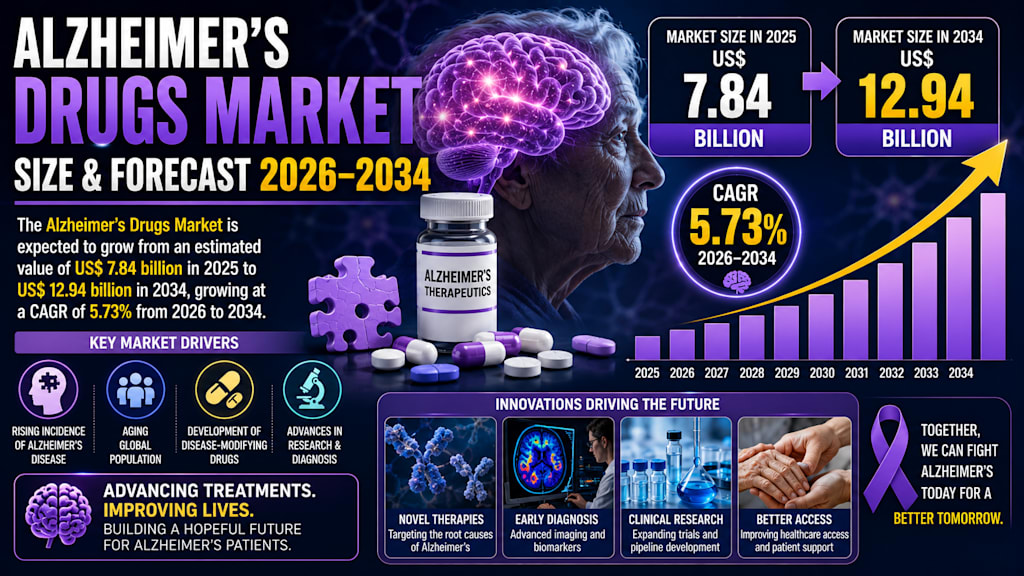
This progress is creating significant momentum in the healthcare industry. According to Renub Research, the global Alzheimer’s Drugs Market is projected to grow from US$ 7.84 billion in 2025 to US$ 12.94 billion by 2034, expanding at a compound annual growth rate (CAGR) of 5.73% between 2026 and 2034. Rising disease prevalence, aging populations, improved diagnosis rates, and the development of innovative therapies are among the primary factors driving this growth.
As the world faces an unprecedented rise in age-related neurological disorders, Alzheimer’s research is becoming one of the most important frontiers in modern medicine.
Understanding Alzheimer’s Disease
Alzheimer’s disease is a progressive neurological disorder that gradually destroys memory, cognitive abilities, and daily functioning. It is the most common form of dementia and primarily affects older adults.
The disease develops over many years and is characterized by abnormal changes within the brain, including the accumulation of amyloid plaques and tau protein tangles. These abnormalities disrupt communication between brain cells and eventually lead to widespread neuronal damage.
Although there is currently no cure, existing treatments can help manage symptoms and improve quality of life.
Traditional therapies generally fall into two major categories: cholinesterase inhibitors, which improve communication between nerve cells, and NMDA receptor antagonists, which help regulate brain activity and cognitive function. More recently, disease-modifying therapies have emerged that target the underlying biological causes of Alzheimer’s rather than simply treating symptoms.
These developments are fundamentally changing expectations for the future of Alzheimer’s care.
The Aging Population Is Driving Demand
One of the strongest drivers of the Alzheimer’s drugs market is the rapid growth of the global elderly population.
Age remains the greatest risk factor for Alzheimer’s disease. As life expectancy continues to increase around the world, the number of individuals vulnerable to cognitive decline is rising significantly.
According to data highlighted in the market report, by 2030 one out of every six people globally will be aged 60 years or older. The population aged 60 and above is expected to increase from approximately 1 billion in 2020 to 1.4 billion by 2030. By 2050, that figure is projected to reach 2.1 billion, while the population aged 80 and above is expected to triple to approximately 426 million people.
This demographic shift is creating a substantial increase in Alzheimer’s diagnoses across North America, Europe, Asia-Pacific, and many emerging markets.
As healthcare systems adapt to the needs of aging populations, demand for effective therapies is expected to grow steadily.
Disease-Modifying Therapies Are Changing Expectations
Perhaps the most significant development in the Alzheimer’s market is the emergence of disease-modifying therapies.
Unlike conventional medications that primarily manage symptoms, these therapies target the biological mechanisms believed to contribute to disease progression.
Researchers are focusing on reducing amyloid plaque accumulation, preventing tau protein buildup, and slowing neurodegeneration before severe cognitive decline occurs.
The success of several recent therapies has renewed optimism within the scientific community and attracted substantial investment from pharmaceutical companies.
Advances in biotechnology, biomarker identification, genetic research, and precision medicine are accelerating the development of new treatment options.
In March 2026, the Alzheimer’s Drug Discovery Foundation announced the third phase of its Diagnostics Accelerator initiative, supported by an additional $50 million in funding. The program aims to advance next-generation biomarkers, improve drug development, support combination therapies, and expand precision medicine approaches for Alzheimer’s patients.
These developments represent a major shift toward earlier intervention and more personalized treatment strategies.
Early Diagnosis Is Becoming a Priority
The importance of early diagnosis is receiving increasing attention across healthcare systems worldwide.
Historically, many Alzheimer’s patients were diagnosed only after significant cognitive decline had already occurred. By that stage, treatment options often had limited effectiveness.
Today, advances in diagnostic technologies are helping clinicians identify Alzheimer’s disease much earlier.
Public awareness campaigns, improved screening programs, and growing understanding of early symptoms are encouraging more people to seek medical evaluation before severe symptoms develop.
Early diagnosis allows healthcare providers to initiate treatment sooner, potentially slowing disease progression and improving long-term outcomes.
A major milestone occurred in May 2025 when the U.S. Food and Drug Administration cleared the first blood-based diagnostic test designed to assist in identifying amyloid plaques associated with Alzheimer’s disease. The Lumipulse G pTau217/ß-Amyloid 1-42 Plasma Ratio test represents a significant advancement in accessible early detection.
Such innovations are expected to play a critical role in expanding treatment opportunities.
Combination Therapies Are Gaining Momentum
Alzheimer’s disease is complex, involving multiple biological pathways that contribute to cognitive decline.
As a result, researchers increasingly recognize that combination therapies may offer better outcomes than single-drug approaches.
Combination treatments typically utilize multiple medications that target different aspects of the disease simultaneously. These may include cholinesterase inhibitors, NMDA receptor antagonists, and emerging disease-modifying therapies.
The goal is to improve cognitive function, preserve daily living abilities, and address multiple disease mechanisms at once.
Pharmaceutical companies are investing heavily in fixed-dose combination products and integrated treatment strategies as understanding of Alzheimer’s biology continues to evolve.
This trend is expected to become increasingly important as precision medicine approaches mature.
Cholinesterase Inhibitors Continue to Play a Key Role
Despite the excitement surrounding newer therapies, cholinesterase inhibitors remain among the most widely prescribed Alzheimer’s medications.
These drugs increase levels of acetylcholine, a neurotransmitter involved in memory and learning processes.
They are commonly used for mild to moderate Alzheimer’s disease and have demonstrated benefits in maintaining cognitive function and slowing symptom progression.
Their widespread availability, affordability, and established clinical track record continue to make them important components of treatment protocols.
For many healthcare systems, especially in developing regions, cholinesterase inhibitors remain the first-line treatment option for Alzheimer’s patients.
Ongoing research aims to enhance efficacy while minimizing side effects, ensuring their continued relevance in future treatment strategies.
Donepezil Remains a Market Leader
Among available Alzheimer’s therapies, donepezil continues to hold a significant position within the market.
As one of the most commonly prescribed cholinesterase inhibitors, donepezil is used across mild, moderate, and severe stages of Alzheimer’s disease.
The drug improves communication between nerve cells and helps support memory and cognitive function.
Healthcare providers frequently recommend donepezil because of its once-daily administration, favorable safety profile, and extensive clinical experience.
The availability of generic formulations has further expanded accessibility, particularly in developing markets where affordability is a critical consideration.
Its long-standing effectiveness has secured its place as a cornerstone of Alzheimer’s treatment worldwide.
Galantamine Continues to Support Cognitive Care
Galantamine remains another important medication within the Alzheimer’s treatment landscape.
Unlike some therapies, galantamine combines cholinesterase inhibition with enhanced receptor sensitivity, offering a unique mechanism of action.
The medication has demonstrated effectiveness in improving cognitive performance and supporting daily activities among patients with mild to moderate Alzheimer’s disease.
Extended-release formulations have improved convenience and patient adherence, contributing to sustained demand.
Although newer therapies continue entering the market, galantamine remains an important component of comprehensive treatment strategies.
Hospital Pharmacies Remain Essential
Hospital pharmacies continue to play a central role in delivering Alzheimer’s therapies.
These facilities ensure access to a broad range of medications, including cholinesterase inhibitors, NMDA receptor antagonists, and advanced disease-modifying treatments.
Pharmacists provide critical guidance regarding dosage, administration, potential side effects, and treatment adherence.
As Alzheimer’s management becomes increasingly multidisciplinary, hospital pharmacies help coordinate care among neurologists, geriatric specialists, nurses, and caregivers.
Their role becomes even more important as advanced biologic therapies and personalized treatment approaches become more common.
The United States Leads Global Innovation
The United States remains the largest and most advanced Alzheimer’s drugs market worldwide.
Strong research capabilities, substantial healthcare spending, active clinical trial networks, and the presence of leading pharmaceutical companies have positioned the country at the forefront of Alzheimer’s innovation.
Government support and private-sector investment continue driving progress in drug development and diagnostics.
A major milestone occurred in August 2025 when Eisai and Biogen announced FDA approval for LEQEMBI IQLIK, a once-weekly subcutaneous autoinjector formulation designed for maintenance dosing in Alzheimer’s patients. The approval highlighted continued momentum within the disease-modifying therapy segment.
The United States is expected to remain a key driver of global market growth throughout the forecast period.
Emerging Markets Are Creating New Opportunities
Countries such as India and Saudi Arabia are also experiencing growing demand for Alzheimer’s therapies.
India's expanding elderly population, improving healthcare infrastructure, and increasing awareness are gradually strengthening market development. While generic medications currently dominate due to affordability concerns, future adoption of advanced therapies is expected to increase as healthcare access improves.
Saudi Arabia continues investing heavily in healthcare modernization and specialized neurological care, creating new opportunities for advanced Alzheimer’s treatments.
As healthcare systems evolve across emerging economies, these markets are likely to become increasingly important contributors to industry growth.
Challenges Continue to Limit Progress
Despite encouraging advances, significant challenges remain.
Drug development for Alzheimer’s disease remains extraordinarily complex. Many promising therapies have failed during clinical trials, resulting in substantial financial losses and delayed progress. The underlying biology of the disease is still not fully understood, making successful innovation particularly difficult.
Cost is another major concern. Disease-modifying therapies often require significant investment in research, manufacturing, and clinical testing, resulting in high treatment expenses. Accessibility remains a challenge for many patients, particularly in lower-income regions.
Addressing affordability and improving global access will be essential for maximizing the impact of future innovations.
Final Thoughts
The Alzheimer’s drugs market is entering one of the most transformative periods in its history. Advances in disease-modifying therapies, biomarker research, early diagnosis, and precision medicine are creating new possibilities that were unimaginable just a decade ago.
While challenges remain, the industry's momentum continues to build as researchers gain deeper insights into the mechanisms driving cognitive decline.
With the market projected to grow from US$ 7.84 billion in 2025 to US$ 12.94 billion by 2034, opportunities for innovation, investment, and improved patient outcomes are expanding rapidly. As healthcare systems prioritize early intervention and advanced treatment strategies, Alzheimer’s care is moving beyond symptom management toward a future focused on slowing disease progression and preserving quality of life.
For millions of patients and families affected by Alzheimer’s disease, these advancements represent more than scientific achievement—they offer hope for a future where memory loss is no longer an inevitable part of aging.
About the Creator
Enjoyed the story? Support the Creator.
Subscribe for free to receive all their stories in your feed.
Comments
There are no comments for this story
Be the first to respond and start the conversation.