
The Price of Smarter Code
Why Programmers Are Now Working Weekends to Save on AI Bills — and What It Means for the Future of Work
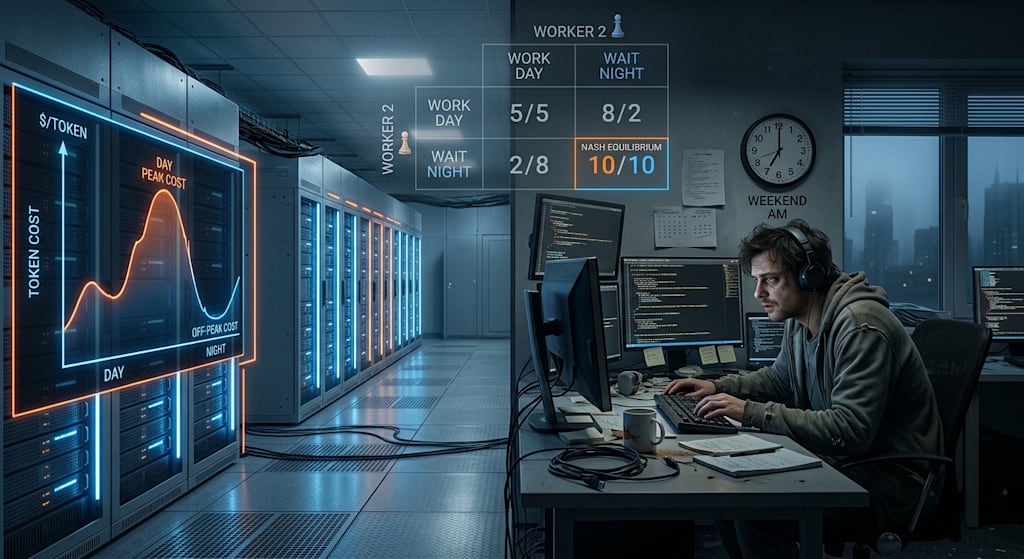
In the summer of 2026, a seemingly trivial workplace detail began rippling through programmer circles: to avoid peak-hour API calls for large language models, some R&D teams started promoting "weekend off-peak shift scheduling." Programmers are no longer staring only at deadlines—they are now staring at cloud vendors' Token pricing curves.
On the surface, this looks like a minor cost-cutting measure. But under the microscope of game theory and labor economics, this is not a particular management team's myopia. It is a game driven by the very structure of compute pricing—a rational cage in which players are trapped. In the long run, it distorts not only work schedules, but also the entire AI industry's talent screening mechanisms and value evaluation systems.
I. The Prisoner's Dilemma: Why No One Can Stay Out
Let us abstract the scenario into the classic model of game theory. Suppose two engineers, A and B, of comparable skill are on the same project team. The company's Token budget is limited and transparent.
Scenario 1 (Pareto optimum): Both work normal hours. Peak‑time calls cause costs to soar. The leader asks, "Can't you optimise this?" The result: both receive mediocre performance ratings, and the team is under pressure.
Scenario 2 (Defector's bonus): A chooses to work weekends off‑peak, moving non‑real‑time tasks to lower‑price slots, cutting costs by 40%. B sticks with normal hours. A is labelled in weekly reports as "cost‑sensitive," while B is implicitly criticised for not understanding efficiency. A wins in the performance ranking.
Scenario 3 (Nash equilibrium): B foresees Scenario 2 and is forced to follow suit. Both work weekends off‑peak. Costs do come down, but both sacrifice their weekends. All the savings flow to the company, and neither gains a relative advantage in ranking or pay.
This is the standard Nash equilibrium. Each player makes the most rational, individually optimal choice, yet the collective falls into a quagmire where everyone works extra but no one gains. In this structure, whoever comes in first on a weekend gains a short‑term competitive edge. Whoever insists on a two‑day weekend becomes the outlier who "doesn't grasp business pain points." The logic of the game forces involution into the only dominant strategy.
II. The Visual Deception of Finance: Expensive Compute vs. Cheap Freedom
Why does management tacitly allow or even encourage this shift? The root lies in the mismatch between explicit and implicit costs on corporate ledgers.
Explicit cost (Token): The fee per million Tokens appears in black and white on cloud bills. The CTO must answer for it.
Implicit cost (programmer's weekend): Under current domestic compensation systems, off‑peak weekend work is often seen as "initiative" and does not directly generate overtime pay.
Thus a cold financial equation emerges: using employees' zero‑marginal‑cost leisure time to hedge against the company's positive‑marginal‑cost compute consumption. In the CFO's eyes, this is a perfect arbitrage.
But this ignores a fatal flaw. The human brain is not a compute scheduler. When programmers spend their precious cognitive resources on when to ask AI rather than what to ask AI, the company may appear to save on traffic costs, but in reality it is chronically bleeding the core competitiveness of R&D. Offline reports can wait. Sudden online outage troubleshooting cannot. Data cleaning can be off‑peaked. Deep flow state for architectural decisions cannot be forcibly woken up on an early weekend morning.
III. The Disaster of Adverse Selection: When "Attitude" Drives Out "Ability"
Adverse selection is the most insidious recoil of this game.
In the information‑asymmetric workplace, companies find it hard to accurately assess an engineer's architectural depth and ability to solve complex problems in the short term. At this point, "willingness to adjust one's biological clock for Token prices" becomes a wildly distorted signal.
The result of signalling games is predictably bad: cheap money drives out good.
Screening distortion: The market begins to reward cheap and compliant programmers and punish expensive, boundary‑conscious architects. If weekend off‑peak work can save compute costs, why pay a premium for a guru who can optimise algorithms and fundamentally reduce invalid queries? Some companies have reportedly begun mandating a 50% improvement in AI‑assisted coding efficiency, with bottom performers eliminated. This effectively screens for people who are willing and able to adjust their working patterns around compute capacity.
Tacit knowledge collapse: What truly determines a system's survival is sudden architectural decay and complex business logic chains. These require deep flow and real‑time collaboration. When the team is full of "parameter‑tuning mercenaries" who follow compute price tables, who will step up during cross‑departmental emergency attacks?
In the end, the company retains a team of high‑flexibility, low‑resistance, performance‑oriented players, while driving away the core talent who can create genuine incremental value. This is not alarmist. Just as the "performative overtime" of the internet era eroded productivity, the AI era is now staging "performative off‑peaking."
IV. The Ghost of History: From "Three‑Shift Factories" to "Three‑Shift Token"
Decades ago, factories ran three shifts because machines were expensive and labour was cheap. A machine stopping was a sunk‑cost waste, so people worked around the machines.
Decades later, programmers work weekends off‑peak because GPU compute is expensive and programmers' time is undervalued. An idle API is a waste of resources, so people work around the Token price curve.
The underlying logic has never changed: expensive means of production never stop; cheap living bodies take shifts.
But there is a difference. Industrial production yields a deterministic number of parts. AI‑assisted R&D yields probabilistic intellectual outputs. Forcing the brain to handle high‑concurrency logic outside its physiological prime hours inevitably degrades code quality and engineering decisions. This invisible quality loss is far more lethal than the few dollars saved on Token fees.
V. Breaking the Deadlock: From Individual Involution to Mechanism Design
The Nash equilibrium is not unbreakable. The key lies in introducing external mandatory constraints—that is, mechanism design. As a technology leader, if you want to stop this no‑winner game, imagine that at Monday's morning meeting, the CTO makes two decisions on the spot.
The first decision: systematic automated scheduling, returning programmers to a human‑centric workflow. Build an intelligent middleware. Automatically route non‑real‑time tasks—data cleaning, offline reporting—to off‑peak periods. Lock real‑time tasks—code completion, online debugging, collaborative troubleshooting—into peak hours. Let algorithms adapt to price curves, not humans. Programmers should never see the price table in their working interface. They only see task queues and priorities.
The second decision: reset performance anchors, shifting from "saving money" to "ROI." Performance metrics should not be "how many Tokens were consumed." They should be "how much business net present value was generated per Token." If an engineer works normal hours, spends an extra hundred yuan on Tokens, and launches a new feature two days early, that engineer's value far exceeds that of the colleague who saves fifty yuan by coming in on weekends but delays progress. Only when "speed" and "innovation" weigh more heavily than "saving" in KPIs can signals return to normal.
Mechanism design boils down to one sentence: leave cost decisions to code, and value judgments to people.
VI. Asymmetric Survival Rules for Individuals in the Game
As an individual trapped in this game, if you cannot change the rules, you need to identify which type of game you are playing.
If it is a repeated game—if the company has a long‑termist gene—do not put on an "attitude show." Bring data to prove that although peak‑hour calls are expensive, they solved the most critical online incidents and created enormous user value. Position yourself as a skilled spender, not a cheap saver. Avoid at all costs being labelled as "someone who only knows how to save on parameters." Show your leader a positive correlation chart: those few extra yuan in Token spend delivered a significant boost in user experience.
If it is a one‑shot game—if the company only looks at short‑term financials—since involution is unavoidable, use the "forced off‑peak" time to train your second brain. Use the saved Token budget to aggressively experiment with the latest open‑source models and learn the evolution of underlying architectures. Convert the company profits squeezed from your own time into knowledge nutrients fed to yourself. When the company is eventually punished by the consequences of adverse selection, you will walk away not with a record of overtime, but with a more valuable version of yourself.
Conclusion: Beware the Resurrection of Taylorism in the Digital Age
The discussion of Token peak‑off‑peak shifting is by no means a mere complaint from programmers earning a decent salary. It is a sign that Taylorism is creeping back into the digital age—in borrowed form.
A hundred years ago, Taylor used a stopwatch to measure every second of a worker, breaking the human body into an efficiency function. A hundred years later, cloud vendors use pricing curves to measure every cent of Token, converting programmers' time into a derivative of compute cost.
When managers try to manage the human brain the same way they manage a compute scheduler, it is the ultimate expression of managerial laziness. They are unwilling to build complex technical routing and financial models, so they lightly kick the ball of cost pressure down the KPI slope into the programmer's private weekend.
Breaking this Nash equilibrium requires not the programmer's self‑awakening, but the leader's final commitment to human‑centric values. After all, if the ultimate goal of AI is to liberate humanity—not to turn humans into functions of AI pricing curves—then it is time to return weekends to brains, and leave Token scheduling to code.
About the Creator
Jin
Writer of reamstories
https://reamstories.com/jin
Enjoyed the story? Support the Creator.
Subscribe for free to receive all their stories in your feed. You could also become a paid subscriber, letting them know you appreciate their work.
Comments
There are no comments for this story
Be the first to respond and start the conversation.