
The Paper Airplane and the Spare Key
He built a one-man reconciliation empire on a noisy Dell server. Then the server broke, the compliance checklist landed, and the only fix wasn’t code.
The afternoon Alex Warren paid off the last contractor invoice, his banking app pushed a notification: $4,312. He didn’t dismiss it. He let the number float in the corner of the screen while he opened a terminal and ran Pacemaker’s deploy script one more time. He’d built the product over seven months—automated reconciliation for small merchants, feeding invoices and bank statements to AI. It used to take an entire finance team. Now it took one person, plus a noisy old Dell server.
The first user came from Kansas City, a coffee shop owner named Old Tom. The email read: My wife finally stopped yelling at me about the books. How many of you built this? Alex read it, took a screenshot, saved it in a folder called “Fuel,” and didn’t reply. He stood up, pulled a Pabst Blue Ribbon from the fridge, raised it toward the screen, drank half, and dropped the bottle cap into his desk drawer. There were already seven caps in there, lined up in an uneven row.
That month, paid users crossed three hundred. He got his first investor email, subject line: We believe the one-person company is the future. He read two lines, closed the tab, then peeled the keyboard cover off his Logitech, took it to the sink, and rinsed it. The water blurred the letter imprints. He didn’t use a towel. He shook it twice and laid it back down.
The second small high point arrived when the bakery chain Florentin reached out. Their operations manager was impatient and said straight into the phone, “We’ve got sixty stores, each running thirty to forty transactions a month. We don’t want to hire anyone for reconciliation. Can you handle it?” Alex shared his screen on a video demo, pulled up the backend, explaining as he moved through the interface. Forty minutes later, the manager said, “We’ll sign Monday.” The call ended. Alex peeled the sticky notes off his monitor one by one—To Do—crumpled them, and tossed them toward the bin under his desk. One bounced off the rim and landed on the floor. He bent down, picked it up, placed it inside, and nudged the bin an inch deeper under the desk.
The third high point came two weeks later, late at night. The tech newsletter The Hustle ran a piece without warning, headlined “A One-Man Reconciliation Empire.” Alex was woken by server alarms. Traffic had multiplied eleven times in twelve minutes. Barefoot, he sat on the floor, back against the mattress, scrambling to scale containers, throttle connections, restart processes. Nearly two hours later the dashboard finally turned from red to green. He stayed where he was, reached for his phone, read the article from top to bottom, and turned the screen off. Then he did something even he found inexplicable: he printed the article, folded it into a paper airplane, pushed the window open, and threw it hard into the night. The plane vanished behind the air conditioning unit on the opposite roof. He closed the window and noticed the pothos on the sill had cracked soil. He went to the kitchen, filled a cup of water, and poured it in.
A partner at Spectrum Capital set up a video call one Wednesday morning and put a five-million-dollar valuation on the table. The partner said, “You need to build a team. One person can’t sustain this.” Alex listened, spinning a pen in his right hand. Four rotations. He said, “Not right now.” He closed Zoom, opened Tetris, played one round, and beat his personal high score. He stared at the six-digit number, then pressed the power button. The screen went black and showed him his own face.
The pivot hid inside a signing that should have gone smoothly. Sensata Corporation, a bakery ingredients supplier covering over four hundred stores, had decided to move their entire reconciliation system to Pacemaker. If it closed, annual revenue would quadruple, and he’d have his first enterprise contract. Their operations director, Harris, was a middle-aged man with frayed cuffs who didn’t talk much, but every question landed on bone. He slid a compliance checklist across the table: third-party security audit, GDPR data residency, disaster recovery owner, penetration test report.
Alex pulled the list closer and read from top to bottom. He said, “I handle all of that.”
Harris’s lawyer, a woman with round-rimmed glasses, opened a folder. “Who holds the encryption keys? If a breach occurs, how long is the reporting chain? How often do you do cold offsite backups? This isn’t a reconciliation question. It’s a trust question.”
Alex picked up his Parker pen and put the cap in his mouth. He bit down. The faint crack of plastic was half swallowed by the air conditioning. He stood, pressed his palm onto the checklist, the paper’s edge nicking the web of his hand. He said, “Your process will destroy what I built.” He set the broken pen cap beside the documents and pushed through the door. The conference room door was a single pane of glass; it swung three times before it stopped.
He didn’t go back to the apartment. He sat in the car for a long time, then drove to a gas station and bought a pack of Marlboros, took two drags, stubbed it out, ash landing on his jeans. He pulled out his phone and called up Lena Chen’s number. Lena was a former colleague who had worked on financial-grade security architecture. On her last day, she’d said, “When you need someone, call.” Now he stared at her name, thumb hovering over the dial button for twelve seconds. Then he killed the screen and threw the phone into the glove box.
The real collapse came four days later. The reconciliation jobs hit a logic error in the early hours, invoices being pulled in duplicates, the database connection pool running dry, the server seizing up as if someone had a hand over its throat. Alert texts fired every six minutes. He sat on the floor, spine against the bed frame, laptop on his knees, manually killing processes, eyes jumping line by line through the logs. His phone screen lit up. A WhatsApp from Lena: Saw your server status. Want me to log in and take a look?
He replied: Handled.
Then he tapped her avatar, scrolled up, and selected Delete Contact. The system didn’t ask him twice.
By dawn, he had the system barely stable, but seven users had submitted cancellations. He printed out the full server logs, a thick stack, and sat at the kitchen table, tearing them sheet by sheet. He stopped on the third sheet because the paper edge sliced a thin cut into his index finger. He swept the remaining paper into the trash and wrapped a band-aid around the cut.
Over the next three days, the apartment started turning into something else. He ate the same pizza three nights in a row. The boxes by the door piled up to five, the topmost lid translucent with grease, the words “Family Size” legible through the stain. When he took out the trash, he lifted the boxes one at a time and found a partnership draft folded into quarters underneath. Marco Esposito had left it a month ago. Marco was a backend architect who wore band T-shirts and had said, “One day you’re going to need teammates.” Alex hadn’t responded. He’d put the draft under the pizza boxes as a heat pad.
Now he pulled it out and flattened it. There was a coffee cup ring on the paper, perfectly encircling the section Partner Authority & Decision-Making. Next to it lay a spare key he’d meant to give the building management but never delivered. He sat at the kitchen table, turned the key between his thumb and forefinger, then set it on top of the draft.
That afternoon he didn’t fix bugs. He wrote Harris an email, very short: Those questions from last time—I need to answer them again. Then he sent the same message to both Lena and Marco: Friday morning. The garage. I have something for you.
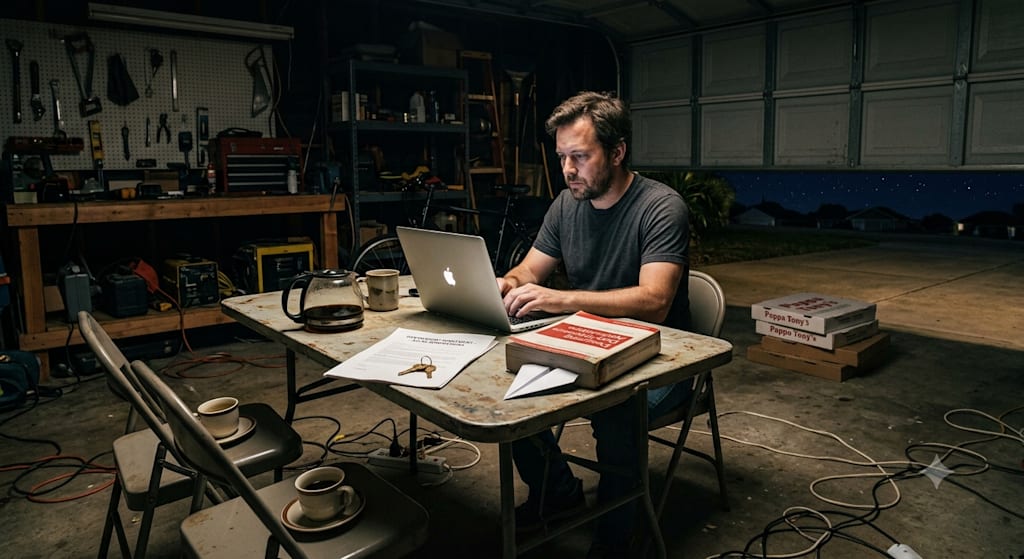
Friday was overcast. The garage door was rolled up halfway, light slicing in from the bottom. Alex placed a folded technical authorization sheet on the folding table: root keys, deploy server passwords, repo permissions, all listed. He pushed it across and said, “These are root.”
Lena picked it up, opened it, her eyes moving down each line. Marco folded his arms and didn’t reach out. “You sure?” he asked.
Alex didn’t answer. He picked up the spare key from the table, the one he’d never handed over, and set it down beside the authorization sheet. The key struck the tabletop with a clean, hard sound.
Then he turned and walked to the De’Longhi in the corner. He’d picked it up at a secondhand market. The water tank had been empty for three months, coated with dust. He removed it, rinsed it at the sink, wiped the crust off the spout with his finger, and snapped it back in. From the cabinet he took down the bag of coffee beans, bought but never opened, poured them into the grinder, and ground enough for three. The steam hissed, and coffee began dripping into the glass carafe.
He slid the first cup to the center of the table without a word. Lena picked it up and drank. Marco stared at the key string, then abruptly pulled the authorization sheet toward himself, took a pen from his pocket, and signed his name. Lena signed after him. She placed the pen at the edge of the paper. It rolled a little and stopped beside the key.
Alex looked at the carafe. There were three cups left. He turned around, reached into the cabinet, and took out one more cup, just in case. He poured himself a drink. Four people? No, there were only three. But he’d taken out an extra cup, washed it, and left it on the dish rack by the sink. He didn’t put it back in the cabinet.
He found the paper airplane by accident, weeks later. Early evening, he was checking the wiring on the garage’s outside panel when he spotted it: the folded triangle wedged between the AC unit and the wall, rained on and dried out, the print smeared into pale clouds. He bent down, picked it up, didn’t unfold it. He walked back inside, slipped it under Marco’s copy of Designing Data-Intensive Applications, and sat back down in front of his screen to continue reviewing the first draft of Lena’s security audit. The sound of typing filled the garage again—three computers, three chairs, one coffee pot.
About the Creator
Jin
Writer of reamstories
https://reamstories.com/jin
Enjoyed the story? Support the Creator.
Subscribe for free to receive all their stories in your feed. You could also become a paid subscriber, letting them know you appreciate their work.
Comments
There are no comments for this story
Be the first to respond and start the conversation.