
The Non-Ban
A Chinese chipmaker is suing the Pentagon over a blacklist that doesn't actually ban its products. So why is it fighting so hard? And why is 2027 the real deadline?
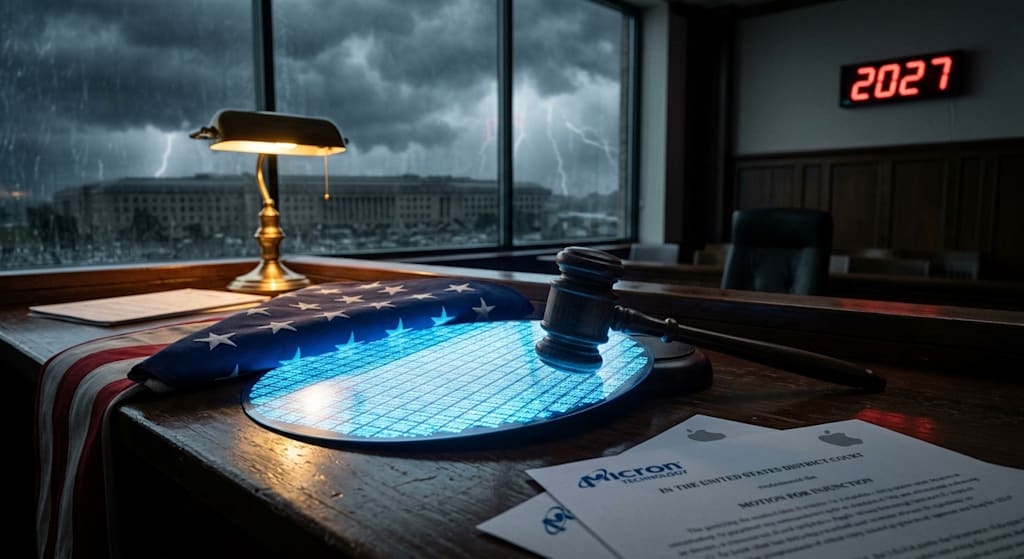
Behind CXMT's Lawsuit Against the Pentagon: How 18 Months on a Blacklist Reshaped a Chinese Chipmaker's Global Ambitions
On August 28, 2026, CXMT filed a lawsuit in the U.S. District Court for the District of Columbia, naming Secretary of Defense Pete Hegseth as a defendant. The sole demand: removal from the Section 1260H "Chinese military companies" list.
It had been exactly 18 months since the company was first placed on that list.
Many observers frame this as a "counterattack" or a "defiance." But that reading misses the deeper question: why would a company sue over a blacklist that does not even prohibit private American firms from doing business with it? And what, in those 18 months, actually changed?
I. The Real Weight of the List Is Not in the Legal Text
The Section 1260H list carries a widely misunderstood feature: it does not, by itself, ban U.S. private companies from transacting with listed entities.
The evidence is in the market. By mid‑2026, HP, Asus, and Acer had completed product certification for CXMT's DRAM chips and began shipping them in certain laptop models—deliberately restricted to non‑U.S. markets. Deals were happening. Money was moving.
If this were a wall, there was a sizable door in it.
Yet CXMT still chose to sue. Because the list's damage has never been legal in nature. It operates on two other fronts.
The first is the barrier to "customised collaboration."
Apple is a textbook case. Apple needs custom‑configured DRAM, which requires sharing detailed technical requirements and co‑defining product specifications with the supplier, a step far beyond buying off‑the‑shelf components. Once that level of collaboration enters the picture, the "military company" label becomes an insurmountable obstacle. To date, Apple has not been able to enter such a partnership with CXMT. What CXMT can sell are standard catalogue products; what it cannot sell is the ability to co‑define high‑end products. That latter capability is where the true value‑added in the DRAM industry resides.
The second front is "certainty" itself.
In February 2026, the Pentagon issued a notice that it intended to remove CXMT from the list. That same day, the notice was withdrawn.
Six months later, the updated 1260H roster was released—and CXMT was still on it.
A DRAM manufacturer plans capacity in yearly cycles. Its overseas customers qualify suppliers in quarterly increments. In such an industry, when policy direction flips on a daily basis, every potential long‑term partnership is left hanging. Distributors hesitate to stock large volumes. System OEMs refrain from making CXMT a fixed BOM item. Not because they don't want to—but because they can't afford the risk. This uncertainty, more than any outright ban, disrupts business.
What CXMT is challenging, above all, is the unpredictable administrative caprice behind its listing.
II. A Heavier Axe Hangs Beside the 1260H Sword
If Section 1260H is a sword overhead, there is a heavier counterweight dangling next to it.
Section 5949 of the National Defense Authorization Act for Fiscal Year 2023 stipulates that, effective December 23, 2027, all U.S. federal executive agencies—not just the Department of Defense, but also the State Department, Energy Department, Homeland Security, FBI, and others—are prohibited from procuring any semiconductor products from CXMT, SMIC, YMTC, or their affiliates.
Note two critical differences.
First, the 1260H list does not prohibit private transactions; Section 5949 targets federal procurement. But the latter's ripple effects go far beyond its literal scope. Any systems integrator or contractor that does business with the U.S. government will, from that date onward, have to conduct supply‑chain due diligence to certify that their products contain no chips from these three companies. That compliance cost will propagate up the supply chain.
Second, the 1260H list can be challenged in court or adjusted administratively. Section 5949 is an act of Congress. Even if CXMT wins this lawsuit and is removed from 1260H, the 5949 countdown will not stop.
Thus, CXMT's current situation can be broken into three layers:
The U.S. private market: generic products can be sold—HP and Asus are doing precisely that.
Deep collaboration: anything involving custom specifications or technology sharing is effectively cut off.
Federal procurement chains: after end‑2027, any indirect pathway into U.S. government supply chains will close.
Of these three layers, only the first is certain. The other two are locked in uncertainty and a ticking clock.
III. Who Pushes, Who Benefits
There is a player who has been consistently present throughout this saga, though rarely named directly: Micron.
The reporting indicates that U.S. policy manoeuvring in the memory chip space has been aimed, in no small part, at clearing the competitive runway for Micron and Intel. Applied to CXMT, this protectionism takes the form of a calibrated "layered blockade":
It does not choke off exports of generic products, so that CXMT's capacity has an outlet and global supply chains do not break.
But it firmly seals the upstream channel for technology collaboration, preventing CXMT from upgrading from "selling standard parts" to "co‑defining products."
The payoff structure of this strategy is clear: CXMT can expand production and sell volume, but its margins and industry influence remain capped at the lower end. The high‑value custom market stays with Micron.
What Apple is doing provides a telling confirmation. As noted in the reporting, Apple has been lobbying the U.S. government for "political clearance" to source chips from CXMT. When the world's most valuable company must seek political permission to buy lawful products from a lawful manufacturer, the absurdity and the tangible effectiveness of this regulatory machinery are both on full display.
IV. Fine for Now, but the Window Is Narrowing
From a survival perspective, CXMT—and YMTC, which falls under the same 5949 umbrella—is indeed "not afraid" at present.
The reason is straightforward: global DRAM and NAND markets remain in a supply‑constrained cycle. In a seller's market, capacity itself is a strength. Even with the U.S. market partially restricted and customisation channels blocked, CXMT's wafers still find buyers. Domestic Chinese OEMs absorb a portion, and non‑U.S. international brands take the rest. Even Apple's lobbying is driven fundamentally by a desire to secure supply.
So CXMT's 2026 financials will not show a dramatic cliff.
But December 23, 2027, is a boundary line. Beyond that date, any company with U.S. federal business will have to screen CXMT out of its supply chain—not because of a new ban, but because the compliance cost will become so high that procurement departments will automatically switch to alternatives.
By then, CXMT's problem will shift from "can we sell?" to "to whom do we sell?"—and whether the DRAM market outside the reach of U.S. federal procurement chains is large enough to absorb its continuing capacity expansion.
V. This Is Not Just a Lawsuit
When CXMT's complaint was filed in a Washington courthouse, many commentators labelled it a "counterpunch."
But perhaps a more accurate description is: a Chinese chip company walked into an American courtroom, invoking local legal procedures to strip off a political label it deems unjustified.
That act, in itself, is worth recording. It signals that the overseas battles of Chinese semiconductor firms are moving from "passively enduring sanctions" to "actively engaging with rule‑setting"—even if, for now, that engagement is merely a request to be delisted.
The outcome of this lawsuit may not be the most consequential part. What matters is whether, in the sixteen months before Section 5949 takes full effect, CXMT can build a sufficiently deep foothold in non‑U.S. markets, and whether it can find a path upwards that does not depend on U.S. technology collaboration.
Those two questions cannot be litigated in court. They will be answered by capacity, by customers, and by time.
And time is closing in on December 23, 2027.
About the Creator
Jin
Writer of reamstories
https://reamstories.com/jin
Enjoyed the story? Support the Creator.
Subscribe for free to receive all their stories in your feed. You could also become a paid subscriber, letting them know you appreciate their work.
Comments
There are no comments for this story
Be the first to respond and start the conversation.