
The Mini LED Mirage: How a Lack of Industry Standards Sparked a High-Stakes TV Lawsuit
As TCL accuses Samsung of marketing budget LCDs as premium Mini LED sets, consumers are left navigating a wild west of display technology where marketing buzzwords frequently outpace actual hardware performance.

“What makes a display a Mini LED display?” On the surface, it sounds like a straightforward technical question with a definitive, easily verifiable answer. In reality, it has become the explosive centerpiece of a major federal lawsuit between two of the most prominent names in the global television market. In a complaint filed in the US District Court for the Central District of California, TCL has accused its longtime rival, Samsung, of engaging in deceptive “fraud” by falsely advertising its budget-friendly M-series LCD-LED televisions as premium Mini LED sets.
While TCL certainly has a vested interest in challenging a competitor’s marketing claims, the lawsuit shines a harsh, necessary light on a pervasive problem for modern consumers: in the absence of universally agreed-upon industry standards, television manufacturers have been granted free rein to define cutting-edge technology on their own terms, often to the detriment of buyer trust.
The Core of the Allegation: Hardware vs. Software
At the heart of TCL’s lawsuit is the assertion that Samsung’s M-series TVs ranging from a $300 43-inch model to a $2,300 100-inch behemoth are merely recycled, pre-existing, low-end standard LED televisions from Samsung’s entry-level Crystal UHD line, hastily re-labeled to ride the coattails of the Mini LED trend.
The most critical technical distinction in this dispute revolves around Full Array Local Dimming (FALD). In the display industry, FALD is widely considered the gold standard for LCD-LED backlighting. A true FALD system utilizes dozens, hundreds, or even thousands of small LEDs (mini-LEDs) grouped into distinct zones across a two-dimensional array. Each of these zones can be controlled and dimmed independently. This hardware-level precision is what allows a television to display deep, inky blacks right next to brilliant highlights, a contrast ratio that is absolutely critical for delivering a high-quality High Dynamic Range (HDR) viewing experience.
According to TCL’s complaint, Samsung’s M-series models contain none of these technological advancements. Instead, the product specifications for these TVs feature a line item titled “Micro Dimming,” which Samsung markets as “Supreme Mini LED Dimming.” However, a tiny, easily overlooked footnote on the downloadable spec sheets clarifies a devastating detail: “Supreme Mini LED Dimming is Software-based (not full-array hardware-based) technology.”
Software-based dimming operates on an entirely different and vastly inferior principle. Rather than physically dimming specific clusters of LEDs behind the screen, the television’s processor analyzes each frame of video, divides it into virtual zones, and globally modifies the frame’s brightness to simulate contrast. Critically, the actual backlight remains uniformly lit across the entire panel. While software algorithms have improved since their heyday, in the was never as effective as a well-designed, hardware-based local dimming solution, especially in scenes highly susceptible to blooming artifacts.”
The Teardown Evidence
TCL’s legal team did not rely solely on spec sheets. The complaint alleges that TCL physically disassembled Samsung M70H and M80H models, confirming that they lack the necessary LED control chips and circuitry required for true local dimming. Furthermore, the lawsuit claims these sets utilize the exact same processors as Samsung’s entry-level Crystal TVs.
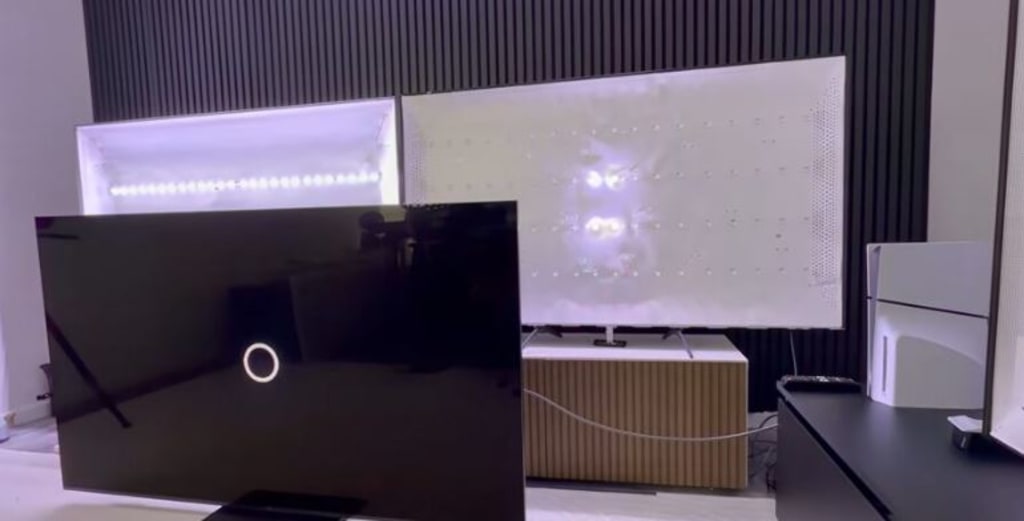
This internal assessment was visually corroborated by a teardown video from the YouTube channel AP Tech, which revealed that the M-series backlight does not feature a 2D array of LEDs. Instead, the illumination is provided by a mere two rows of LEDs mounted on aluminum strips. Industry analysts universally agree that this architecture fundamentally disqualifies the display from being categorized as a true Mini LED system. Eric Virey, a principal displays analyst at Yole Intelligence, noted that FALD is a hardware feature first and foremost, requiring a “2D array of LEDs uniformly distributed across the entire area of the display.” To Virey, the concept of “software-based Mini LED dimming” is an oxymoron if the underlying hardware lacks the physical zones to support it.
The Wild West of Display Marketing
Beyond the FALD debate lies an even more fundamental question: How small must an LED be to earn the “Mini” moniker? The unsettling answer is that there is no official rulebook.
TCL’s lawsuit asserts that Mini LEDs are generally between 0.1 mm and 0.3 mm in size, and alleges that the LEDs used in Samsung’s M-series are a comparatively massive 0.5 mm a size that many industry observers would still classify as a traditional, standard LED. Furthermore, while true Mini LED displays boast hundreds or thousands of individual LEDs, TCL alleges the M-series contains only a few dozen.
Because no authoritative standards organization exists to define and enforce these parameters, television brands have historically exploited this regulatory vacuum. Bob O’Brien, research director at Counterpoint, noted that because Mini LED was originally introduced as an improved FALD technology, the industry has always assumed that a Mini LED TV inherently possesses FALD capability. Samsung’s own website reinforces this assumption, stating that Mini LED uses tiny LEDs for “more precise backlight control through local dimming zones.” Yet, the fine print on the M-series tells a different story, creating a gray area where marketing terminology actively misleads the average shopper.
The Performance Reality Check
While display enthusiasts may delight in dissecting the complex underpinnings of backlight architecture, the average consumer ultimately cares about one thing: picture quality. When subjected to independent testing, the limitations of Samsung’s M-series become glaringly apparent.
According to comprehensive testing by the review site RTINGS, the Samsung M80H exhibits a “low” contrast ratio of 6,440:1. In practical terms, this means dark scenes look noticeably washed out when viewed in a dimly lit room. Its HDR performance is similarly compromised; content mastered at standard 600 or 1,000 nits cuts off rapidly at the TV’s peak brightness, causing bright highlights to blend together without proper gradation.
By stark contrast, Samsung’s own $1,200 Neo QLED QN80H which utilizes genuine, individually addressable Mini LED dimming zones, achieved a calibrated contrast ratio of 80,000:1. This hardware advantage translated directly to visible improvements, with RTINGS noting the QN80H “looks good in a dark room thanks to its high contrast ratio and great black uniformity.”
Interestingly, the “Mini LED” label is not a guaranteed silver bullet, even for the plaintiff. RTINGS found that TCL’s own budget QM6K Mini LED TV, while boasting an impressive contrast ratio, suffers from noticeable haloing around bright highlights and mediocre HDR brightness, failing to deliver a truly impactful HDR experience. This underscores a vital truth: the presence of small LEDs and local dimming zones does not automatically equate to premium picture quality if the overall implementation is flawed.
Conclusion: A Call for Consumer Vigilance
TCL’s lawsuit against Samsung is undeniably a strategic move by a fierce competitor looking to gain market share by casting doubt on a rival’s claims. However, the underlying premise of the complaint raises a critical, industry-wide question that demands an answer: What should consumers reasonably expect when a television is boldly marketed as “Mini LED”?
A television that merely features slightly smaller-than-average LEDs but completely lacks the hardware for local dimming, should not be permitted to wear the Mini LED badge. The defining characteristic of the technology is not merely the microscopic size of the diodes, but how they are utilized to deliver tangibly improved contrast and HDR performance.
Until a governing body steps in to establish strict, enforceable definitions for display technologies, the market will remain muddied by creative marketing. For shoppers, the lesson is clear: comparative pricing and rigorous, independent testing are infinitely more valuable than a glossy buzzword printed on a cardboard box. In the modern television market, buyers must look past the label and demand transparency regarding dimming zone counts, calibrated contrast ratios, and genuine hardware capabilities.
About the Creator
Mark Lim
Hi I am mark an automotive student and a car, tech and food enthusiast ! Im gonna try and post daily & hope you enjoy what I write and do share my page with people you know. I would gladly appreciate it! Cheers
Enjoyed the story? Support the Creator.
Subscribe for free to receive all their stories in your feed.
Comments
There are no comments for this story
Be the first to respond and start the conversation.