
The Microwave Oven Market Is Evolving Far Beyond Simple Reheating
Smart kitchens, ready-to-eat meals, urban lifestyles, and multifunctional appliances are driving a new era for microwave ovens worldwide.

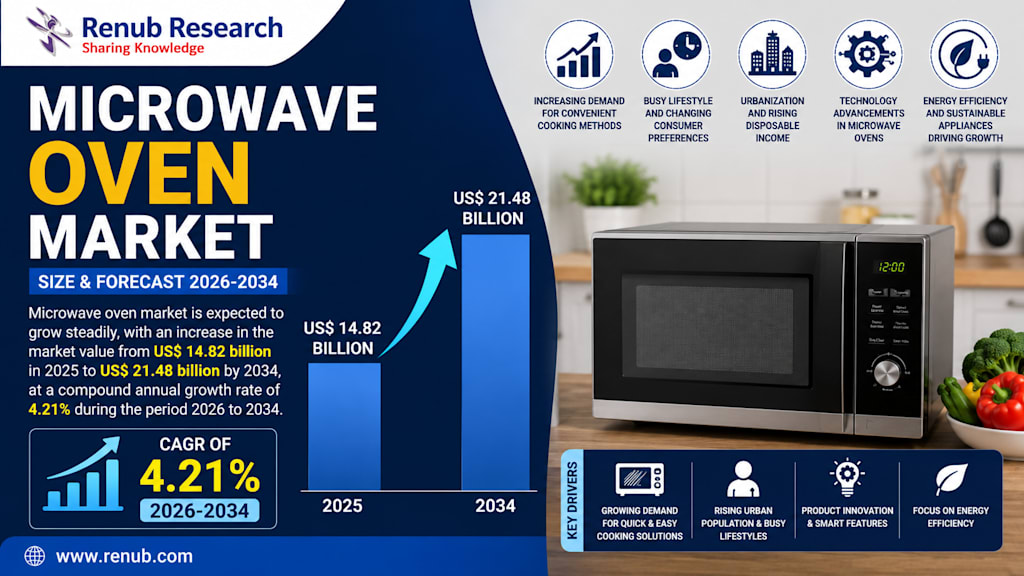
Microwave ovens are becoming smarter, faster, and more essential
For many households, the microwave oven began as a simple kitchen appliance used for reheating leftovers. Today, it has become a central part of modern cooking habits, driven by changing lifestyles, urban living, convenience-focused consumers, and rapid advances in smart home technology.
As people increasingly seek faster and more efficient ways to prepare meals, microwave ovens are evolving into multifunctional cooking systems that can grill, bake, air fry, defrost, and connect with mobile applications. What was once considered a convenience appliance is now becoming a smart kitchen necessity.
According to Renub Research, the Microwave Oven Market is expected to grow from US$ 14.82 billion in 2025 to US$ 21.48 billion by 2034, expanding at a compound annual growth rate (CAGR) of 4.21% from 2026 to 2034. The report attributes this growth to increasing demand for convenient cooking solutions, urbanization, busy lifestyles, and technological advancements in energy-efficient microwave systems.
The market may not be growing as explosively as some digital industries, but it is steadily transforming through innovation and shifting consumer behavior.
Convenience has become the biggest market driver
Modern consumers value speed and efficiency more than ever before. Long work hours, urban lifestyles, and increasingly busy daily schedules are pushing people toward kitchen appliances that save both time and effort.
Microwave ovens meet those expectations by offering rapid heating, cooking, and defrosting functions with minimal supervision. Compared to traditional cooking methods, they significantly reduce preparation time while maintaining convenience and consistency.
This demand for convenience is one of the strongest forces behind market growth.
Consumers today are looking for appliances that simplify daily routines without requiring advanced cooking skills. Microwave ovens provide a practical solution for students, working professionals, families, and even commercial food businesses that need quick meal preparation.
The report also highlights the growing role of urbanization in boosting demand. As more consumers move into cities and adopt fast-paced lifestyles, compact and efficient kitchen appliances are becoming increasingly important.
Ready-to-eat food culture is fueling microwave usage
Another major factor driving the market is the worldwide increase in ready-to-eat and packaged food consumption.
Food manufacturers are designing frozen meals, instant snacks, and ready-to-cook products specifically for microwave preparation. This has made microwave ovens an essential appliance in many modern households.
Consumers increasingly prefer meals that can be prepared quickly without extensive cooking processes. Students, office workers, and younger consumers are especially attracted to convenient food solutions that save time.
The report points out that changing food habits and urban lifestyles are accelerating the popularity of ready-to-cook meals. In countries such as India, the ready-to-eat and ready-to-heat food segments are emerging as major long-term consumption opportunities.
As the global packaged food industry expands further, microwave ovens are expected to remain tightly connected to that growth.
Smart microwave ovens are changing the market
One of the most important developments in the industry is the integration of smart technologies into microwave ovens.
Modern microwave systems now include features such as sensor cooking, automatic cooking programs, touch controls, AI-powered assistance, energy optimization, and smart home connectivity.
Consumers can now operate some microwave ovens through mobile applications or voice commands, creating a more connected cooking experience.
Smart kitchen ecosystems are becoming increasingly popular in developed markets where consumers prefer appliances that integrate with digital lifestyles. Built-in microwave ovens are also gaining popularity because they align with modern kitchen aesthetics and modular home designs.
The report highlights Panasonic’s launch of the HomeCHEF™ 4-in-1 Multi-Oven and Panasonic Kitchen+ app experience in February 2025. The appliance combines microwave, baking, broiling, and air frying capabilities within a single smart cooking platform.
This reflects how manufacturers are shifting from basic microwave products toward multifunctional cooking ecosystems.
Competition from alternative appliances remains strong
Despite positive market growth, microwave ovens face increasing competition from other kitchen technologies.
Consumers now have access to air fryers, induction cooktops, convection ovens, toaster ovens, and multifunctional cooking devices that offer additional cooking capabilities such as frying, crisping, and grilling.
Air fryers in particular have emerged as major competitors because they are associated with healthier cooking and crispier food textures.
Some consumers also believe that traditional cooking methods produce better taste and food quality compared to microwave preparation. These perceptions continue to influence buying decisions in certain markets.
As a result, microwave manufacturers are increasingly adding grilling, convection, and air-frying functions to remain competitive in the evolving kitchen appliance landscape.
Health perceptions continue to influence consumer behavior
Health concerns and misconceptions also remain challenges for the microwave oven market.
Some consumers worry that microwave cooking may reduce nutritional value or negatively affect food texture and taste. Others simply prefer traditional cooking methods because of cultural habits and cooking preferences.
Although scientific research generally supports the safety of microwave cooking, consumer perceptions still influence purchasing behavior in several regions.
Manufacturers are addressing these concerns by emphasizing advanced cooking technologies, energy efficiency, and multifunctionality that improve cooking quality and versatility.
Education and marketing around healthier cooking features may become increasingly important as brands compete for health-conscious consumers.
Grill microwave ovens are gaining popularity
Among the major product categories, grill microwave ovens are seeing strong demand because of their multifunctional capabilities.
Unlike standard microwave ovens, grill models combine microwave heating with grilling functions, allowing users to prepare a wider variety of meals using a single appliance.
Consumers increasingly prefer appliances that maximize kitchen efficiency while reducing the need for multiple cooking devices.
Urban households, smaller kitchens, and modern apartment living are all contributing to the popularity of compact multifunctional appliances.
As consumers continue prioritizing convenience and space optimization, grill microwave ovens are expected to remain one of the strongest-performing market segments.
Commercial microwave ovens are supporting the food industry
Commercial microwave ovens are becoming increasingly important in restaurants, cafes, hotels, food chains, and other food service businesses.
These heavy-duty systems provide faster cooking, higher durability, and greater efficiency compared to residential microwave models.
The rapid growth of the food service industry, quick-service restaurants, and ready-to-serve food businesses is helping drive commercial demand globally.
Commercial kitchens depend on fast food preparation and consistent service quality. Microwave ovens help improve operational efficiency while reducing preparation times.
As tourism, hospitality, and food delivery industries continue expanding worldwide, commercial microwave demand is expected to strengthen further.
Built-in microwave ovens are becoming lifestyle products
Built-in microwave ovens are increasingly associated with premium kitchen design and smart home aesthetics.
Unlike countertop models, built-in microwaves integrate directly into kitchen cabinets and walls, offering cleaner layouts and more organized spaces.
Modern consumers increasingly view kitchens as lifestyle spaces rather than purely functional areas. This shift is encouraging demand for visually appealing appliances that match luxury interior designs.
Built-in microwave ovens also often include advanced features such as convection cooking, grilling, and smart controls, making them attractive to high-end consumers.
The rise of modular kitchens and home renovation trends is further strengthening this market segment globally.
High-power microwave ovens are seeing increased adoption
The market for microwave ovens above 1000 watts is also growing steadily.
These high-power appliances provide faster cooking, quicker heating, and greater efficiency for both residential and commercial applications.
Restaurants, food businesses, and heavy users particularly prefer high-power models because they can handle larger food volumes and improve cooking speed.
As consumers increasingly prioritize performance and convenience, demand for high-capacity microwave systems is expected to continue rising.
Offline retail still plays a major role
Despite the growth of e-commerce, offline retail remains highly important in the microwave oven industry.
Consumers often prefer visiting electronic stores, appliance retailers, supermarkets, and hypermarkets to physically examine products before making purchasing decisions.
Product quality, trust, after-sales support, and in-store demonstrations continue to influence consumer preferences, particularly in developing markets.
Strong retail distribution networks therefore remain critical for major appliance brands competing in the global microwave oven market.
The United States remains a leading market
The United States continues to dominate the microwave oven market because of widespread adoption of modern kitchen appliances, high consumer spending power, and strong demand for convenience-oriented products.
Smart kitchen adoption, modular home designs, and rising consumption of frozen and ready-to-eat meals are supporting continued growth in the country.
Major appliance companies are also investing heavily in AI-powered and voice-controlled systems. The report highlights GE Appliances’ launch of smart kitchen products designed around AI, voice control, and connected home technologies.
India is becoming a fast-growing market
India’s microwave oven market is expanding rapidly due to urbanization, rising disposable income, and increasing awareness of modern kitchen appliances.
Urban households, working professionals, and younger consumers are increasingly adopting microwave ovens as part of changing lifestyles and food habits.
Growth in packaged food consumption and modern housing infrastructure is also supporting market expansion across Indian cities.
As awareness of smart appliances continues growing, India is expected to remain one of the most promising long-term growth markets for microwave manufacturers.
Final thoughts
The microwave oven market is no longer centered only on reheating food. It is evolving into a technology-driven segment shaped by smart homes, modern lifestyles, digital connectivity, and multifunctional cooking experiences.
Consumers today want convenience, speed, flexibility, and smarter kitchen ecosystems. Microwave manufacturers are responding with AI-enabled appliances, mobile integration, energy-efficient designs, and multifunctional systems that fit modern lifestyles.
While competition from air fryers and other cooking appliances remains strong, microwave ovens continue to hold a central role in kitchens worldwide because of their convenience and versatility.
With the market expected to surpass US$ 21 billion by 2034, microwave ovens are transitioning from simple utility appliances into intelligent lifestyle products designed for the future of connected living.
About the Creator
Enjoyed the story? Support the Creator.
Subscribe for free to receive all their stories in your feed.
Comments
There are no comments for this story
Be the first to respond and start the conversation.