
The Man Who Shredded His Own Instruction Manual
Leo outsourced everything — weekly reports, dentist appointments, even how to answer his boss — until a broken coffee schedule showed him exactly what AI will never notice.
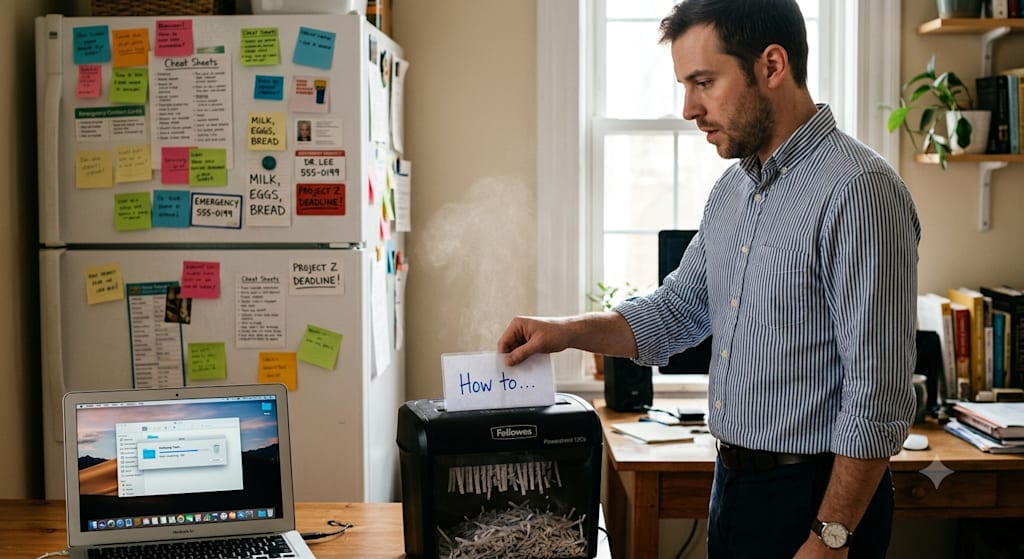
Leo’s fingers were dry when he fed the seventh version of the New Hire Onboarding Master Guide into the shredder. No sweat. Before, whenever he cleaned out his bookmarks, he’d gnaw at his cuticles first, then back the links up to three different places, like burying time capsules. This time he just watched the paper drop into the clear bin and thought about the expired supermarket loyalty card still stuck to his fridge.
It had started with PowerPoint templates. Four years ago, Leo landed his job at the San Francisco firm with a deck called Essential Logic Charts for Consultants. He still remembered the HR director raising one eyebrow at the Gantt chart on the third-to-last page, a micro‑expression he promptly filed into a folder named Reading Interviewer Faces. After that came prompt libraries, workflow breakdowns, a step‑by‑step guide for reporting a stolen debit card, even a seventeen‑point manual titled How to Book a Dentist Appointment. The refrigerator door disappeared under layers of laminated cards: emergency contacts, insurance policy numbers, a cheat sheet for the coffee machine error codes. It wasn’t that he couldn’t do these things. He just believed that outsourcing his brain to someone else’s steps was a kind of efficiency.
The first time he received a model‑generated weekly report, he assumed the project team had rolled out a new template. Then he noticed a line of grey text in the footer—Generated by WorkMind—and realised the entire department was already using it. He submitted his first self‑written summary in three years. It came back with a single blue annotation from his manager: There’s no conclusion here, just a remix of last week’s emails.
He didn’t sleep that night. Four hours bouncing between the international version of Xiaohongshu and Reddit’s r/LifeProTips, searching “how to make weekly reports deep”, “analysis techniques AI can’t write”. He saved nineteen new pages into a folder called Breakthrough. The next day he filled in the framework from one of those posts and handed it in. His manager didn’t leave a note this time. She just booked a one‑on‑one for the following week.
On the day of that meeting, the air‑conditioner drip was louder than the conversation. She turned a laptop toward him. On the screen was a competitor analysis the model had just run. At the bottom sat an auto‑generated list of questions. The first question was the very one Leo had been preparing to raise at the quarterly review. She said, “You don’t need to prepare questions anymore. It already asks sharper ones than any of us.” She closed the laptop. “But the company still needs people to do what it can’t. Do you know what that is?”
Leo had no answer. His phone’s notes app held seven versions of How to Handle Your Boss’s Tough Questions, but none of them applied to this moment. He swiped the screen without thinking, as if waiting for a new guide to refresh into existence. All that refreshed was the weather.
The turning point came on an unremarkable Thursday. Two departmental assistants were fighting over the schedule for a product demo. Both were clutching a PDF titled Cross‑Department Coordination Workflow, complete with a template for who to cc when the conflict escalated. The AI helpdesk determined both requests were compliant and auto‑replied with the same sentence: Your request has been logged and will be addressed within two business days. Both sides received the automatic delay notice at the same time, then nearly smashed their mugs in the break room.
Leo happened to be refilling his water. He heard one of them say into the phone, “I honestly don’t know what to do, it’s not in the process,” while the other had already started drafting an email to a senior director. He set his cup down beside the water dispenser. He didn’t reach for his phone to look up office conflict resolution tips. He walked over and did exactly one thing. He spoke the name of the assistant writing the email. “Isa, Kevin never schedules meetings on Wednesday afternoons because he picks his daughter up from preschool. Move it to Thursday morning. He’ll give way.” Then he turned to Kevin. “She needs last month’s raw data from your team for the presentation. Send her the unredacted version before you leave today. She’ll keep it confidential.”
Both of them blinked. It wasn’t some advanced negotiation technique. It was just that he’d noticed Isa wore running shoes during the last week of every month, rushing to daycare, and he’d once seen Kevin write in meeting minutes that his daughter was three and had entered the “why” phase. No guide would ever have written those things down.
The problem dissolved. Leo walked back to his desk, opened his bookmarks, and selected the folder labelled Work. It held one hundred and forty‑four entries. He hit Select All but didn’t delete right away. He did something he hadn’t done in three years first: closed the browser tab, opened a blank document, and typed a single line: That laminated card on the fridge—I never actually scanned it once. I just felt ready knowing it was stuck there.
Only then did he right‑click and choose Delete. When the confirmation box popped up, he didn’t bite his nails, and he didn’t create a new folder called Backup. He blew a soft puff of air at the screen, as if blowing away a fleck of paper dust.
On his way out, he passed the shredder and fed that card from the fridge into it too.
About the Creator
Jin
Writer of reamstories
https://reamstories.com/jin
Enjoyed the story? Support the Creator.
Subscribe for free to receive all their stories in your feed. You could also become a paid subscriber, letting them know you appreciate their work.
Comments
There are no comments for this story
Be the first to respond and start the conversation.