
The Local Multiplayer Audience Is Bigger Than the Industry Thinks
What I learned running a website dedicated to a format the rest of the games industry stopped serving
AI-Generated: This article was drafted with AI assistance and edited by the author. The events, observations, and analytics referenced are real.
A friend came over a few months ago for dinner. We finished eating, the evening still had two or three good hours in it, and she asked what I wanted to do. We considered a movie, considered just talking, considered the usual options. Then she said, almost as a joke: "Do you have any games we could play together? Like, here? On something?"
The honest answer was that I didn't, not immediately. I had a desktop, a laptop, and a phone, but the latest games my devices were hosting were almost all single-player or online multiplayer. We could sit next to each other on the couch and each play our own game. We could each open Discord and play together remotely, even though we were sitting in the same room. What we couldn't easily do was the simplest, oldest version of the request — share a single screen, play at the same time, see each other's faces in the moments of victory and loss.
Eventually we found something workable in a browser. But the difficulty of the search stuck with me. Local multiplayer used to be the default mode of gaming. Now it's a treasure hunt.
A few weeks later, I started building 2playerfun.com, a website dedicated entirely to free browser games designed for two people sharing one keyboard.
This is what I've learned running it.
How a category becomes invisible
The games industry didn't deliberately kill local multiplayer. It made a series of rational decisions over a decade and a half, and the cumulative effect was the same as if it had.
The rational decisions: online multiplayer scales, local multiplayer doesn't. A game with online multiplayer can be sold to a million people who each play it in their own homes. A game with local multiplayer requires two people to be in the same room at the same time, which is by definition a much smaller market. Online multiplayer also generates ongoing engagement metrics — sessions, matches, monthly active users — that work well for games-as-a-service business models. Local multiplayer is one and done. You play with your friend, you stop, and the analytics don't capture much.
Add to this that platform-holder incentives reinforce online over local. Steam highlights online multiplayer in its filters. Console manufacturers push subscription services that depend on online play. Mobile, where most casual gaming now lives, doesn't really have a workable local multiplayer paradigm at all.
So over time, "multiplayer" came to mean "online multiplayer" by default. Game stores hid the local-only filter behind two extra clicks. Reviews stopped mentioning local play unless it was a specifically retro experience. Friends stopped asking each other if they had any couch games, because they assumed the answer was no.
The category didn't get killed. It got quiet, and then it got invisible.
Who shows up when you stop hiding the category
The first thing that surprised me about running 2playerfun was the demographics.
When I look at the analytics, I see an audience that doesn't match the typical browser game profile. The visitors skew older — the median age looks like it sits somewhere in the mid-thirties, with a long tail into the forties and fifties. They visit on weekends much more than weekdays. They visit in pairs, statistically — two-page sessions where the cursor patterns suggest two people taking turns at the keyboard.
They are not, by any meaningful definition, "gamers" in the modern sense. They are people who used to play games when local multiplayer was the default, who haven't gamed actively for years, and who have a friend or partner over and remember that this used to be a thing.
The second surprise was retention. People who find this site come back. The repeat visit rate is roughly three times what I see on my other casual game sites. Once someone realizes the site exists, they bookmark it. They return the next time they have a friend over, sometimes weeks later, sometimes months. The audience isn't large, but it's loyal in a way I haven't seen anywhere else in my portfolio.
The third surprise was the unsolicited feedback. People email me. Not many people, but enough to be unusual for a small site that doesn't ask for engagement. The emails are warm and oddly personal. Someone telling me they used the site at a family gathering. A teacher using it for end-of-class downtime. A parent using it to spend time with their kids on rainy weekends. The site fills a specific kind of need that hadn't had a clear address on the internet for years.
The technical paradox of local multiplayer
There's a quiet design paradox in local multiplayer that most people don't notice.
From a pure programming perspective, local multiplayer is easier than online multiplayer by an order of magnitude. There's no networking. No latency to compensate for. No matchmaking. No anti-cheat. No persistent player accounts. No server costs. The entire game runs on one machine with two simultaneous input streams, and the technical scope is roughly that of a single-player game with a slightly more complex input handler.
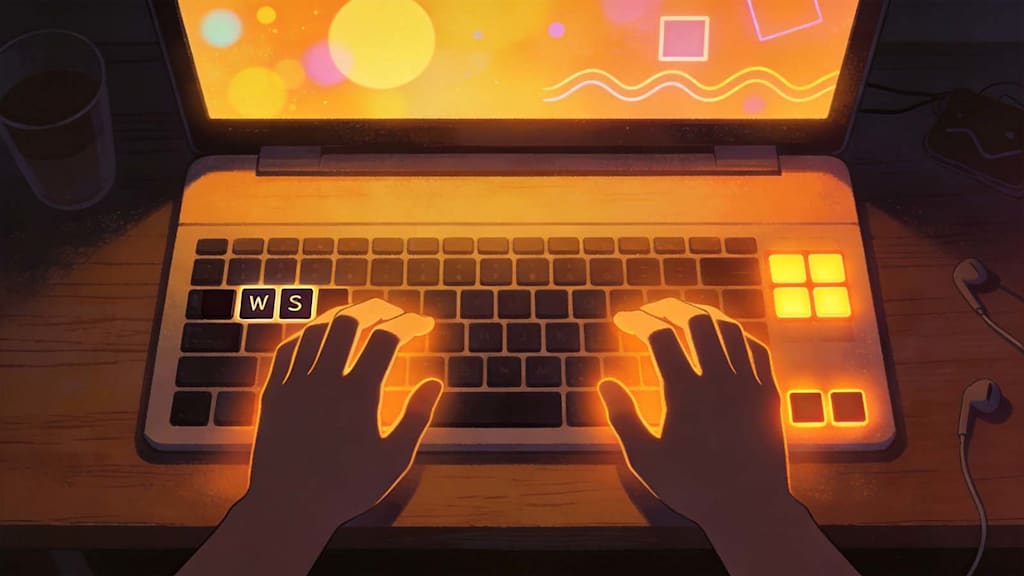
From a user-experience perspective, however, local multiplayer is harder. The challenge isn't networking — it's ergonomics. Two people sharing one keyboard means you have to design control schemes that work side by side without players physically colliding. WASD plus the arrow keys is the classic solution, but it requires the keyboard to be wide enough that two people can fit comfortably. Some keyboards aren't. Numpad-based controls work for one player but feel cramped for the other. Hybrid schemes have to acknowledge that you don't have two mice.
The games on 2playerfun that work best are the ones that solve this ergonomic problem cleanly — they assume a standard keyboard, give each player a small control footprint with no overlap, and don't require any input that needs the mouse. Games that violate any of these constraints work technically but feel awkward in practice. The one-keyboard, two-player constraint is more limiting than it looks, and a surprising number of indie developers don't quite nail it.
What the audience reveals
I think there's a useful pattern here that goes beyond local multiplayer.
The internet has gravitational pull toward the largest audience. Every category gets dominated by the version that scales best. Online multiplayer over local. Subscription gaming over one-time purchase. Mobile-first over desktop-first. Each of these wins is rational in isolation. The cumulative effect is a media landscape where mid-sized audiences with specific needs become slowly under-served.
The under-serving is rarely deliberate. It's structural. Bigger players move toward bigger audiences because that's how their economics work. The mid-sized audiences left behind aren't visible to them — they don't show up in the metrics big platforms optimize for. So the assumption gets made that those audiences are gone.
They aren't gone. They're just smaller than the threshold that mainstream products are built to serve.
This is the gap that small operators can fill. The audience that wants local multiplayer is too small for a major studio to build for. It's the right size for an indie operator with a hundred games and a willingness to ignore growth charts. The audience that wants honest product reviews in a niche category is too small for the affiliate networks that dominate that vertical. It's the right size for one person with attention to detail. The audience that wants real educational games — actually educational, not edutainment dressed up — is too small for venture-backed edtech. It's the right size for a curator who cares.
The under-serving creates the opportunity. The opportunity is real. It just requires accepting that "audience" doesn't have to mean "everyone."
Closing thought
I don't have illusions about 2playerfun becoming a major site. The audience is what it is. The growth is what it is. The success metric I care about is whether, when someone has a friend over and remembers they wanted to play a game together, the site is there.
It is. That's the whole product.
The web has thousands of these gaps — categories the mainstream gave up on, audiences that aren't worth a corporation's attention, formats that became invisible. Each one is a small invitation. The invitation is to build for the people who are still there, even if the industry stopped seeing them.
The local multiplayer audience didn't disappear. It got quiet, because it didn't have anywhere to be loud. Build them somewhere to be loud, and you'll find they were there the whole time.
About the Creator
Marvin Tang
Indie game developer building free browser games & web tools. Creator of PhyFun, SortFun, 2 Player Fun, RandTap. Writing about gamedev, HTML5 & browser game SEO. phyfun.com
Enjoyed the story? Support the Creator.
Subscribe for free to receive all their stories in your feed.
Comments
There are no comments for this story
Be the first to respond and start the conversation.