
The Living Room Coup
How a $70 Million USB Dongle Just Killed the Set-Top Box (And Who's Fighting Back)
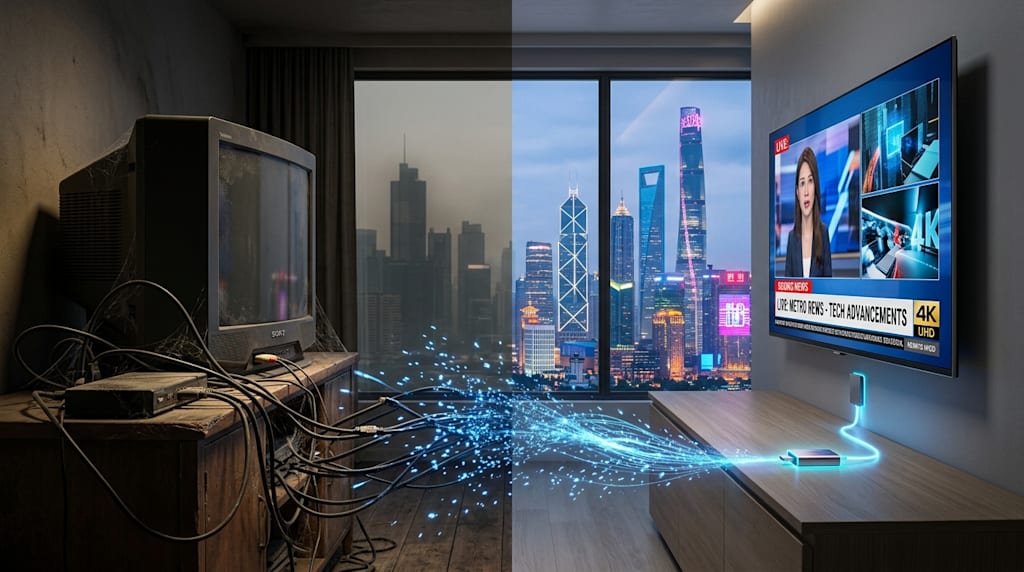
The black box that has squatted on living room TV cabinets for more than two decades finally has a replacement on the way.
In early September 2026, China Broadcasting Network (CBN) published a centralized procurement notice for 8.18 million adapters with a budget of nearly 490 million yuan. This is CBN's first nationwide tender aimed directly at replacing the traditional set‑top box.
The announcement promised, "goodbye to multiple remotes and messy cables, turn on and watch." It landed precisely on the sorest point for hundreds of millions of families.
I. Not Abolishing the Set‑Top Box, but Compressing It into a USB Stick
One clarification: this adapter is not a smart TV with built‑in set‑top functions.
The tender splits the 8.18 million units into three packages. RF‑type with coaxial cable interface, 3.21 million units; RJ‑45 type with Ethernet port, 1.52 million units; single‑port type, 3.45 million units.
All three share the same technical logic: the TV handles computing and display; the adapter handles the channel and security.
Why not build live broadcast directly into the TV system? From 2022 to 2023, Huawei, Hisense, Changhong, and Xiaomi tried exactly that. Turn on the TV, the home page showed live programming, watch over Wi‑Fi. Elderly users stopped calling their children for help. But at the end of 2023, a regulatory order halted the feature.
The reason is straightforward. Broadcast television signals in China must travel over a physical private network — controllable, manageable, traceable. Live streaming over the public internet cannot meet security broadcasting standards.
So the adapter in this tender looks like a USB stick, but functions as a dedicated interface for CBN's private network. It solves the contradiction: the TV is already smart, but live broadcast still requires a dedicated line. The adapter is the connector for that line.
II. The Two‑Remote Era Ends in 2026
The most striking phrase in the announcement is not the numbers, but "turn on and watch."
Behind that phrase lies an absurdity that has persisted for twenty years: to watch a news program, you turn on the TV, then turn on the set‑top box, then juggle two remotes. Young viewers are put off by the complexity. Older viewers get trapped: press the wrong button, and they never find their way back.
Integrated TV merges these two paths into one.
The cabinet holds one fewer box, one fewer HDMI cable, one fewer power plug. The TV boots directly into CCTV, skipping the choice between "signal source" and "home page." Live, time‑shift, catch‑up, and on‑demand live inside a single app. No more "TV content" versus "box content."
This is not a technological breakthrough. It is someone finally remembering the most basic use of a television: turn it on and watch.
III. Four Operators and Five TV Makers: Who Holds the Living Room Key?
The deeper signal of this procurement is not about user experience, but about who controls the living room.
In 2026, CBN, China Telecom, China Unicom, and China Mobile plan to roll out tens of millions of integrated TVs nationwide. For the first time, the four major operators are aligning on a single approach to delivering live broadcasts to TVs.
In the past, CBN had its DVB boxes, telecom operators had IPTV boxes, and internet firms had OTT boxes. The more devices piled up, the faster users gave up and scrolled on their phones instead.
The integrated solution moves the "box" from the physical layer to the software layer. A pre‑installed app plus a USB adapter pushes the live broadcast entry onto the TV's factory home screen. CBN no longer makes money selling set‑top boxes. It makes money by pushing its live service into every new TV at the lowest possible threshold.
The phrase in the announcement — "verification of business docking with 28 provincial networks" — matters more than the procurement numbers. It signals that the national broadcasting network is effectively connected. The fragmented "one province, one network" model is being stitched together by a standard USB interface.
IV. The Elderly Turn on the TV, Their Fingers Hover
Optimists skip one question: what about the existing stock?
China still has a vast number of non‑smart TVs — seven‑ or eight‑year‑old LCDs in living rooms, with no USB port at all. This group is the most dependent on live broadcasts: the elderly. They do not need 4K, time‑shift, or catch‑up. They only need the TV to start on CCTV‑1.
The adapter solution does not cover them. Policy documents do not detail a transition plan. The reality is likely that old set‑top boxes will continue serving these households for a long time, while new adapters go to those who bought smart TVs in the last two years.
There is another concern in early test feedback: USB adapters heat up noticeably during long sessions. Running 4K bitstreams, the metal casing gets hot enough to warm your hand. If thermal design is inadequate, stuttering will return. Users who just threw away their set‑top boxes do not want to reboot their router for a USB stick.
V. Only the TV Remains. Now What?
The adapter is only the beginning. What determines success or failure is whether the app inside the TV is actually usable.
What users are tired of is never the box itself. It is the "pay another membership for everything you watch" logic. If integrated TV merely bundles a CBN subscription with internet video memberships into a single price, the goodwill from hardware downsizing will evaporate at the first renewal.
There is a subtler challenge: TV viewership has dropped from 70% ten years ago to below 30%. This number means most people have already moved from TV to phone. To bring them back, you do not need a USB stick. You need one simple reason: turn it on, something plays. No ads, no mazes, no "please purchase a membership to continue."
VI. From Roof Antenna to Behind the TV, Thirty Years
In the 1990s, every household had a metal antenna on the roof. Wind and rain turned the picture to snow. Someone went outside to turn the antenna while the people inside shouted, "Stop, that's good!"
Then came coaxial cable, then set‑top boxes, then IPTV — more boxes, denser cables. But the most basic thing, "turn on and watch," somehow became harder.
The adapter flattens the antenna, squeezes it into a USB stick, and hides it behind the TV. You may not even see it working.
This is the direction technology takes: powerful functions should become invisible. They should be there, but you do not need to know they are there.
After autumn 2026, if the rollout meets its targets, tens of millions of households will turn on their TVs and see a program directly. No more switching signal sources. No more hunting for remotes. The black box that once squatted on the cabinet will go into storage, alongside old antennas, coaxial cables, and VCD players.
No one will miss it.
About the Creator
Jin
Writer of reamstories
https://reamstories.com/jin
Enjoyed the story? Support the Creator.
Subscribe for free to receive all their stories in your feed. You could also become a paid subscriber, letting them know you appreciate their work.
Comments
There are no comments for this story
Be the first to respond and start the conversation.