
The Light on the Dashboard
A creased repair bill, a Raspberry Pi, and what three students built so no one’s mother would have to pay $700 for a code she couldn’t read
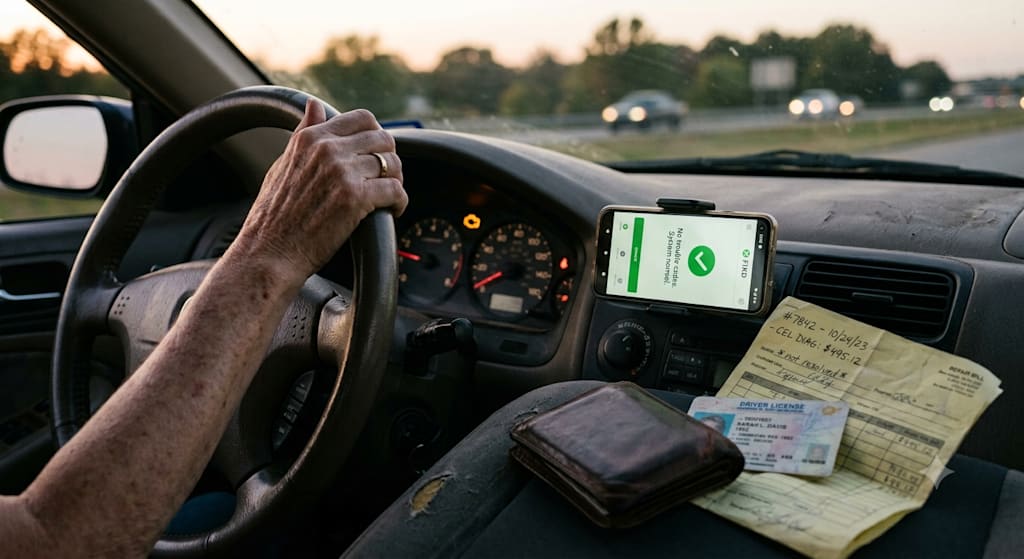
In 2014, John Gattuso took a folded repair bill from his mother's hand. The paper was creased hard along the edges where she'd been gripping it. The check engine light had come on in her car. A shop replaced an oxygen sensor. They charged her seven hundred dollars. She paid with her hand shaking, because she didn't know what an oxygen sensor was or whether she needed one, and the man behind the counter hadn't offered to explain.
John put the bill in his wallet. That crease, he never smoothed out.
At the time, he was a senior at Georgia Tech, spending late nights in a small lab with two classmates, Julian Knight and Frederick Grimm. Their hands smelled like solder and flux. They had a Raspberry Pi wired to the OBD2 port of a beat-up 1999 Camry, and they were trying to solve a problem that felt personal to all three of them: the check engine light speaks in code, and most people don't speak code.
The light was talking the whole time. It was saying things like P0420, P0301. A mechanic could read those strings of letters and numbers. A driver, standing in the driveway with a sinking feeling, could not. You just took the car in. You waited. You paid. John wanted to make the light say something his mother could understand without an interpreter.
That project became FIXD. A small Bluetooth sensor you plug into the OBD2 port under the steering wheel—most cars built after 1996 have the port—and an app that translates over seven thousand trouble codes into plain English. Not "P0420," but "Catalytic converter efficiency below threshold. You can keep driving for a bit, but your fuel economy will get worse." The kind of sentence you can read aloud to someone standing next to you in the garage.
They launched on Kickstarter. Orders came in faster than they expected. The sensor sold, and kept selling, and over time found its way into more than three million vehicles. John's wallet, through all of it, still held that repair bill, tucked behind his driver's license.
How It Works, in Human Terms
You don't need to know what an OBD2 port looks like to find it. You bend down near the pedals, push the sensor in until it clicks, and open the app on your phone. You tap scan. The app returns a list. Green means small stuff. A loose gas cap, for instance. You twist the cap tight, clear the code, and the light goes off without you ever having to drive anywhere.
Yellow means something needs attention soon. Red means stop and deal with it now. The app explains what each code actually means for the car and what happens if you ignore it. It doesn't tell you what to do. It gives you the information you'd need to make the call yourself.
Why It Stuck
After the launch, John started hearing from people who used the thing in moments that caught them off guard. A woman driving alone at night, the light flicking on, pulling over to scan it instead of sitting in the dark wondering. A father teaching his teenage daughter what to do when the dashboard lights up, passing the phone to her and letting her press the button. The stories were small. They were mostly about the moment of relief when the screen said something manageable instead of something unknown.
That's the thing about the check engine light. It doesn't tell you whether to panic. FIXD does, quietly, in green and yellow and red.
Last Christmas
John's mother bought a used RAV4. He put a sensor in her glove box without making a speech about it. She found the small blue box, reached into her bag, and pulled out that old bill from 2005—creased harder now, worn soft along the folds. "How long does this thing last?" she asked.
He plugged the sensor into the port. The phone lit up. A green line appeared. "System status normal. No trouble codes."
She looked at the screen for a few seconds. Then she ran her finger across the glass, the way you might wipe dust off a photograph, as if she wanted the words to be a little brighter.
Less than a second. That's how long the motion took.
Some things don't need a manual. You just want to know that everything's okay.
About the Creator
Jin
Writer of reamstories
https://reamstories.com/jin
Enjoyed the story? Support the Creator.
Subscribe for free to receive all their stories in your feed. You could also become a paid subscriber, letting them know you appreciate their work.
Comments
There are no comments for this story
Be the first to respond and start the conversation.