
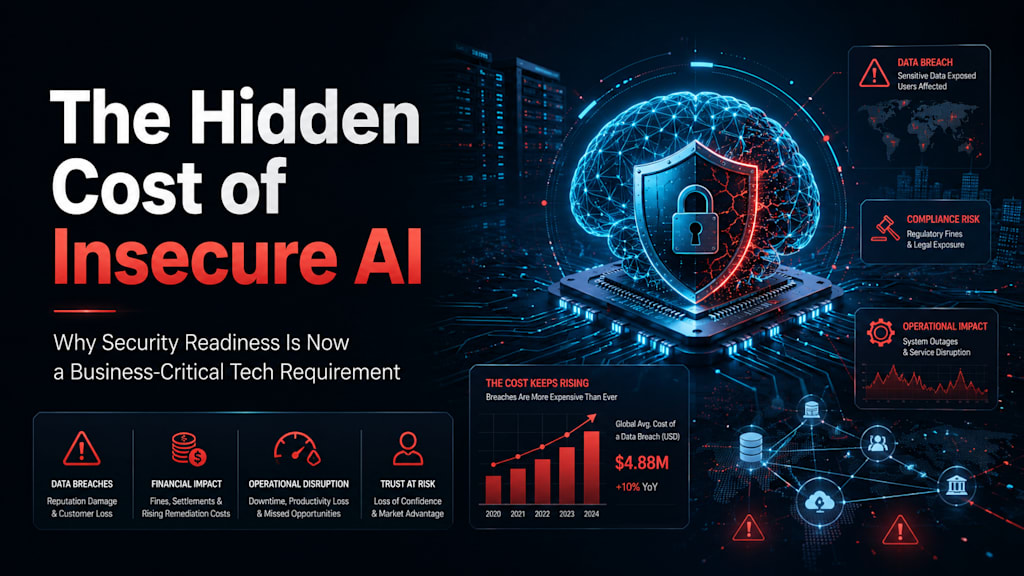
The Hidden Cost of Insecure AI: Why Security Readiness Is Now a Business-Critical Tech Requirement
Most AI companies don't lose deals because of bad products. They lose them because of bad security posture.
We live in an era where AI adoption is no longer optional for businesses that want to stay competitive. From intelligent automation and predictive analytics to generative AI tools embedded in everyday workflows, the technology is moving fast , and enterprises are spending billions to keep up.
But there's a quiet problem growing in the background that most AI teams don't talk about openly: security unreadiness is quietly killing deals, stalling enterprise adoption, and costing AI companies revenue they never see on a spreadsheet.
I wrote a detailed breakdown of this dynamic over on my original article here: Why Security Readiness Is the Ultimate Revenue Gatekeeper for AI. In this piece, I want to zoom into the tech-specific dimensions of the problem , because for anyone building, buying, or investing in AI systems, this is one of the most important infrastructure conversations happening right now.
The Anatomy of an AI Security Failure
Let's start with what actually happens when an AI product hits an enterprise security review.
The buying team loves the demo. The product solves a real problem. The pricing is reasonable. And then the IT security team , or more commonly, an external auditor working on behalf of the enterprise , sends over a vendor security questionnaire.
This document can run anywhere from 50 to 300+ questions. It covers:
- Data architecture: Where does data go? Who can access it? Is it stored in-region?
- Model transparency: Can the AI's decisions be explained or audited?
- Access controls: What authentication mechanisms are in place? Is there role-based access?
- Subprocessor risk: What third-party APIs or models does your system depend on?
- Incident response: What is the documented plan if a breach occurs?
- Certifications: Are you SOC 2 compliant? ISO 27001? HIPAA if touching health data?
For AI-native startups , especially those built on top of foundation models from OpenAI, Anthropic, Google, or others , many of these questions open uncomfortable conversations. The underlying model's data handling practices become part of your security story whether you like it or not.
Why AI Products Face a Uniquely Difficult Security Bar
Traditional SaaS products have a relatively contained attack surface. They store data, they process it, they display results. The flow is predictable and auditable.
AI products are fundamentally different. A few things make them harder to secure , and harder to demonstrate as secure:
Non-determinism. Unlike traditional software, AI models don't always produce the same output for the same input. This makes auditing behavior and proving compliance much harder. How do you certify an output that varies?
Third-party model dependency. Most AI companies don't build their own foundation models , they build on top of them. This means their security posture is partially dependent on vendors like OpenAI or Anthropic. Enterprise buyers want to know: what happens to our data if that vendor's terms change? Do they use our inputs for training?
Data sprawl during inference. When an enterprise employee sends a prompt to an AI system, what happens to that prompt? Does it get logged? For how long? Who can see it? These questions matter enormously in regulated industries like healthcare, finance, and legal.
Hallucination risk. Beyond traditional security concerns, enterprise buyers worry about AI producing inaccurate outputs that affect decisions. This isn't a cybersecurity risk in the classic sense, but it's increasingly part of what procurement teams call "AI risk" , and it shapes how they evaluate vendors.
The Gap Between Being Secure and Being Security-Ready
Here's the distinction that most AI founders miss, and it's an important one.
You can have genuinely excellent security practices , encrypted data at rest and in transit, strong access controls, good internal hygiene , and still fail enterprise security reviews. The reason? Security readiness is about your ability to demonstrate and document your security posture to external parties, not just maintain it internally.
Enterprise buyers can't fully audit your infrastructure. They work with proxies: certifications, completed questionnaires, documented policies, named security contacts, and evidence of audit history. If you can't produce those, you look insecure even if you aren't.
This creates a very specific technical and operational to-do list for AI companies:
SOC 2 Type II is the baseline for US enterprise sales. The process requires an independent auditor to evaluate your systems over a period of time (typically 6-12 months), covering security, availability, processing integrity, confidentiality, and privacy. It's not fast, and it's not cheap , but it's the ticket to serious enterprise conversations.
A documented data processing agreement (DPA) that clearly articulates how you handle customer data, what you share with subprocessors, data retention timelines, and customer rights under GDPR, CCPA, or other applicable regulations.
An AI-specific risk disclosure. This is newer but increasingly expected: a clear statement of how your model behaves, what its known limitations are, and what safeguards are in place to prevent misuse or harmful outputs.
An incident response plan , written down, assigned to named individuals, and tested. Enterprises want to know who calls them if something goes wrong and within what timeframe.
The Tech Architecture Decisions That Make Security Easier (or Harder)
How you build your AI system from the start determines how hard it is to be security-ready later. Some architectural choices create security debt that's very expensive to unwind.
Single-tenant vs. multi-tenant deployments. Enterprise buyers increasingly prefer or require single-tenant environments , dedicated infrastructure where their data doesn't share compute or storage with other customers. If you've built a strictly multi-tenant system, retrofitting this is a major engineering lift.
Data residency controls. Where your infrastructure lives matters legally. GDPR requires that EU citizen data stays within approved jurisdictions. Healthcare data in the US has HIPAA implications. Building region-aware infrastructure from the start is far easier than migrating later.
Logging and audit trails. Enterprise security teams want to see logs , who accessed what, when, and from where. AI systems that log prompts and responses at the user level enable this; systems that don't are difficult to audit retroactively.
Model versioning and rollback. If your AI model produces a problematic output , or a vendor pushes a change that affects behavior , can you roll back to a previous version? This is basic change management, but it's often neglected in AI systems where model updates happen fluidly.
Separation of concerns for sensitive data. In RAG-based systems (Retrieval Augmented Generation), the data your AI retrieves from during inference should be clearly scoped. Who can retrieve what? Is customer A's data ever retrievable in a query from customer B's environment? These access boundaries need to be architected, not assumed.
The Revenue Reality
For any technologist thinking about this purely from an engineering perspective, here's the business case that connects the dots.
Enterprise contracts in AI typically run from $50,000 to several million dollars annually. A single failed security review , one that causes a deal to stall, get deprioritized, or quietly die , can represent months of pipeline work and six figures in revenue.
Worse, security-related losses rarely show up clearly in CRM data. They appear as "deal stalled," "went with competitor," or "no decision." The actual reason , that your security posture wasn't enterprise-grade , gets lost.
The cost of SOC 2 Type II ranges from roughly $30,000–$100,000 depending on the scope and the auditor. The cost of a fractional CISO or part-time security advisor is typically $5,000–$15,000 per month. These numbers sound significant until you compare them to what a single enterprise deal is worth , or what you lose when three of them fall through in a year.
Security readiness is not a cost center. For AI companies targeting enterprise, it's a growth investment.
What This Means for the Broader AI Ecosystem
Zooming out from individual company decisions, this dynamic is reshaping how enterprise AI adoption happens at scale.
The AI companies that will dominate enterprise over the next three to five years are not necessarily the ones with the most technically sophisticated models. They are the ones that can clear enterprise procurement processes reliably, build trust with security teams, and demonstrate that buying their product is a defensible decision.
This shifts competitive advantage. If two AI products are functionally similar, security posture becomes a differentiator. Certifications become moats. A well-documented, enterprise-ready security program becomes a sales asset, not just an operational requirement.
For engineers and product leaders building AI systems today: the architecture decisions you make now , on data isolation, logging, access controls, and vendor dependencies , will determine how quickly you can pursue enterprise revenue later. Security readiness isn't a feature sprint. It's infrastructure.
Build it that way from the start.
About the Creator
Yashas Mahadev
I create easy-to-follow tech tutorials and how-to guides. From no-code tools to modern development, I help you learn faster and build with confidence.
Enjoyed the story? Support the Creator.
Subscribe for free to receive all their stories in your feed.
Comments
There are no comments for this story
Be the first to respond and start the conversation.