
The Great Compute Dump: Meta’s Wake‑Up Call to AI Infrastructure
Meta offloading surplus AI capacity forced the market to reprice “excess compute” in real time — and Nvidia’s hasty buyback pledge only sharpened the signal.
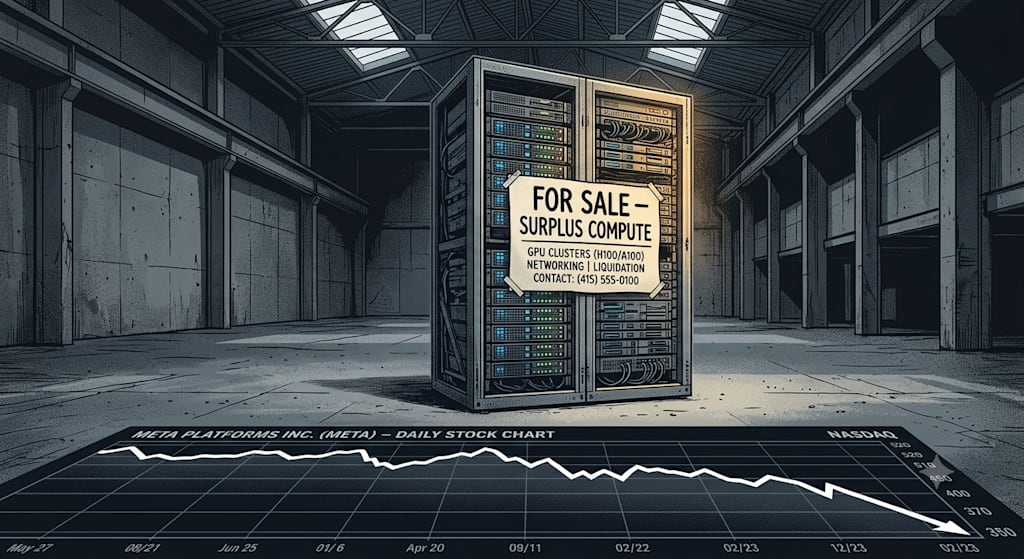
Without Meta’s subsequent stock surge, it would have been hard to pinpoint exactly what triggered the broad sell-off in U.S. tech stocks. In hindsight, though, calling it a “Meta-triggered sell-off” is accurate.
The market’s judgment was straightforward: it repriced companies based on their exposure to “excess compute,” idle or unproductive AI capacity. The core concern was whether that capacity could ever be turned into profit.
On July 1, Meta publicly stated it would sell off some of its unused AI computing resources. Meta’s stock jumped 9% that day. The market voted with its wallet: shedding idle capacity improves profitability. Other big tech names, however, fell across the board. Nvidia was especially quick to react. Almost as soon as Meta’s news broke, Nvidia announced a “GPU procurement financial guarantee service”: if certain cloud or compute-leasing companies couldn’t find downstream customers, Nvidia promised to buy back their unused GPUs.
The market soon dismissed this as wordplay. Given the current build-out pace at mid- and downstream companies, genuinely “unused” GPU inventory is extremely limited. A buyback pledge on that scale offered little real support. Capital didn’t buy it. On July 1, Nvidia fell as much as 3.16% intraday and closed at $197.58, down 1.25% for the day. Over the whole of June, Nvidia’s stock had already been sliding from its all-time high of $236.54 in May, and by early July the cumulative decline had topped 15%.
Nvidia itself clearly understands that compute demand from mid- and downstream players is shaky, which ultimately reflects the uncertain value of real-world AI applications. Another signal: it simultaneously announced plans to restart production of the consumer-grade RTX 3060 graphics card. That move says more about how Nvidia views the structure of compute demand than any official statement ever could.
If you look only at global investment volumes and the expansion plans of AI companies in different countries, it’s still too early to declare a full-blown “AI retreat.” Meta selling off excess compute is simply one result of overinvestment upstream. But the AI infrastructure build-out hasn’t generated broad-based heat across industries. For now, most of the action is an internal loop between the upstream and a slice of the midstream. The market is betting on the idea of AI, while AI’s ability to prove its worth by solving complex, high-end problems remains stubbornly absent.
In its global risk outlook report published earlier this year, Deutsche Bank included a telling statistic: 57% of respondents ranked “tech valuation crash / AI boom fading” as the number-one risk over the coming year. In the same survey, the next biggest risks were private-capital distress (22%), bond yields rising more than expected (21%), central banks returning to rate hikes because of sticky inflation (15%), and AI causing a significant shock to unemployment that spills over into markets (13%). That risk ranking shows how heavily the market had already priced in the likelihood of a tech bubble bursting.
Now back to the physical layer. The core components that underpin computing power are constrained by materials science and fabrication processes. There’s a hard physical ceiling that can’t be breached in the short term. That constraint risks pushing an excessive concentration of resources into compute infrastructure and superficial, entertainment-oriented applications, squeezing employment for ordinary people and starving other sectors of resources. In low-end service industries where margins are razor-thin, and demand is highly price-sensitive, that squeeze is already visible. For sectors that depend heavily on funding rounds, and for the private-capital funds connected to them, the pressure will only be released in a more concentrated way.
If AI infrastructure goes through a bubble that pops, many Wall Street firms are likely facing a thorough reset of asset valuations and a full structural overhaul.
About the Creator
Jin
Writer of reamstories
https://reamstories.com/jin
Enjoyed the story? Support the Creator.
Subscribe for free to receive all their stories in your feed. You could also become a paid subscriber, letting them know you appreciate their work.
Comments
There are no comments for this story
Be the first to respond and start the conversation.