
The Godmother of AI Just Sold Her Startup for $8.2 Billion. Here’s Why Embodied AI Founders Are Nervous.
AMD’s purchase of World Labs gives Li Fei-Fei capital and compute. For independent world model startups, it raises a harder question: can anyone build this alone?
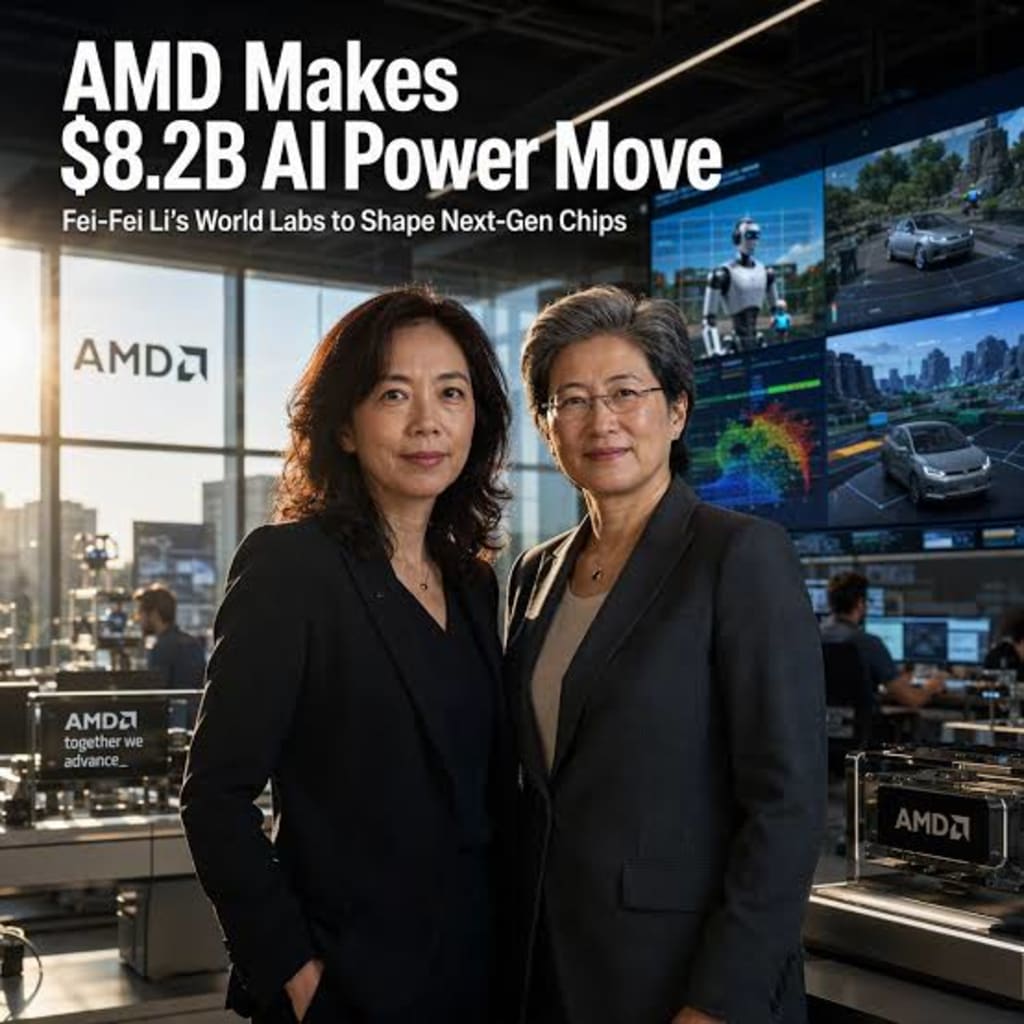
On September 28, AMD announced it had signed a definitive agreement to acquire World Labs in an all-stock deal valued at about $8.2 billion, or roughly RMB 55 billion. The transaction is expected to close by the end of 2026, subject to regulatory approval and other customary closing conditions.
It is AMD’s second-largest acquisition, after its roughly $50 billion purchase of Xilinx in 2022.
The news broke after U.S. market hours. AMD’s stock barely moved. WeChat groups for embodied AI investors reacted first.
1. What Does $8.2 Billion Buy?
World Labs was founded in early 2024 and is based in San Francisco. Its co-founders include Li Fei-Fei, Justin Johnson, Ben Mildenhall, and Christoph Lassner. The company works on spatial intelligence and large world models.
In September 2024, it raised $230 million in its first major round. a16z, NEA, Radical Ventures, and other firms invested. Its valuation crossed $1 billion. In February 2026, it raised $1 billion in a round led by Autodesk. AMD, Nvidia, Fidelity, and Emerson Collective also invested. The post-money valuation was about $5 billion.
Seven months later, AMD offered $8.2 billion.
AMD Ventures joined the first round in September 2024 and followed on in February 2026. Lisa Su was also an early investor. In this deal, AMD is both buyer and shareholder.
World Labs has about 70 employees. It has two products. Marble, released at the end of 2025, is a 3D scene generation platform for developers. It uses a subscription model. The Pro version costs $35 per month. Atlas, released in September 2026, is an underlying world model. It is still in an early open-access stage. Its claimed leading results are largely based on internal tests.
The company has not disclosed revenue, profit, or its customer list.
A securities analyst who tracks embodied AI said: “A listed company is paying a high price to acquire a company with no revenue, no business model, and technology that is still very early. The acquirer is also an early investor in the target. If this happened at an A-share listed company, many people would call it a coordinated cash-out.”
Lisa Su said in the announcement: “Building computing platforms for the next generation of AI requires a deep understanding of how models evolve. Dr. Li Fei-Fei and her World Labs team have outstanding scientific leadership and model expertise. Together, we will use these insights to develop the hardware, software, and systems that support the next generation of AI, and strengthen the open AI ecosystem.”
After the deal closes, Li Fei-Fei will join AMD as executive vice president and chief scientist. She will report to Lisa Su. Justin Johnson and Ben Mildenhall will continue to lead model R&D.
2. There Is No Standard Answer for World Models
The controversy centers on the technical route.
World models today fall into several camps. World Labs represents the 3D spatial intelligence camp. Yann LeCun’s AMI Labs represents the non-generative latent space camp. Nvidia represents the platform infrastructure camp. Each route has a different logic and implementation. Which route will work has no answer.
A world model practitioner said there are many technical routes, and no one’s route has been verified as correct. In China, many startups take the same 3D route as World Labs. Li Fei-Fei’s company has not built a strong competitive advantage.
“World Labs still risks being ‘killed’ by general-purpose large models. The 3D capabilities of general-purpose large language models are getting stronger. From a business perspective, selling at this point and at this price may be the best window for World Labs.”
At the end of 2025, Yann LeCun left Meta and founded Advanced Machine Intelligence Labs. The lab aims to build systems that understand the physical world, have persistent memory, and reason and plan complex actions. Li Fei-Fei and Yann LeCun went into business, and the world model track drew more attention.
In China, about 10 world model startups were founded in 2025. The time from founding to a large funding round was only three to six months. In 2026, according to IT Juzi, more than 20 new world model startups were founded in the first seven months.
Overseas, Nvidia, Meta, Google, and Runway are all working on world models. World Labs was one of the most watched startups in the track. Now AMD owns it.
The world model industry has lost an independent, prominent startup.
3. AMD’s Calculation
AMD is second to Nvidia in general-purpose GPUs. IDC estimates that Nvidia holds about 81% of the AI accelerator market, while AMD has about 13%.
Nvidia has built the Cosmos training platform for world models. Companies such as XPeng and Figure AI already train their own world models on Cosmos. Nvidia is trying to repeat its success in compute chips. It uses software to tie customers to its hardware and become the main supplier for the world model market. Not long ago, Nvidia announced it would acquire open-source model platform Hugging Face for about $13 billion.
AMD chose a second front. After buying World Labs, the 3D generation route it is betting on is one of the main routes for world models today.
The two sides had worked together for months. World Labs began deep technical work with AMD last year, starting with model training and inference optimization on AMD GPUs. At CES in January 2026, Lisa Su invited Li Fei-Fei onto the keynote stage. Li Fei-Fei said she could not wait to see how it performs on the next-generation MI450. Nine months later, Lisa Su bought the company.
Traditional chipmakers adapt hardware after models take shape. Hardware chases models. After AMD brings model R&D into its own system, hardware design can align earlier with the compute needs of spatial intelligence and robot simulation.
AMD’s market value briefly broke $1 trillion this year. Its stock is up more than 180% year to date. But it is not at the center of the AI story. The “godmother of AI,” a frontier research team, world models, and physical AI give AMD a new story for its valuation.
For World Labs, the acquisition buys two things.
Capital. World models require long-term investment. World Labs has raised about $1.2 billion over two years. That sounds like a lot, but it is not comfortable in the frontier model race. AMD can ease funding pressure.
Compute. AMD is the world’s second-largest compute chip supplier after Nvidia. For World Labs, this means a stable, sufficient supply of compute tuned to its models.
4. Why Embodied AI Founders Are Worried
Many embodied AI companies treat world models as one of the “brains” of a robot. For robots to act in the physical world, they need to understand space, predict changes, and plan actions. If world models work, they could become key infrastructure for robot generalization.
Many embodied AI companies either build world models in-house or rely on third-party platforms. One of the most closely watched independent world model companies has been acquired by AMD. The leading independent company in the track is gone.
Embodied AI companies that rely on third-party models face a choice: use Nvidia’s Cosmos, or use World Labs under AMD? Will they have to tie themselves to a specific chip system? Cost, openness, and iteration pace will all be affected.
For embodied AI companies building world models in-house, the competitive threshold has risen. Large companies are bundling models and chips. Without enough compute and capital, startups will find it hard to compete at the underlying model layer.
The capital signal is also changing. If world models cannot commercialize independently, primary-market enthusiasm will cool. In recent months, world model funding has moved fast, and valuations have risen quickly. After the benchmark company sold to a large company, investors will ask more cautiously about revenue, customers, and deployment.
But independent entrepreneurship is not impossible. Vertical scenarios, data flywheels, on-device models, specialized hardware, and robot closed loops can still be directions for startups to build advantages. The key is that they can no longer tell only a grand “world model” story. They must answer who pays, why they pay, where the data comes from, and how the closed loop forms.
An investor in embodied AI said Li Fei-Fei’s company has done nothing but demos for more than two years. It has not figured out how world models should be built, and it looks more like a cash-out and run. This sentence was forwarded many times in group chats.
5. After Li Fei-Fei Sells
Li Fei-Fei joins AMD as executive vice president and chief scientist, reporting to Lisa Su. The other two co-founders of World Labs continue to lead model R&D. After the deal closes, World Labs will continue to develop world models, but it will no longer be independent.
The technical route has not converged, the business model has not been proven, the evaluation system is incomplete, and physical data is scarce. Wang Zhongyuan, president of the Beijing Academy of Artificial Intelligence, said world models still face major bottlenecks, and the next three to five years will be a period of continuous iteration.
Marble’s subscription page remains, with the Pro version at $35 per month. Atlas’s demo video is still on the official website. Li Fei-Fei’s badge now says AMD. The group chats of embodied AI founders keep buzzing.
About the Creator
Jin
Writer of reamstories
https://reamstories.com/jin
Enjoyed the story? Support the Creator.
Subscribe for free to receive all their stories in your feed. You could also become a paid subscriber, letting them know you appreciate their work.
Comments
There are no comments for this story
Be the first to respond and start the conversation.