
The Global Drone Market Is Taking Off Fast — and It Is No Longer Just About Flying Cameras
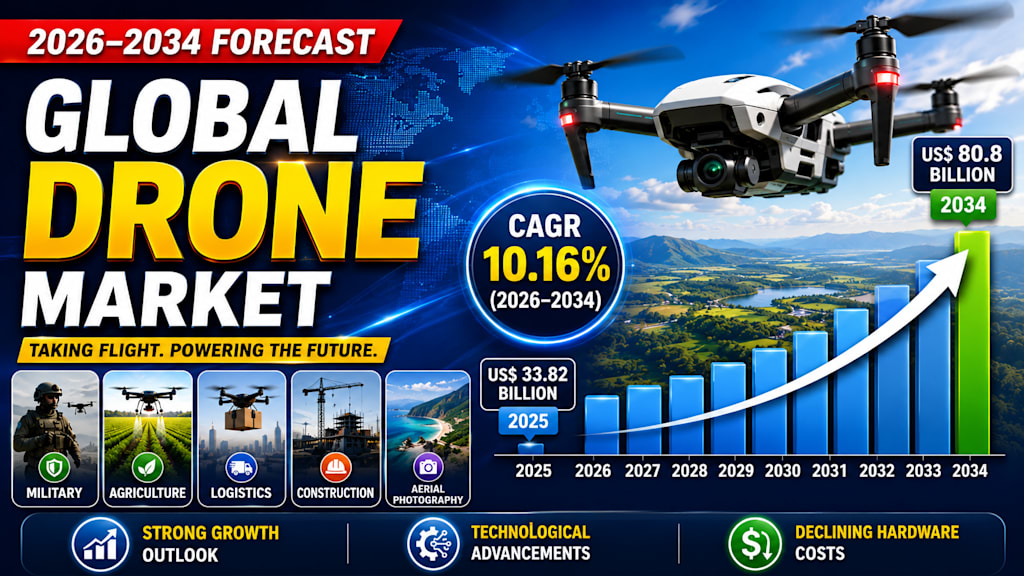
From farming and construction to defense, logistics, and public safety, drones are becoming one of the most versatile technologies in the modern economy. Backed by Renub Research figures, the market is projected to rise from US$ 33.82 billion in 2025 to US$ 80.8 billion in 2034, growing at a CAGR of 10.16% from 2026 to 2034.

Drones Have Moved Beyond Hype
There was a time when drones were seen mostly as toys, gadgets for hobbyists, or tools for flashy aerial photography. That picture has changed dramatically. Today, drones are embedded in a much broader industrial story, one shaped by automation, data collection, cost savings, and safety. The global drone market is no longer a niche category; it is becoming a serious part of how businesses inspect assets, monitor crops, support emergency response, and strengthen security. Renub Research projects that the worldwide drone market will expand from US$ 33.82 billion in 2025 to US$ 80.8 billion in 2034, a clear sign that drone adoption is moving into a long growth cycle.
At the center of this expansion is a simple idea: drones can do many jobs faster, safer, and more efficiently than traditional methods. They can gather high-resolution data from hard-to-reach places, reduce human risk in dangerous environments, and provide real-time visibility that improves decision-making. That combination is helping drones move from “nice to have” to “must have” across industries.
Why the Global Drone Market Is Growing
One of the strongest drivers of the market is the rapid rise in commercial and industrial use. Agriculture, construction, mining, energy, and telecommunications are all using drones more actively than before. In agriculture, drones help with crop monitoring, spraying, and yield analysis. In construction, they are used for site inspection, surveying, and tracking project progress. In energy and telecom, they support asset inspection and maintenance. Because drones can deliver fast, accurate, high-resolution data, they are becoming an important productivity tool.
Technology is also pushing the market forward. Improvements in battery systems, sensors, image capture, and navigation have made drones more capable and more dependable. The integration of artificial intelligence and machine learning has added another layer of value, allowing drones to fly autonomously, detect objects, and analyze data in real time. Fleet management software and data-processing tools have also become more advanced, making drone operations easier for enterprises.
Defense and public safety remain major demand centers as well. Governments use drones for surveillance, reconnaissance, border security, disaster response, and search-and-rescue missions. In situations where access is dangerous or limited, drones provide a safer and faster alternative. Rising geopolitical tensions and growing security concerns continue to support investment in this segment.
Commercial Use Is Expanding the Fastest
The commercial drone story is especially interesting because it shows how quickly a technology can evolve once real business value is proven. Drones are no longer used only for images and videos; they are now used to solve operational problems. In agriculture, they support precision farming. In construction, they reduce the time needed for surveying and progress checks. In mining and energy, they help inspect difficult terrain and critical infrastructure. In other words, drones are becoming a practical layer of enterprise intelligence.
That momentum is also visible in recent product development. Renub Research notes that DJI launched the Agras T100, T70P, and T25P in July 2025, reflecting the continued push into agricultural spray drones after years of research and development. That kind of innovation matters because it signals where the market is headed: toward more specialized, industry-focused drones rather than one-size-fits-all consumer models.
AI Is Changing What Drones Can Do
Artificial intelligence is one of the biggest reasons the drone market feels so different from even a few years ago. A drone is no longer just a remote-controlled aircraft with a camera. With AI, it can become a data-gathering and decision-support tool. It can identify objects, support predictive maintenance, improve route planning, and help organizations make sense of complex environments in real time.
The file also highlights anti-drone innovation, including Telewind Electronics’ AI-driven systems shown in January 2026, which combine radar, electro-optical sensors, and centralized command systems to detect, track, and neutralize aerial threats. That is a strong reminder that drone markets are growing on both sides of the equation: drone deployment and drone defense.
Why Defense and Public Safety Keep Buying
In defense, drones have become indispensable for intelligence and tactical operations. Their ability to observe, assess, and support missions without putting personnel in immediate danger is one of their biggest advantages. Public safety agencies also rely on drones for crowd control, traffic monitoring, emergency response, and crime scene analysis. Thermal imaging, night vision, and facial recognition tools are improving their effectiveness further.
The file’s examples make this trend concrete. In September 2025, Teledyne FLIR Defense unveiled the SkyCarrier platform at the DSEI tradeshow in London, while in December 2025, the U.S. Defense Department began a $1 billion program focused on U.S.-made drones for one-way attack missions. These developments show how drones are moving deeper into national security planning, procurement, and operational strategy.
The Market Still Faces Real Obstacles
Even with strong growth, the drone industry is not frictionless. Regulation remains one of the biggest barriers. Different countries have different rules for altitude, airspace, beyond-visual-line-of-sight operations, and urban flights. That makes commercial scaling complicated and often slow. Privacy and air traffic control concerns add more complexity, especially as drone use expands in crowded environments.
Battery life is another challenge. Many drones still have limited flight time and payload capacity, which restricts long-range delivery, large-area surveying, and continuous monitoring. Weather is also a limiting factor, since wind and rain can interfere with performance. These constraints are one reason the market continues to invest heavily in better battery design, stronger navigation systems, and smarter power management.
Different Segments, Different Growth Stories
The drone market is not one single market. It includes several specialized segments, each with its own use case and growth path. Energy drones are gaining traction because utilities, solar farms, wind farms, pipelines, and offshore platforms all need inspection and monitoring. Drones reduce manual inspection risk and improve preventive maintenance through real-time thermal scanning and analytics.
Entertainment drones have also carved out a visible space. They are used in aerial filming, live shows, and drone light displays. The file notes that drone light shows are increasingly replacing fireworks because they are reusable, safer, and more environmentally friendly. That makes the segment both visually appealing and commercially relevant.
Law enforcement drones are another growing category. They help with crowd control, traffic surveillance, search and rescue, and crime scene analysis. They give officers a safer way to gather intelligence from above, especially in potentially dangerous situations.
Then there is the split between fixed-wing and rotary-wing drones. Fixed-wing drones are valued for endurance and large-area coverage, making them useful for mapping, surveying, agriculture, and border security. Rotary-wing drones dominate in versatility because they can hover, take off vertically, and operate in tight spaces, which is why they are popular in inspection, media, construction, and public safety.
Regional Markets Are Developing at Different Speeds
The United States is one of the most developed drone markets in the world, with strong demand across defense, agriculture, construction, logistics, energy inspection, and aerial imaging. Commercial adoption is supported by software integration, innovation, and a strong startup ecosystem. The file also points to a major U.S. defense investment in drone production, which further supports the market’s long-term outlook.
The United Kingdom is also moving steadily, with drones increasingly used in infrastructure inspection, media, agriculture, and public safety. The file notes that Amazon has begun successful drone flights from its Darlington fulfillment center, with Prime Air expected later in 2026. This is a meaningful signal that logistics use cases are moving from experimentation to practical deployment.
India is one of the fastest-growing drone markets, supported by government policy, agricultural use, infrastructure surveying, mining, and defense demand. The startup ecosystem and domestic manufacturing are helping make drones more affordable and widely available. The file also notes that Garuda Aerospace announced eight drones for defense, safety, and military use at Aero India in February 2025, underlining the speed of innovation in the Indian market.
Saudi Arabia is another important growth story. Drones are increasingly used in smart cities, infrastructure, oil and gas, security, mapping, and logistics. The file mentions a successful drone parcel delivery trial in Jeddah in September 2025, which is a sign that logistics applications are beginning to take shape in the region.
The Future Looks Broad, Not Narrow
What makes the global drone market compelling is not just the size of the growth, but the breadth of the opportunity. Drones are no longer tied to one industry. They are becoming part of agriculture, construction, energy, entertainment, law enforcement, logistics, and defense all at once. That diversity gives the market resilience and helps explain why the forecast remains strong through 2034.
The market also appears to be entering a more mature phase. Early drone adoption was driven by novelty and visibility. Now, adoption is driven by ROI, workflow integration, risk reduction, and operational intelligence. That shift is important because it suggests the market is not depending on hype; it is being supported by real commercial and strategic utility.
Final Thoughts
The global drone market is growing because it solves real problems. It helps farmers monitor crops, assists construction teams with surveys, supports utilities with inspections, gives defense agencies better situational awareness, and helps public safety teams respond faster. The technology is improving, the use cases are multiplying, and the market is becoming more specialized and more valuable. With Renub Research projecting growth from US$ 33.82 billion in 2025 to US$ 80.8 billion in 2034, the drone industry looks set for a decade of expansion powered by automation, AI, and practical demand.
If there is one clear takeaway, it is this: drones are no longer just flying devices. They are becoming essential tools for modern industry. And that makes the drone market one of the most exciting technology stories to watch right now.
About the Creator
Enjoyed the story? Support the Creator.
Subscribe for free to receive all their stories in your feed.
Comments
There are no comments for this story
Be the first to respond and start the conversation.