
The Future of Household Refrigeration in a Smart Home Era
Rising Urbanization, Smart Technology, and Energy-Efficient Innovations Are Driving a New Chapter in the Global Refrigeration Industry

For decades, refrigerators and freezers have been among the most essential appliances in homes around the world. Their primary purpose has always been simple: preserving food and keeping beverages fresh. However, today's refrigeration systems are no longer just storage appliances. They have become intelligent, energy-efficient, and highly connected devices that play a crucial role in modern households.
As consumers embrace smarter lifestyles and governments encourage energy conservation, the global household refrigerators and freezers market is undergoing a significant transformation. Advanced cooling technologies, artificial intelligence, Internet of Things (IoT) integration, and innovative designs are reshaping the industry and changing consumer expectations.
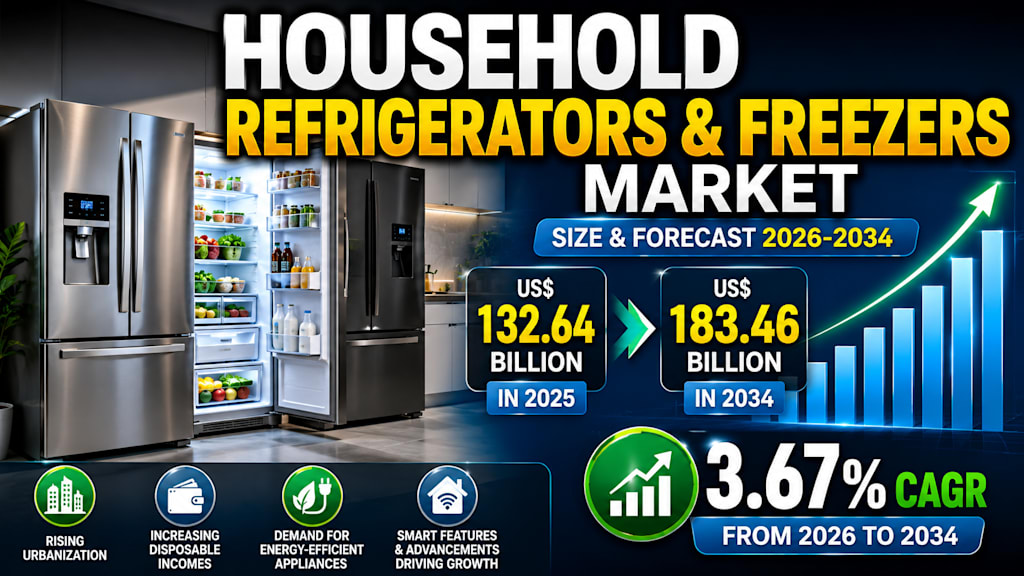
According to Renub Research, the Household Refrigerators and Freezers Market is projected to grow from US$ 132.64 billion in 2025 to US$ 183.46 billion by 2034, registering a compound annual growth rate (CAGR) of 3.67% between 2026 and 2034. The growth is being fueled by rising urbanization, increasing disposable incomes, expanding housing infrastructure, and growing demand for energy-efficient appliances.
The refrigerator may be one of the oldest household appliances, but its future has never looked more exciting.

Refrigerators Have Become a Necessity Rather Than a Luxury
Household refrigeration has become deeply integrated into everyday life. Whether storing fresh vegetables, preserving dairy products, freezing meat, or keeping beverages cold, refrigerators have become indispensable in both developed and developing economies.
Modern consumers depend heavily on refrigeration appliances because they support convenience and help reduce food waste. Families can purchase groceries in larger quantities, store them safely for longer periods, and reduce the frequency of shopping trips.
As lifestyles become increasingly busy, refrigerators provide practical solutions for food management. They support meal preparation, preserve nutritional value, and ensure that food remains safe for consumption.
The increasing importance of convenience has elevated refrigerators from luxury products to essential household investments. As a result, demand continues to grow across diverse demographic and economic segments.
Urbanization Is Creating Strong Market Momentum
One of the most influential factors supporting market growth is global urbanization.
Today, more than half of the world's population lives in urban areas, and this number continues to rise. As cities expand and residential construction increases, demand for household appliances naturally follows.
New homeowners often prioritize refrigerators among their first major appliance purchases. Urban households typically have greater access to electricity, retail stores, and financing options, making appliance ownership more accessible.
Urban lifestyles also encourage food storage practices that depend heavily on refrigeration. Busy work schedules and growing reliance on supermarkets motivate consumers to buy food in bulk and store it efficiently.
The expansion of apartment complexes, housing developments, and modern residential communities is therefore creating a favorable environment for continued growth in the refrigeration market.
Smart Refrigerators Are Redefining Convenience
Technology is transforming nearly every aspect of modern life, and refrigerators are no exception.
Today's smart refrigerators offer capabilities that would have seemed futuristic just a decade ago. Equipped with Wi-Fi connectivity, touch-screen displays, and intelligent sensors, these appliances provide a new level of convenience for consumers.
Users can remotely adjust temperature settings through smartphone applications, receive maintenance alerts, and monitor energy usage in real time. Some models can even suggest recipes based on available ingredients or help create shopping lists automatically.
Artificial intelligence has become another important innovation. AI-powered compressors can analyze household usage patterns and optimize cooling performance accordingly. This helps improve efficiency while reducing electricity consumption.
Manufacturers continue to invest heavily in smart appliance development. The growing popularity of connected homes is encouraging consumers to view refrigerators as integral parts of broader smart living ecosystems.
Rather than serving solely as food storage units, refrigerators are evolving into intelligent household assistants.
Energy Efficiency Is Driving Consumer Decisions
Energy consumption has become a major concern for both consumers and governments.
Because refrigerators operate continuously throughout the day and night, they account for a substantial portion of household electricity usage. Rising energy costs have made efficiency one of the most important purchasing considerations.
Consumers increasingly seek appliances that minimize electricity consumption without compromising performance. In response, manufacturers are introducing advanced technologies such as inverter compressors, adaptive cooling systems, and enhanced insulation materials.
Energy-efficient refrigerators offer multiple benefits. They reduce electricity bills, lower environmental impact, and often provide superior long-term reliability.
Government regulations and appliance labeling programs are further accelerating the shift toward energy-conscious products. Consumers are becoming more aware of sustainability issues and actively choosing appliances that align with environmental goals.
The focus on energy efficiency is expected to remain one of the strongest forces shaping the industry's future.
Rising Disposable Income Is Supporting Premiumization
Growing incomes are changing consumer purchasing behavior worldwide.
As households gain greater financial flexibility, they are increasingly willing to invest in appliances that provide enhanced convenience, aesthetics, and performance.
Many consumers are upgrading from basic refrigerators to premium models that feature advanced cooling technologies, larger storage capacities, and modern designs. Premium segments such as French door refrigerators and side-by-side units continue to experience strong demand.
The growth of the middle class in emerging economies is particularly important. Millions of households are entering the consumer appliance market for the first time, creating substantial opportunities for manufacturers.
Additionally, financing programs, seasonal promotions, and online shopping platforms have made premium appliances more accessible than ever before.
As purchasing power continues to rise globally, demand for feature-rich refrigeration products is expected to increase steadily.
The Rise of French Door Refrigerators
French door refrigerators have emerged as one of the most desirable product categories in the global market.
These models combine sophisticated design with practical functionality. Featuring dual refrigerator doors above a spacious freezer compartment, French door refrigerators provide improved organization and convenient access to stored items.
Consumers appreciate their wide shelves, flexible storage options, and modern appearance. Many models also include advanced features such as water dispensers, ice makers, touch-screen controls, and smart connectivity.
Although French door refrigerators typically carry higher price tags, increasing disposable incomes and growing consumer interest in premium appliances continue to drive demand.
Their popularity reflects a broader trend toward high-end kitchen appliances that combine style with functionality.
Large-Capacity Refrigerators Are Becoming More Popular
Changing shopping habits are creating demand for larger refrigeration units.
Consumers increasingly purchase groceries in bulk from supermarkets, warehouse clubs, and online retailers. As a result, households require greater storage capacity to accommodate larger quantities of food.
Refrigerators exceeding 30 cubic feet are gaining popularity among large families and consumers who prioritize food preservation.
These models often include multiple compartments, customizable storage arrangements, dual cooling systems, and enhanced freshness technologies.
The trend toward home cooking has further strengthened demand for spacious refrigeration solutions. Consumers who prepare meals at home frequently need larger storage areas for ingredients and leftovers.
Manufacturers continue introducing innovations that improve the efficiency and convenience of large-capacity refrigerators, helping expand this growing segment.
Challenges Remain Despite Strong Growth
Despite positive market fundamentals, the refrigeration industry faces several challenges.
One of the most significant concerns involves environmental impact. Refrigeration systems consume considerable amounts of energy, and older models may use refrigerants that contribute to greenhouse gas emissions.
Manufacturers must comply with increasingly strict environmental regulations while maintaining product affordability.
High purchase costs also present challenges. Advanced refrigerators equipped with smart features often require substantial upfront investments. Price-sensitive consumers may hesitate to upgrade despite long-term energy savings.
In mature markets such as North America and Western Europe, market saturation represents another obstacle. Most households already own refrigeration appliances, meaning manufacturers depend heavily on replacement demand.
To remain competitive, companies must continue innovating while balancing affordability and performance.
Emerging Markets Offer Massive Opportunities
While developed markets remain important, much of the industry's future growth will come from emerging economies.
India represents one of the most promising markets. Rapid urbanization, expanding electrification, rising incomes, and increasing awareness of modern appliances are driving strong demand.
Consumers in India continue to favor affordable and energy-efficient models, particularly single-door and top-mounted refrigerators. However, premium categories are gradually gaining popularity among urban households.
Similar growth opportunities exist across Southeast Asia, Latin America, and parts of Africa. These regions are experiencing rising living standards and increasing appliance penetration.
As infrastructure improves and consumer purchasing power grows, demand for refrigeration appliances is expected to accelerate significantly.
Innovation Will Shape the Next Decade
The future of household refrigeration will be defined by innovation.
Artificial intelligence, machine learning, predictive maintenance, and advanced connectivity will continue transforming appliance functionality. Refrigerators will become increasingly integrated with broader smart home ecosystems.
Manufacturers are also exploring sustainable technologies that reduce energy consumption and environmental impact. Future products may incorporate even more efficient cooling systems, eco-friendly refrigerants, and advanced food preservation solutions.
Consumer expectations will continue evolving, creating opportunities for companies that can successfully combine technology, convenience, and sustainability.
The next generation of refrigerators is likely to be smarter, greener, and more personalized than ever before.
Final Thoughts
The household refrigerators and freezers market is entering a dynamic period of transformation driven by technological innovation, urbanization, rising disposable incomes, and sustainability initiatives.
As smart homes become increasingly common and consumers prioritize convenience, refrigerators are evolving from simple food preservation appliances into intelligent household hubs. Energy-efficient technologies, premium designs, and connected features are creating exciting opportunities for manufacturers and consumers alike.
According to Renub Research, the market is expected to grow from US$ 132.64 billion in 2025 to US$ 183.46 billion by 2034, highlighting the industry's strong long-term potential.
In a world where convenience, efficiency, and sustainability matter more than ever, the future of household refrigeration is not simply about keeping food fresh—it is about enhancing the way people live every day.
About the Creator
Enjoyed the story? Support the Creator.
Subscribe for free to receive all their stories in your feed.
Comments
There are no comments for this story
Be the first to respond and start the conversation.