
The Failed Cloud Product That Ate ChatGPT
Inside Codex’s ten-month turnaround: a Rust rewrite, a coding app with no editor, and a team that asked the same question every day
In the summer of 2025, in a conference room at Mission Bay, Dan Shipper said, “We don’t really look at the code anymore,” and blushed. Across from him sat Alexander Embiricos, former head of product for Codex. Two unopened bottles of water stood on the table. Arrows from an earlier discussion were still on the whiteboard. No one had erased them.
Shipper had gotten GPT-5 a month early. For everyday use, he was satisfied. Put it inside Codex to write code, and the response was flat: fast, smart, but always stopping too early. Like a pair-programming partner afraid to step past the boundary. His own way of working had already changed: hand the whole task to Opus 4 in Claude Code, walk away, and wait for a complete feature, or even a whole app, to be handed back.
Leaving that night, Shipper thought one thing: OpenAI might be building the perfect tool for a workflow that was about to die.
Less than a year later, the ChatGPT desktop app on Mac still reported its name to the system as com.openai.codex. Internally, Codex had swallowed ChatGPT.
There was no decision at the top to split out the model line. Tibo later told Shipper’s recorder that it began as a research exploration, meant to let researchers run their own experiments a little faster.
Seven Weeks
In February 2025, Anthropic released a research preview of Claude Code. It lived in the terminal, used the files and tools you already had, and could be interrupted at any time. Developers adopted it quickly.
The Codex team bet on the cloud. In about seven weeks, Codex Cloud launched on May 16: describe a task in ChatGPT, and Codex would edit code and run tests on an isolated cloud machine, then return a button to submit a PR.
Inside OpenAI, it was a success. Outside, developers praised it and went back to their own laptops. They had to spend hours rebuilding their local software, permissions, and configuration in the cloud. Tasks could not be corrected mid-flight; even a follow-up question required spinning up a new cloud machine. OpenAI’s standardized internal development environment hid how high those requirements were for ordinary users.
Embiricos admitted the model was not smart enough yet. Mia Glaese’s postmortem was shorter: the team had a vision for the future, but it had not gone where users were, which was their laptops.
The terminal prototype had actually been built internally. Tibo said they abandoned it after a month and went all-in on the cloud. Inside OpenAI, the ideal form of an agent had long been imagined as something working autonomously in the cloud, continuing even after you closed your laptop. Brockman’s formulation: the right form is a cloud AI with its own laptop.
Then the engineering manager left for Cursor. In July, OpenAI’s reported $3 billion acquisition of Windsurf fell apart. For the first time, the Codex team had no clear next move.
On the conference-room whiteboard, the cloud version’s growth arrow was drawn halfway and then stopped.
One Month
Reasoning models backtrack. When they find they have taken the wrong path, they re-examine their assumptions and take another. The Codex team did the same thing next.
At the time, Codex was described by designer Ed Bayes as OpenAI’s “remote corner.” If you wanted to be a glamorous designer, you went to ChatGPT.
Tibo took over and changed direction: local. He did not rush to pile features onto the CLI. Instead, he rewrote the agent itself in Rust, separating the code that read files and ran commands from the terminal interface. That way it could later run in editors, desktop apps, the cloud, and even ChatGPT.
On the model side, Michelle Pokrass led the effort to make GPT-5 better at real-world programming. Brockman’s analogy: OpenAI’s models could score high in programming contests but had never seen a messy codebase. Pokrass’s team sat next to programmers and watched, turning the places where the model failed into training tasks.
The timidity Shipper felt that night had a source. OpenAI, burned by the cloud version, had built a cautious collaborator. And that was exactly what most engineers wanted at the time. After GPT-5 launched, usage of the VS Code and Cursor extensions grew more than tenfold by October. Embiricos said the rebuilt local agent finally had a model that could drive it: “Now we can fight.”
A Lap Around the Desks Every Day
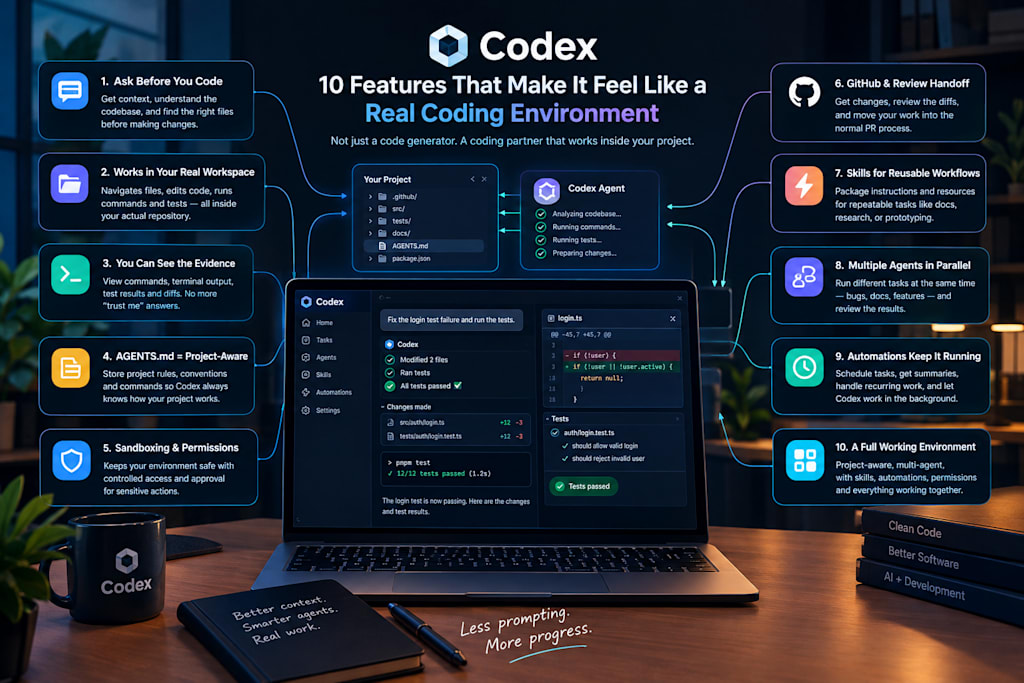
By conventional logic, the next step should have been to double down on the CLI and editor extensions. The Codex team put its biggest next bet on a native desktop app.
Tibo saw that the tasks models could complete were getting longer. People would soon run several agents at once and spend all day with them. Managing all of that in a plain-text window from the 1970s was absurd.
Embiricos saw the workflow the cloud version had never achieved: first collaborate closely with the agent, then, like onboarding a new colleague, gradually learn which tasks could be handed off.
After Andrew Ambrosino joined, the four-person team took inspiration from chat apps rather than VS Code and made its most dangerous decision: no built-in code editor. If you wanted to change any code, you had to make the agent change it.
His reasoning was direct: once users are allowed to type code, they will expect everything an editor has: undo, search, keyboard shortcuts. Codex could not win by being a bad editor. It could only win by making the agent good enough that people stopped missing the editor.
The awkward part was that they were still using VS Code to build this VS Code replacement. Every day Embiricos came into the office, made a lap around the desks, and asked each person: Did you use it as your main tool today? At first, every answer was no. Colleagues complained that replacing a single sentence required writing a prompt. Ambrosino himself admitted that “you can’t edit files” was the decision he doubted most.
In November, Google launched Antigravity with a full editor built in. Team members looked at one another. Had they made a huge mistake by not forking VS Code?
The model was also a bottleneck. Ambrosino believed that with the model quality available in November, the app could not ship no matter how good it was. Then three releases landed in quick succession: GPT-5.1 Codex Max on November 19 could write code for several hours in a row; GPT-5.2 Codex on December 18 was better at editing in large codebases. Because the Codex model line was independent of ChatGPT, the team could iterate quickly without worrying about affecting 800 million ChatGPT users.
By January, the whole team had switched to the Codex app. By February, well-known researcher Noam Brown said he had “fully switched.” Brockman, a longtime terminal and Emacs user, switched too, describing a return to the old workflow as “like going back in time.” Altman later called it the most internally beloved product in OpenAI’s history.
The answers to Embiricos’s daily question began to change. First someone nodded. Then someone removed VS Code from the Dock. A layer of dust settled on the keyboard cover.
February 2
The cloud version had also been wildly popular internally. Everyone remembered how that ended.
On February 2, 2026, the Codex macOS desktop app launched. You could have one agent fix a bug and another build a new feature, each working on an independent copy of the code. Shipper admitted these features were not groundbreaking; the Claude desktop app could already do them. But Claude’s app had been layered up step by step from chat to code to Cowork, and felt a little patched together. The Codex app had no historical baggage: clean, fast, and built entirely around the agent. With no editor, the agent could do almost everything users might want to do.
A few days later, GPT-5.3 Codex launched. Glaese said the Codex model line had begun, for the first time, to move beyond programming-specific training and toward broader knowledge work. Shipper himself shifted from using almost only Claude to using Codex heavily. After GPT-5.4 arrived in early March, Codex became his main tool.
Weekly active users passed 2 million on March 19. In April, a built-in browser was added, with previews for documents, slides, and spreadsheets. In June, weekly active users exceeded 5 million, about one-fifth of them knowledge workers. On July 9, the Codex desktop app officially became the new ChatGPT desktop app.
Codex Cloud had once been just a tab inside ChatGPT. Now ChatGPT runs on top of Codex. Walking out of the all-hands meeting that announced the merger, Bayes said one thing: the few people in the corner had become the future of ChatGPT.
The Whiteboard
In June, Shipper met Embiricos again in Manhattan. Embiricos had moved to head OpenAI’s enterprise product.
On a whiteboard, Embiricos drew Codex’s growth curves: the cloud version rose briefly and then flattened; the CLI after GPT-5 was steeper; the editor extensions were higher; and finally 5.3 Codex and the desktop app made all the earlier curves look small. The first stroke looked like a scratch at the bottom of the whiteboard.
To Shipper, it looked like Christensen’s diagram: mainframes to PCs to phones, each leap creating a simpler form and a larger market. A replacement that took half a century played out inside OpenAI in ten months, by a handful of people.
According to Christensen’s theory, the team that wins one curve almost never wins the next. Shipper thinks Codex escaped that fate for two reasons. First, OpenAI was deliberately organized as a set of parallel bets, giving Codex room to iterate independently outside the scale of ChatGPT. Second, building Codex with Codex changed the physics of product development: a few people could produce a new form in weeks and put it in front of everyone. Tibo put it more briefly: persuading people now takes much less breath.
There was one last curve on the whiteboard. Millions of people already trusted an agent running on their own computers. The next step was to return to the vision that had once failed: an agent that keeps working after you walk away. Embiricos said they were moving toward asynchronous work, which meant going back to the cloud.
This time, Shipper noticed, Embiricos’s laptop was on the conference table. The lid was closed tight.
Outside the window, half the parking lot at Mission Bay was empty. The whiteboard marker, cap off, rolled to the corner of the table and stopped.
About the Creator
Jin
Writer of reamstories
https://reamstories.com/jin
Enjoyed the story? Support the Creator.
Subscribe for free to receive all their stories in your feed. You could also become a paid subscriber, letting them know you appreciate their work.
Comments
There are no comments for this story
Be the first to respond and start the conversation.