
The Evolution of Crypto Wallets: From Seed Phrases to Smart Accounts
How Crypto Wallets Are Becoming More Secure, Recoverable, and User-Friendly

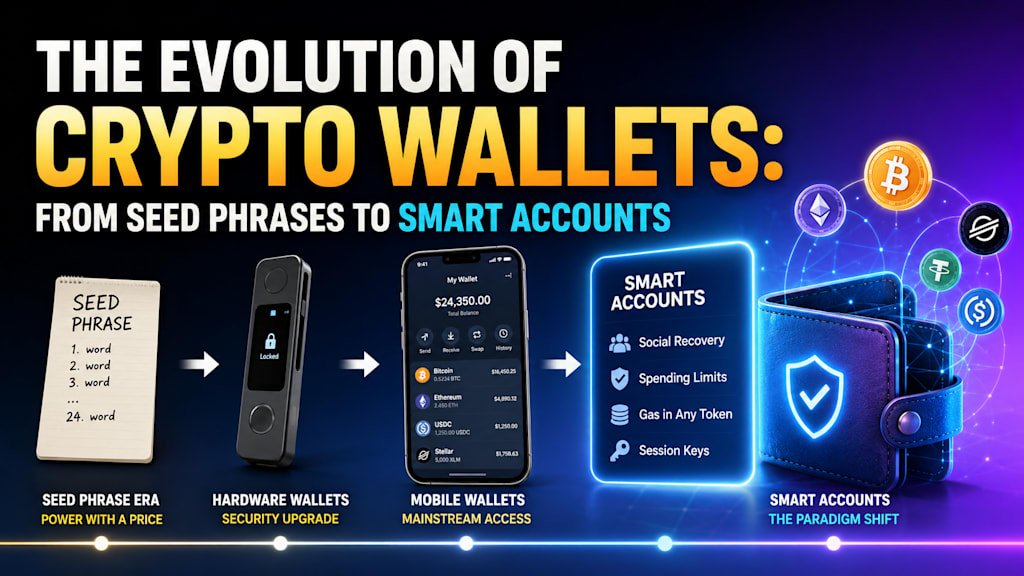
Ask anyone who tried to use cryptocurrency in its early days what the biggest barrier was, and the answer is almost always the same: the wallet. Not the concept of digital money, not the volatility, not the regulatory uncertainty — the wallet. That moment when a new user was handed a 24-word seed phrase and told, with complete sincerity, that losing it meant losing everything forever. No customer support. No password reset. No second chances.
It was a brutal introduction to self-sovereignty, and it drove countless people back to the familiar comfort of centralized exchanges. But the story of crypto wallets is not one of permanent friction. It is one of relentless iteration — and the latest chapter, smart accounts, may finally be the one that brings the next billion users on-chain.
The Seed Phrase Era: Power With a Price
The earliest crypto wallets were built around a simple but unforgiving principle: whoever controls the private key controls the funds. This was a feature, not a bug. In a trustless system, there is no central authority to appeal to, which means ownership must be absolute and cryptographically verifiable.
Hierarchical Deterministic wallets, introduced in the early 2010s, were a major step forward. Rather than managing individual private keys for every address, HD wallets allowed users to generate an entire tree of addresses from a single master seed — those now-familiar 12 or 24 words. Back up the seed phrase, and you back up everything.
It was elegant cryptography. It was terrible user experience. Seed phrases are difficult to store securely, easy to lose, and catastrophic to expose. They are fundamentally incompatible with how most people manage important information in their daily lives — which is to say, with some tolerance for human error and some expectation of recovery options.
The result was a generation of wallets that were powerful for technical users and deeply hostile to everyone else.
Hardware Wallets and the Security Upgrade
As the value stored in crypto wallets grew, so did the sophistication of attacks against them. Malware, phishing schemes, clipboard hijacking, and SIM swapping all emerged as vectors for draining funds from software wallets connected to the internet.
Hardware wallets addressed this by taking private keys entirely offline. A dedicated physical device stores the keys in a secure element, signs transactions internally, and never exposes the private key to a connected computer. Even if your laptop is compromised, your funds remain safe.
Hardware wallets became the gold standard for serious crypto holders. But they introduced their own friction — physical devices that must be purchased, set up, carried, and connected. For day-to-day use, particularly for smaller transactions, they were overkill. And they still relied on seed phrases for backup and recovery.
The security problem was partly solved. The usability problem remained.
Mobile Wallets and the Mainstream Moment
The emergence of sleek mobile wallets marked crypto's first genuine attempt at mainstream accessibility. Apps with clean interfaces, biometric authentication, and built-in token swaps made self-custody feel less like operating a server and more like using a banking app.
Browser extension wallets opened the door to DeFi and NFTs, allowing users to interact with on-chain applications directly from their browser with a single click. For the first time, the experience of using a decentralized application began to approach the fluidity of using a conventional web app.
But the underlying architecture was unchanged. Seed phrases still sat at the foundation. One phishing link, one compromised device, one moment of inattention — and everything was gone.
Spotlight: Stellar and Wallet Accessibility for Global Payments
One blockchain that has long prioritized wallet accessibility and low-friction onboarding is Stellar. Designed from the outset for fast, low-cost cross-border payments, Stellar has built an ecosystem where wallets are lightweight, interoperable, and optimized for users in emerging markets who may be accessing crypto for the first time.
For analysts watching the network's native asset, XLM Price Prediction has become a consistent research topic, particularly as Stellar expands its partnerships with payment corridors and financial institutions across Africa, Asia, and Latin America. Each new wallet integration or remittance corridor announcement tends to renew the XLM Price Prediction conversation, as investor interest tracks closely with real-world payment volume growth on the network.
Smart Accounts: The Paradigm Shift
Account abstraction is the technical term. Smart accounts is the human one. The concept is straightforward: instead of a wallet being controlled by a single private key, it is controlled by a smart contract — one that can encode any rules the user chooses.
The implications are enormous. Social recovery allows users to designate trusted contacts who can help restore access if a device is lost, without any single contact having full control. Spending limits can be set so that small transactions require no confirmation while large ones trigger additional authentication. Gas fees can be paid in any token, removing the requirement to hold a native chain token just to move funds. Sessions keys allow users to pre-authorize a game or application to perform certain actions on their behalf without approving every individual transaction.
These are not incremental improvements. They are the difference between a technology that demands users adapt to it and one that adapts to users.
The Wallet of Tomorrow
The evolution from seed phrases to smart accounts mirrors a pattern seen across every successful consumer technology: initial versions are built for technical early adopters, and mass adoption only follows once the experience becomes invisible. Nobody thinks about TCP/IP when they send an email. Nobody will think about private keys when they use the wallet of tomorrow.
The infrastructure is being built right now. The wallets that win the next decade will be the ones that make self-custody feel as natural as tapping a contactless card — secure by default, recoverable by design, and simple enough that the technology disappears entirely into the background.
That is the wallet the world has been waiting for.
About the Creator
Muhammad Irfan Afzal
I write clear, practical, engaging articles on technology, online safety, and modern digital life. My goal is to help readers understand complex. My aim to provide value, awareness, and real-world solutions for everyday digital challenges.
Enjoyed the story? Support the Creator.
Subscribe for free to receive all their stories in your feed.
Comments
There are no comments for this story
Be the first to respond and start the conversation.