
The Double Harvest: You’re Paying AI Twice—and the Second Price Is Everything You Know
PhDs, doctors, novelists—their expertise is being fed into the machine. They pay with cash. They pay with their knowledge. Most haven’t noticed the second bill yet.
Amanda Brown submitted her final data-labeling report at 2:17 a.m. She shut her laptop and sat in the dark for a while, not bothering to turn on the light. On the kitchen counter sat a cup of tea she’d brewed at six o’clock, untouched, the tea bag sunk to the bottom like a clump of brown sludge.
She was an assistant professor of biology at Tarleton State University in Texas. Summer break, no classes. She wanted a side gig. The platform listed the task at “$60/hour.” It sounded like free money. She signed up without a second thought.
Three months later, she quit. Her supervisor never told her what exactly was “not good enough,” only that it wasn’t. Three words, repeated dozens of times. She later told a friend the experience was “soul destroying.” This summer, she went back to teaching and never looked at those platforms again.
But Amanda is not alone.
Every day, an AI company called Mercor pays more than $4 million to as many as 30,000 contractors. It doesn’t hire people to label cars in photos; it hires physics PhDs, voice actors fluent in Hebrew, doctors with three years of primary‑care experience in Rwanda. Elon Musk’s xAI recruits novelists who’ve sold 50,000 copies or published ten short stories in top‑tier magazines.
These people are doing one thing: feeding their professional expertise, bit by bit, to AI.
I
In 1962, Kenneth Arrow formulated his information paradox. To sell information, a seller must first show it; once shown, the buyer won’t pay. Power back then lay with the buyer. Once knowledge was exposed, it was worthless.
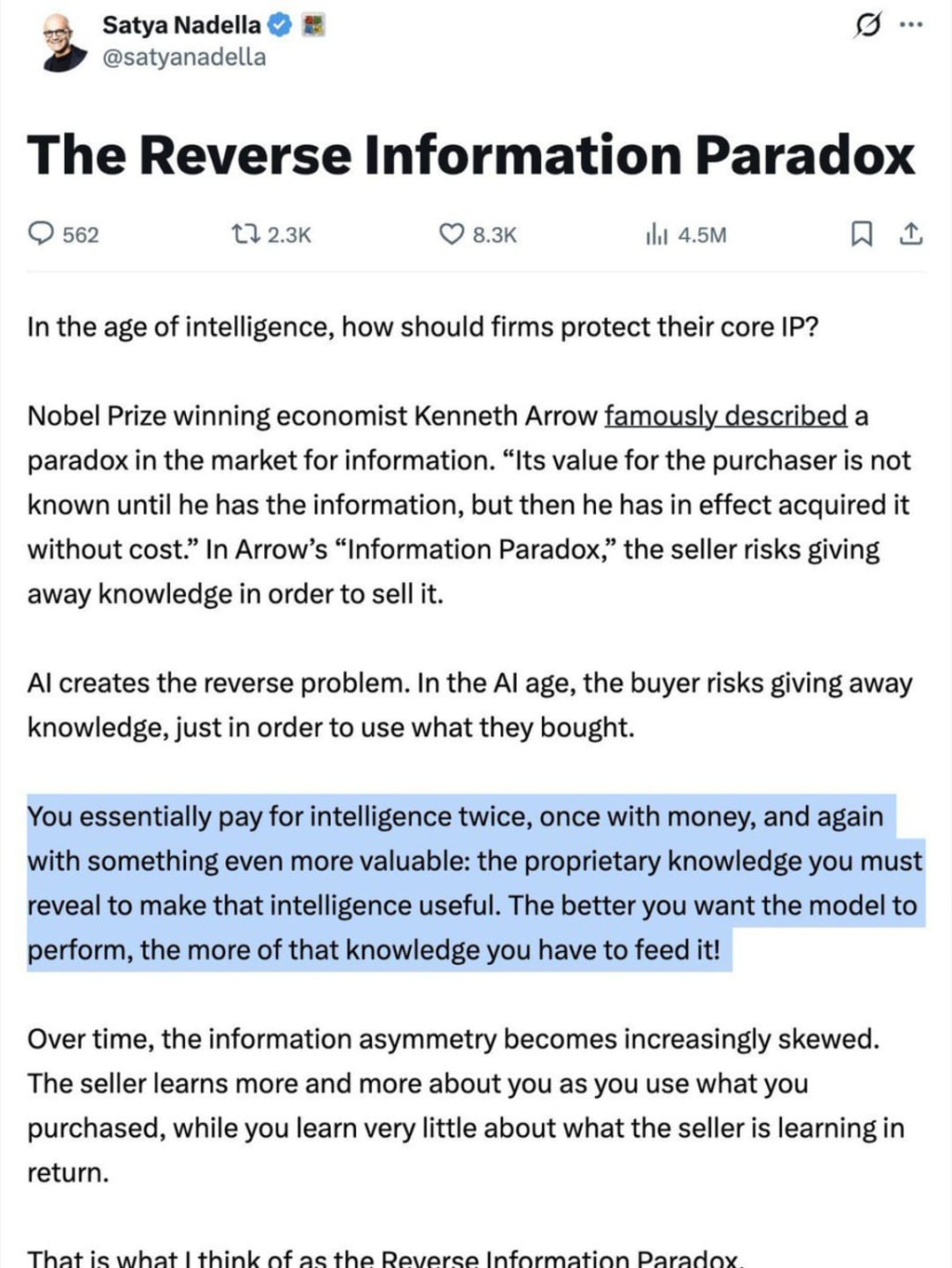
Sixty years later, Microsoft CEO Satya Nadella wrote that AI had flipped the paradox. The new rule: you pay a subscription, and then, to make the model useful, you have no choice but to feed it your business logic, internal data, and industry know‑how. If you don’t feed it, it’s not smart; if you do, it learns what you know.
Nadella calls this the “Reverse Information Paradox.”
He calls the traces of those interactions “digital exhaust”: every prompt, every API call, every time you patiently correct its hallucinations. All of it generates exhaust. The model inhales that exhaust and turns it into its own knowledge. Palantir CEO Alex Karp puts it more bluntly: customers want control over their means of production, not to watch them be transferred to others.
But most white‑collar workers haven’t realized that every time they use a large model, they’re paying two bills at once: one in money, the other in their core knowledge.
II
If this sounds abstract, look at what’s happening in Silicon Valley.
Handshake, a recruiting startup, pivoted to data training only in 2025. By April this year, its annualized revenue had crossed $1 billion. Its business is finding high‑paid professionals to teach AI. Mercor’s CEO Brendan Foody says they’re no longer hiring individuals; they’re cloning entire companies. They recreate an investment bank’s mirror environment: one person plays the client, others play bankers, reenacting real business scenarios. The AI watches all the interactions. Foody says that, in theory, the AI could eventually answer one question: “What the hell do people at Goldman Sachs actually do?”
Once the AI knows what Goldman does, what happens to Goldman’s employees doesn’t require guesswork.
Edwin Chen, founder of Surge AI, is now the world’s 258th richest person. He calls his company “a school for AGI.” He says: “AI comes to us; AI learns how the world works.”
Push this to the limit, and the future of work looks like this: even senior employees will systematically automate nearly every task they perform. In the end, the only human job left is “training AI.” And when AI no longer needs training, the curtain falls.
III
Programmers were the first to feel this dispossession.
Redis founder Antirez recently wrote a blog post. He now uses the DwarfStar framework to run DeepSeek v4 and GLM 5.2 inference fully automatically. He said he had an epiphany: code is dead. For most programmers, staring at code line by line is pointless.
“You can generate a massive amount of code now,” he wrote. “How could you possibly review 5,000 lines a day?”
A day has only eight hours. If you spend that time reading LLM‑generated code, you’re squeezing out what actually matters today: asking what the software should do, thinking about new directions, and doing quality assurance.
The reason code fell first to AI isn’t that it’s text. It’s because of a colder mechanism: zero verification cost. When AI drafts a legal contract, a senior lawyer must spend hours judging it. When AI issues a diagnosis, a doctor evaluates it with clinical experience. But code? Whether it compiles, whether it has bugs, whether it meets performance—the compiler can tell you in milliseconds. Generate, compile, test, fix: no human evaluator needed at any step.
Because verification cost is zero, code became the first knowledge domain to be distilled clean.
Antirez now prefers to have the LLM write a DESIGN.md file in plain human language: capturing data structure ideas, implementation tricks, and design rationale. In the future, if you want to modify software, you read that file, internalize its mental model, and direct your AI agent to make the changes. That’s far more useful than reviewing code.
In 1984, Donald Knuth proposed “literate programming”: code, he said, is prose for humans to read; compilation is incidental. Forty years later, Antirez offers the exact mirror image: prose is enough; code can be thrown away.
Control thought, not code. That might be the only lifeline for technical professionals.
IV
The corporate world is walking a dangerous path too.
Microsoft cut 4,800 jobs; Cloudflare, with revenue growth above 30%, laid off a fifth of its staff; Cisco shed nearly 5% of its workforce despite record earnings. This isn’t a reaction to economic cycles. Harvard Business School’s Joseph Fuller says CEOs are terrified of one thing: if they make only incremental changes while rivals go all‑in on AI, they could wake up “down 0–21 before the game even starts.”
Business Insider calls this “permanent layoffs.” Not a state, but an organizational form. As AI continuously distills, people continuously leave, and organizations continuously restructure.
Moyan Chen, a former Meta data scientist, received her termination notice after 28 days of waiting. She said it felt more like relief than pain. Stanford’s Jeffrey Pfeffer points out that repeated layoffs create persistent uncertainty inside organizations, eroding the relationships and institutional memory that make companies work. When firms discover that AI can’t fully replace humans and are forced to rehire, the tacit coordination built through years of collaboration is gone.
More ironically, as AI takes on more work, companies actually need more, not fewer, people with deep contextual understanding of processes, markets, competitors, and regulations. Fuller says: “You need to keep the people who know the business.”
Nadella says the same. He believes human capital doesn’t depreciate with AI’s growth; it becomes more valuable. If humans don’t set goals, connect blind spots, and recognize patterns, “compute just spins in place.” And if all companies feed value into a handful of large models, society will repeat the tragedy of first‑wave industrial outsourcing: GDP looking good while people are displaced and industries hollowed out.
V
To break this pattern, we need to re‑examine the models themselves.
Scholar Venkatesh Rao says today’s LLMs are essentially “commodity intelligence.” Not omnipotent gods, but coal, potatoes, index funds in the information economy. They carry mostly high‑paradigm, high‑consensus common sense.
He draws an “LBB arc” (Labatut‑Lovecraft‑Ballard) to explain how knowledge becomes common sense. In the first stage, new knowledge is born: encountered firsthand by a tiny number of minds, often maddening and ineffable (e.g., Erdős’s conjecture in 1946). In the second, it spreads, unsettling more people, causing cognitive restructuring. In the third, society fully digests it, turning it into textbook‑level, mundane common sense.
The “distillation” of large models never happens in the first stage. It happens only in the third. Those eighty years of mathematicians annealing that problem into familiar territory: that’s the feed AI devours. Models trained on third‑stage data are strong, but also mediocre.
Rao tried training a personal bot on his own past writing. The result was omniscient but utterly tasteless, responding to any topic with an indifferent “anything goes.” Because what permeated it was all commodity intelligence.
Realize this, and you see: feeding your company’s most precious proprietary knowledge into such a model is trading your unique, scarce asset for mass‑market goods at the grocery store.
VI
The way out isn’t rejecting AI. It’s changing how we engage with it.
Companies: Nadella’s answer is to build a “trust boundary.” Inside that boundary, nothing crosses without consent, not even “intelligence exhaust.” Then, within that boundary, construct your own “learning loop”: private evaluation systems (only you know what “good” means), retention of interaction traces, decision contexts, and institutional memory; decouple the orchestration layer so you aren’t locked to any single model. Even if today’s general‑purpose model disappears, the accumulated “veteran” knowledge remains.
When human capital and compute capital intertwine in this closed loop, the company becomes a hill‑climbing machine. That’s a compounding advantage nobody can steal.
Individuals: Silicon Valley has been saying that “taste is your moat.” Will AI distill away your taste? Yes, but only your past taste.
Sociologist Harry Collins distinguishes tacit knowledge: some is relational (embedded in mentor‑apprentice interactions), some is collective (embedded in team collaboration). These don’t live in text; they live in human connections. The large model that devours text can’t reach them.
As for the taste and experience that can be written down: once discussed and written by enough people, they sink into the third stage and become distillable commodities. But humanity’s brilliance is exactly this: when old taste is commodified, true masters are already generating new taste at the frontier. AI can only chase residue; it never touches the raw juice.
Optimism isn’t built on “I have a secret skill AI can’t learn.” Optimism is built on the fact that the frontier is always moving.
This is the first time humanity has created a real cognitive loop between people and digital systems. In that loop, you either become the director, turning AI into your compounding lever, or you show your cards and become “digital exhaust” feeding the frontier.
Stop surrendering your core thinking for convenience. Stop wrestling with the machine over trivia.
Control your thoughts. Guard your boundaries.
In the storm of double harvest, the only thing you can keep is yourself.
About the Creator
Jin
Writer of reamstories
https://reamstories.com/jin
Enjoyed the story? Support the Creator.
Subscribe for free to receive all their stories in your feed. You could also become a paid subscriber, letting them know you appreciate their work.
Comments
There are no comments for this story
Be the first to respond and start the conversation.